



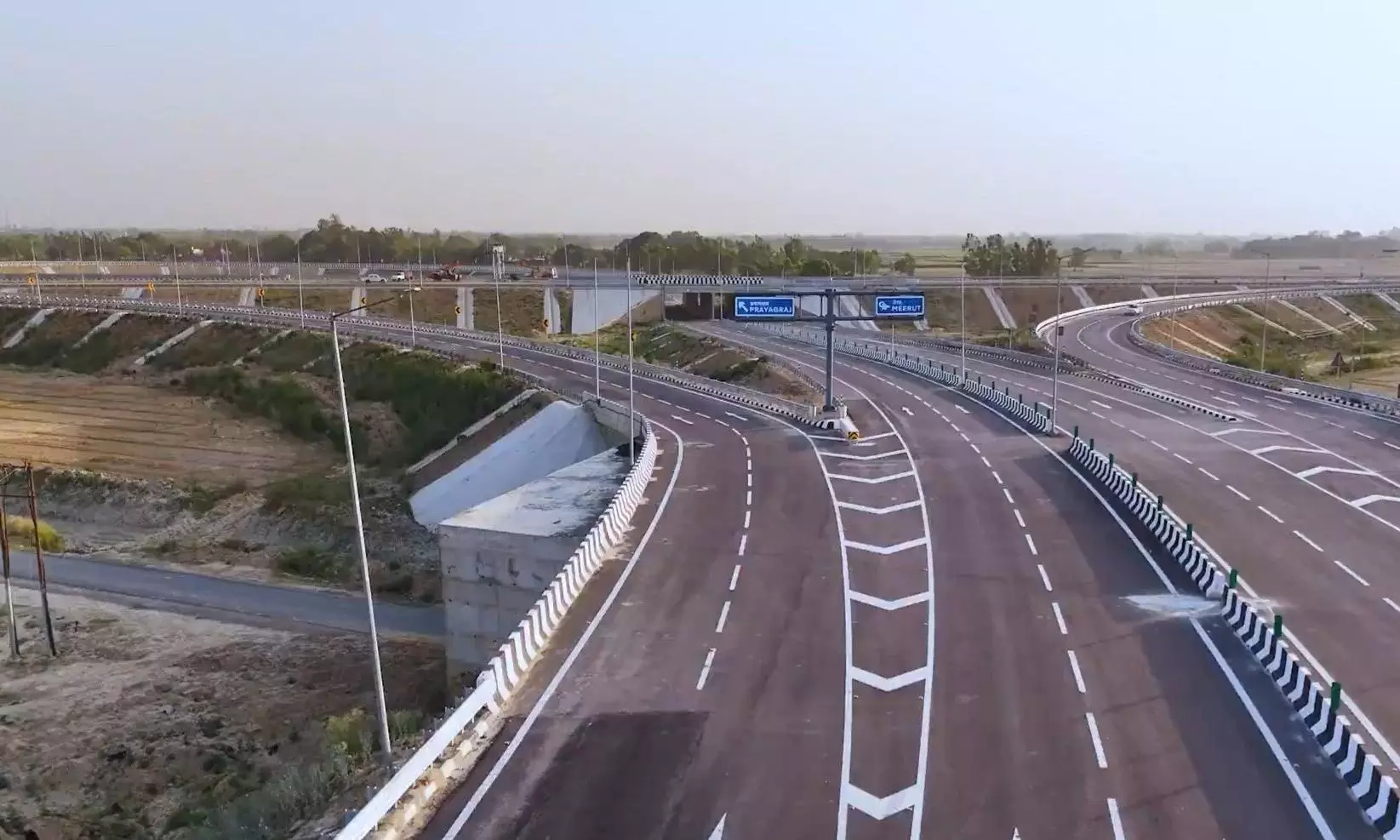
The Expressway connects 12 key districts is expected to significantly reduce travel time from 10–12 hours to 6–8 hours. Photo: Screengrab/@myogiadityanath
PM Modi launches 594-km Ganga Expressway: Here are the key features
The 594-km Ganga Expressway linking Meerut and Prayagraj cuts travel time and aims to boost connectivity, logistics, and industrial growth across Uttar Pradesh

Prime Minister Narendra Modi inaugurated the Ganga Expressway at Hardoi on Wednesday (April 29), connecting Meerut and Prayagraj. The 594-km-long infrastructure project passes through 12 districts.
Uttar Pradesh Chief Minister Yogi Adityanath lauded farmers for their crucial contribution to the construction of the expressway, noting that over one lakh cultivators provided land for the project, enabling its timely completion.
Farmers' contribution
"More than one lakh farmers across 12 districts contributed land for this expressway. I thank all the 'annadata' farmers whose support has made this project a reality," Adityanath said, addressing a gathering ahead of the inauguration ceremony.
Also read: Delhi-Dehradun Expressway opens with 12km wildlife corridor; here are key highlights
The expressway connects 12 key districts - Meerut, Hapur, Bulandshahr, Amroha, Sambhal, Badaun, Shahjahanpur, Hardoi, Unnao, Rae Bareli, Pratapgarh and Prayagraj - and is expected to significantly reduce travel time from 10–12 hours to 6–8 hours.
Adityanath said that around 18,000 acres of land were acquired from farmers for the expressway. Nearly 7,000 acres were separately earmarked for the development of industrial clusters and logistics hubs along the corridor.
The high-speed corridor is expected to significantly boost connectivity across Uttar Pradesh while giving impetus to industrial investment, logistics, agricultural marketing and regional balance.
Here’s all you need to know about the six-lane expressway:
Design and key features
Developed under a public-private partnership model, the expressway is designed for speeds of up to 120 kmph.
A standout feature is a 3.2-km emergency airstrip near Shahjahanpur, enabling fighter aircraft landings during contingencies. The highway is also equipped with modern safety systems, including an Intelligent Traffic Management System (ITMS), CCTV surveillance, emergency call boxes, ambulances and patrolling units.
Also read: Meerut mosque demolished for RRTS corridor in UP
What sets the Ganga Expressway apart is also its positioning as a development corridor rather than just a transport project. The state has planned 12 Integrated Manufacturing and Logistics Clusters (IMLCs) along the route, with over 6,500 acres earmarked for industrial use.
These clusters will house warehouses, cold storage units, agro-processing hubs and manufacturing zones, aimed at boosting investment and employment. Nearly 1,000 investment proposals worth around ₹47,000 crore have already been received.
Connectivity and network impact
The corridor runs through 12 districts, linking relatively developed western Uttar Pradesh with under-invested eastern regions.
Also read: UP sets 3 new construction records on Ganga Expressway, says CM
It will also connect with major expressways such as the Agra-Lucknow, Purvanchal and Bundelkhand corridors, creating a larger integrated road network and improving access to upcoming infrastructure like the Noida International Airport.