







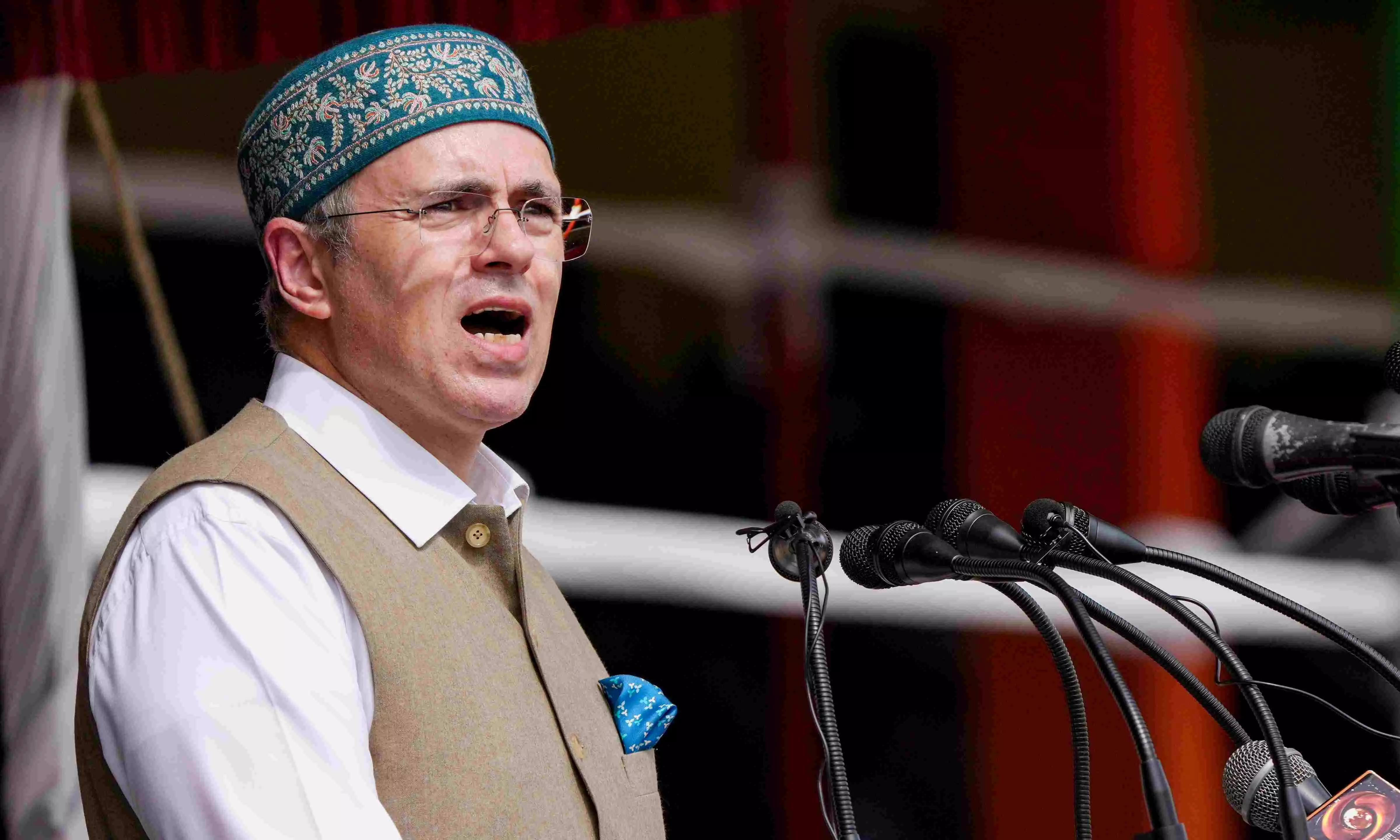
The Chief Minister said that they consider the people of PoJK as their own, adding that seats are still kept vacant in the Assembly for them. Photo: PTI
PoJK may have protested to reconnect with J&K without Article 370 abrogation: Omar Abdullah
Omar Abdullah said PoJK protests vindicated his party’s historical stand and renewed calls for restoring J&K’s special status, constitutional guarantees and statehood

Chief Minister Omar Abdullah in his Independence Day speech on Saturday (August 15), in an apparent reference to the abrogation of Article 370 by the Centre, said that had it not been for the change in Jammu and Kashmir’s status in 2019, the people of Pakistan-occupied Jammu and Kashmir (PoJK) would have been protesting to reconnect with Jammu and Kashmir.
Omar invokes PoJK protests
"Today, when we look at that part of Jammu and Kashmir across the LoC, there is pain, sorrow, and worry. In my place, I have the realisation that perhaps if our conditions had not been changed in 2019, the people of that part of Jammu and Kashmir would today be protesting to reconnect with us,” said Omar.
Also Read: 'Honoured to get love letter,' says Omar after BJP threatens Rs 100-cr defamation suit
Elaborating further, the Chief Minister said that they consider the people of PoJK as their own, adding that seats are still kept vacant in the Assembly for them.
"That part of Jammu and Kashmir is ours. We consider those people as our own. Seats are still kept for them in the Jammu and Kashmir Assembly with the hope that one day those people will be able to use those empty seats," he added.
On statehood demands
Expressing concern over the frequent crackdown on protesters in PoJK, Omar said that it vindicates the stand of the forebears of the National Conference in fighting off the tribal invasion after Independence.
Also Read: Omar Abdullah escalates statehood fight with 'Delhi Chalo' call
"I want to assure the people that we are for you, we will continue to represent you and work to bring Jammu and Kashmir to the level envisioned by the people who fought for freedom and were martyred," Abdullah said in his Independence speech at Bakshi Stadium here.
"To honour that martyrdom, we will realise the dreams they left us as their legacy -– whether it is getting back the special status, restoring constitutional guarantees for Jammu and Kashmir, regaining statehood, or leading a new era of progress," he added.
1947 invasion recalled
Referring to the protests in PoJK, the Chief Minister said the situation vindicated the National Conference founder Sheikh Muhammad Abdullah and his colleagues' decision to fight the Pakistan-backed tribal invaders in 1947.
Also Read: Omar Abdullah under fire from NC MP for not condemning Khamenei assassination
"When I see the situation across the border, I realise that our ancestors who said 'hamlavar khabardar, hum Kashmiri hain tayyar' (Attackers beware, Kashmiris are prepared) were right," he said, adding that Master Abdul Aziz, the NC leader, was killed in Muzaffarabad for trying to stop the attack.
Democracy and federalism stressed
Abdullah termed democracy and federalism as the two biggest strengths of India.
"Protecting democracy at all costs, strengthening democracy at all costs, keeping democracy alive at all costs – this is our huge responsibility," he said.
The Chief Minister said India is a union of states not just on paper but also in spirit.
Centre-state tensions flagged
"When we talk about federalism, strengthening that federalism starts from Jammu and Kashmir. Whatever was snatched from us should be returned so that this federalism and identity are not just in words, but put into practice," he said.
Also Read: BJP targets Omar Abdullah with ‘missing’ posters, sparks political row in J&K
Abdullah said, however, strengthening federalism does not mean just turning a union territory into a state, but rather strengthening the states.
"When central agencies start interfering in the affairs of states, federalism suffers. When the powers of a state are eroded, hollowed out, and used by central agencies, federalism suffers, and the result is often seen on the streets," he said.
NEET, JEE protests cited
Abdullah said the recent student protests on the streets of Delhi were the result of this very issue.
"Under our federal structure, education and health were both responsibilities of the state... But the exam pattern was changed. Exams like NEET, NTA, and JEE were created, and the right of states to give admissions to medical and engineering colleges was taken away. The result was protests and movements in Delhi against this very sequence," he said.
(With agency inputs)