







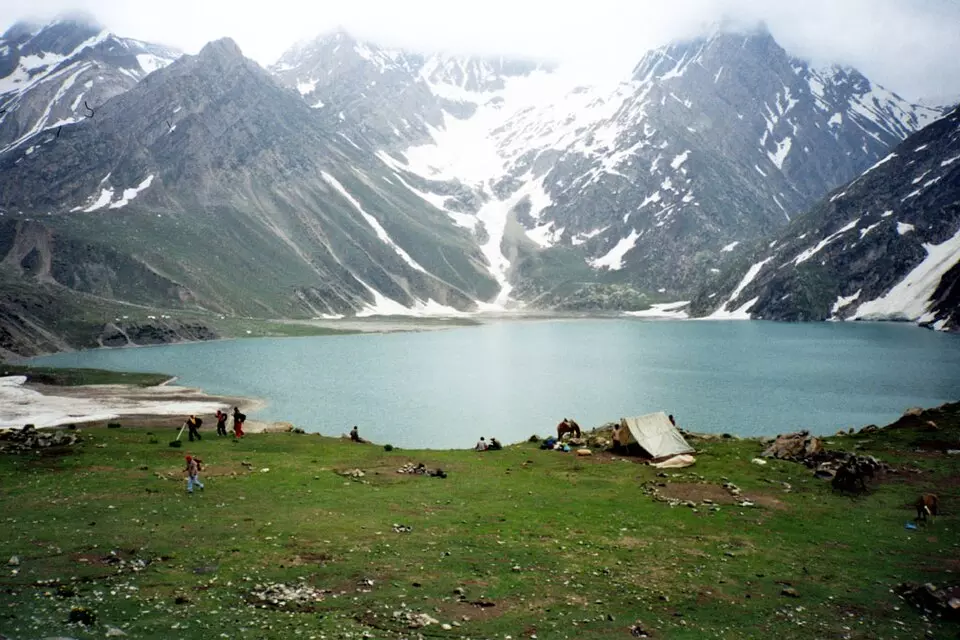
Why are excavators on Sheshnag Lake? Protests erupt across J&K
Heavy machinery digging beside the high-risk glacial lake on the Amarnath Yatra route sparks ecological warnings across the Valley

A viral video showing heavy earth-moving machinery operating beside Kashmir’s high-altitude Sheshnag Lake has triggered sharp political and environmental outrage across the Valley.
According to The Indian Express, the footage — originally uploaded by an Instagram account named ‘Neeraj_excavator-lover’ before being deleted — captures an excavator cutting a track and dumping soil directly onto the shores of the glacial lake, which sits at an altitude of 3,590 metres along the traditional Pahalgam-Amarnath pilgrimage route. Other clips on the same account reportedly showed excavators working across snow-covered Himalayan slopes.
Sheshnag, an oligotrophic lake measuring one kilometre in length and 0.7 kilometres in width, lies 23 kilometres from Chandanwari. Crucially, it is among the 14 high-risk glacial lakes in Jammu and Kashmir closely monitored for environmental vulnerabilities and glacial lake outburst risks.
Also read: COP31 fails to reach consensus on fossil fuel transition, climate finance
Official sources told The Indian Express that the excavation is part of efforts to widen and stabilise the existing track connecting Chandanwari to the Amarnath cave shrine, though the administration has yet to issue an official statement.
Faith and ecology collide
The visuals drew swift condemnation from political leaders, religious figures, and environmentalists, who warned against sacrificing fragile alpine ecosystems in the name of pilgrimage infrastructure.
Peoples Democratic Party (PDP) spokesperson Mohit Bhan described the excavation as a “crime against Hindu faith”, noting that in Hindu tradition, Lord Shiva is believed to have left behind his serpents at Sheshnag before proceeding to the Amarnath Cave to narrate the Amar Katha to Goddess Parvati.
“There is a profound contradiction in invoking Hindu faith while allowing the very landscape associated with that faith to be disturbed through unnecessary construction, road cutting and surface levelling,” Bhan said, adding that faith and ecology are not competing interests and both demand protection.
Also read: Sonam Wangchuk calls Ladakh a ‘colony’, warns of national security risks
Kashmir’s chief cleric, Mirwaiz Umar Farooq, called the footage “very disturbing”. Pointing to retreating glaciers and recent devastating glacier-related floods in neighbouring Nepal, he stressed that while Kashmir has always welcomed Amarnath Yatra pilgrims, improving facilities must not come at the cost of a fragile ecosystem. “Our precious mountains, glaciers and water bodies need protection not plunder, for now and for the future generations. So, this must be immediately stopped,” he said.
Warnings of Himalayan disaster
Former chief minister and PDP president Mehbooba Mufti accused the government of acting as mere spectators while Kashmir’s environment is degraded, citing the felling of Chinar and old walnut trees. She warned that unchecked infrastructure projects risk turning Kashmir into “another Uttarakhand”, referencing the calamities following highway expansion for the Char Dham Yatra, while noting that raising concerns often invites accusations of opposing the pilgrimage.
Former Srinagar Lok Sabha MP Ruhullah Mehdi echoed the comparison to Nepal’s glacial disasters, posting on X: “Kashmir's mountains are not BJP's real estate.” Meanwhile, National Conference MP Mian Altaf urged that Kashmir’s lakes, rivers, and forests be saved at any cost for the sake of the region’s environment, tourism, and public health.
CPI(M) leader and Kulgam MLA M.Y. Tarigami warned that disturbing loose moraine and steep slopes around a high-risk glacial lake is “an invitation to disaster”, cautioning that communities downstream in Pahalgam and along the Lidder river would pay the price. He demanded a halt to the work until a scientific study, environmental impact assessment, and local consultations are conducted.
Apni Party chief Altaf Bukhari similarly called on authorities to verify the video’s authenticity and explain the presence of heavy machinery in an ecologically sensitive zone, while climate activist Raja Muzaffar Bhat termed the episode “a disaster” and questioned how such equipment reached Kashmir’s glaciers.
(with agency inputs)