







Sonam Wangchuk calls Ladakh a ‘colony’, warns of national security risks
The climate activist accuses the administration of imposing decisions without public consent and questions the Hill Council election process

Climate activist Sonam Wangchuk on Saturday (November 21) accused the Ladakh administration of imposing decisions on people without their consent, saying the Union Territory was being treated like a colony. He warned that alienating the strategically important border region could have serious consequences for national security.
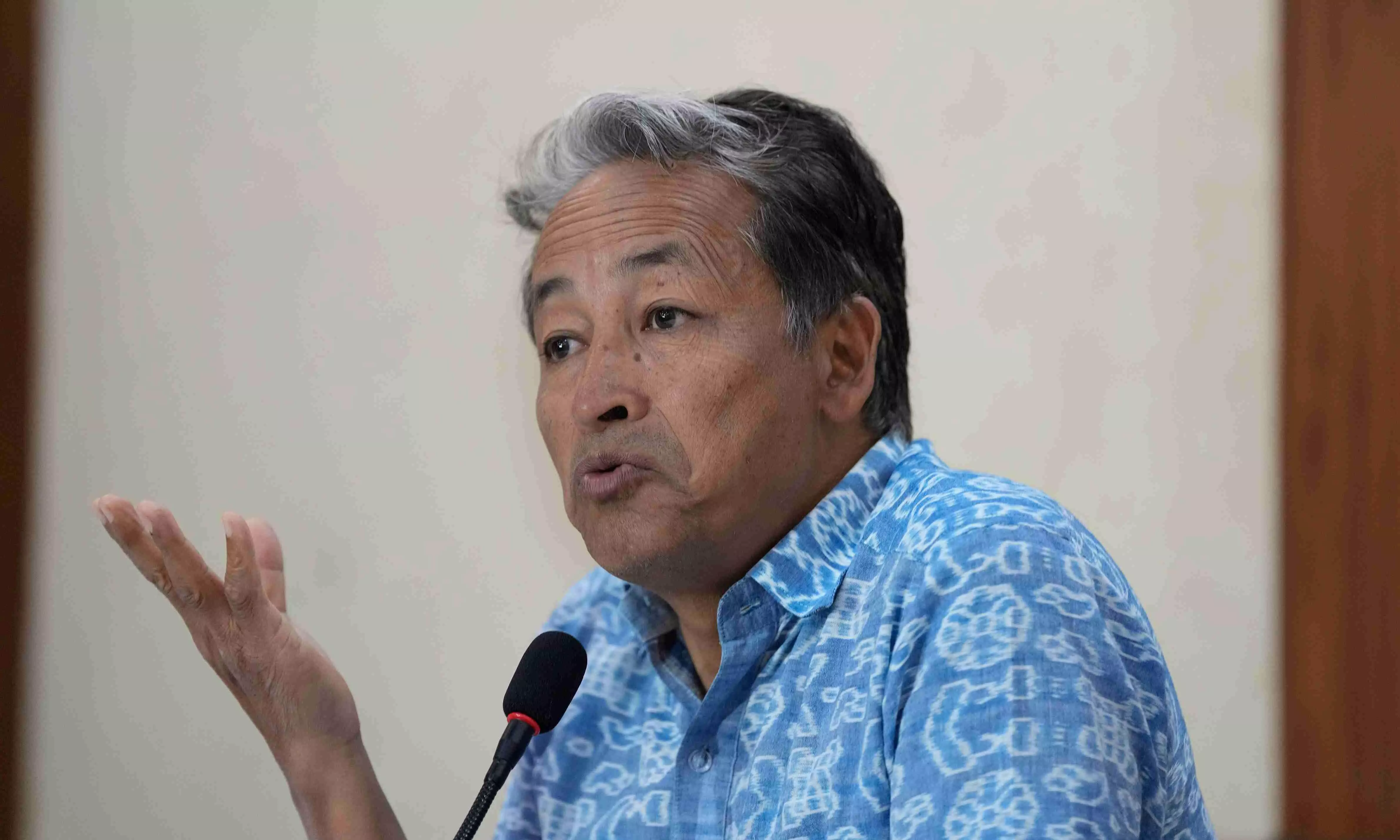
Wangchuk made the remarks at a press conference in Leh alongside Leh Apex Body (LAB) chairman Chering Dorje Lakruk, after joining the ongoing protest in the town.
'Being treated like a colony'
Wangchuk, who is also a member of the LAB, said people in Ladakh were being denied their democratic rights, with the administration going ahead with elections despite widespread opposition to their timing and conduct. "Ladakh has effectively become a colony where the voices of local people carry no weight and decisions are simply imposed on them. How can such a system continue?" he asked.
Also read: Ladakh police withdraw curbs on Sonam Wangchuk, deny house arrest claim
Wangchuk urged Prime Minister Narendra Modi and Defence Minister Rajnath Singh to intervene, arguing that the treatment of people in Ladakh should be examined from the perspective of national security rather than being left solely to the lieutenant governor's administration or the Ministry of Home Affairs. "Ladakh has stood with the country during previous wars, and it should continue to do so. Why are such loyal and patriotic people being repeatedly subjected to this treatment?" he said.
National security concerns
Warning against alienating people in a strategically sensitive border region, he said the consequences of imposing decisions on them might not be immediately visible during peacetime but could become significant during a conflict.
"They may not be able to do much in peacetime, but there could be differences in times of war," he said, urging the Centre to ensure that people in Ladakh received the same democratic rights as citizens elsewhere in the country.
The activist called for an inquiry commission under the Union Home Ministry to examine the grievances of local government employees and officers and assess their views on the administration's functioning.
He claimed that even employees belonging to Ladakh were deeply unhappy with the manner in which decisions were being taken.
Dispute over election process
Wangchuk's remarks came amid continuing protests over Ladakh's political and constitutional demands and the ongoing electoral process.
The activist questioned the decision to hold the Hill Council elections during winter, saying people were not opposed to elections but wanted them conducted in a season that allowed maximum participation.
Also read: Ladakh administration orders Sonam Wangchuk's HIAL to halt school activities
He alleged that several residents, including students pursuing higher education outside Ladakh, would be unable to participate.
He also raised concerns over the use of the 2018 electoral rolls, claiming that several young voters who had become eligible over the past eight years were missing from the lists.
Citing reports from different villages, Wangchuk alleged large-scale deletions from electoral rolls and said some villages had witnessed a complete boycott. He referred to Stok and Stakpu, where he claimed not a single vote was cast, and Uley Tokpo, where he alleged the polling station had been removed.
Demands for greater autonomy
He further alleged that the elections were part of an attempt to sideline the Leh Apex Body and the Kargil Democratic Alliance (KDA), which have been negotiating with the Centre over Ladakh's demands.
He also accused the government of retreating from the democratic framework discussed in May, which envisaged an Assembly for Ladakh with a structure similar to that of a state. He questioned the failure to hold the subsequent round of talks scheduled for October 22.
Also read: Ladakh administration rejects Sonam Wangchuk’s claims on liquor shops
Criticising the proposed Hill Council structure, Wangchuk said Ladakh had been demanding safeguards under the Sixth Schedule but was now being offered a council with even fewer powers than the existing LAHDC.
He also expressed concern over the provision for nominated councillors, arguing that the broad definition of “underrepresented sections of society” could be misused to manipulate council majorities.
He maintained that nominated members should not have voting rights in the election of council leadership.
(With agency inputs)