



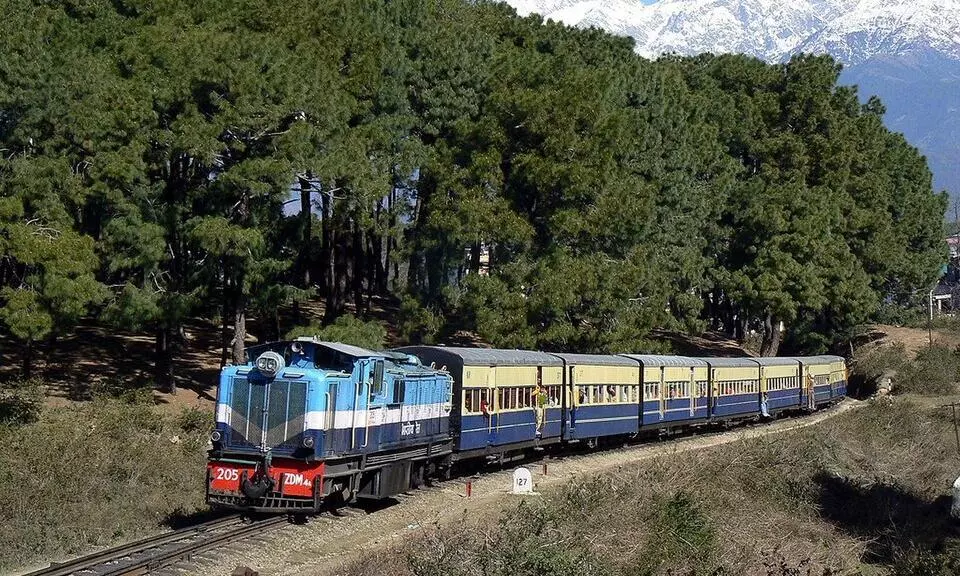
Commissioned in April 1929 during British rule, the Kangra Valley Railway remains one of India's most remarkable engineering and heritage achievements. File photo: Wikipedia
Scenic Kangra Valley toy train back on track after four-year hiatus
Often described as the quieter sibling of the touristy Kalka-Shimla toy train, it offers travellers an affordable and leisurely journey through Himalayan belt

After a gap of nearly four years, the historic Kangra Valley Railway (KVR) has resumed operations, restoring one of India’s most scenic mountain rail journeys and reconnecting communities across the lower Himalayas. The revival comes after the reconstruction of the Chakki Railway Bridge, which was severely damaged in the 2022 flash floods, forcing the suspension of services on the route.
Also read: As climate disasters increase in Himalayas, Himachal proposes scientific study
The 164-km British-era narrow-gauge railway runs from Pathankot in Punjab to Joginder Nagar in Himachal Pradesh and holds the distinction of being the longest narrow-gauge rail line in India.
Served as lifeline
Rail services were suspended after flash floods in August 2022 washed away five piers of the nearly 90-year-old Chakki Railway Bridge located on the Punjab-Himachal Pradesh border. The bridge has now been rebuilt at a cost of around Rs 70 crore with technical support from engineers of IIT Roorkee, paving the way for the restoration of the route.
The reopening has generated excitement among railway enthusiasts, tourists and residents who rely on the service as an affordable means of transport.
Beyond tourism, the KVR remains a lifeline for local communities, with heavily subsidised fares ranging from just Rs 10 to Rs 30 on some stretches. Unlike premium heritage train services, it continues to operate primarily as a commuter railway connecting villages and small towns across the region.
Hence, regular services do not offer online booking, and passengers travelling between Pathankot and Joginder Nagar must purchase unreserved second-class tickets at station counters on the day of travel.
Distinct travel experience
Known for its breathtaking views of the Kangra Valley and the snow-capped Dhauladhar mountain range, the toy train offers travellers an affordable and leisurely journey through some of North India’s most picturesque landscapes.
Also read: Matheran's beloved toy train to sport heritage steam engine makeover
Often described as the quieter sibling of the famous Kalka-Shimla toy train, the Kangra Valley Railway offers a distinctly different travel experience. Unlike many mountain railways that rely heavily on tunnels, the KVR passes through only two tunnels across its entire length. Instead, the route is characterised by sweeping curves, open valleys, river crossings and uninterrupted mountain vistas.
The railway traverses more than 900 bridges and nearly 500 curves, allowing passengers panoramic views throughout much of the journey. The train passes through several important towns and destinations including Kangra, Nurpur, Jawalamukhi, Palampur and Baijnath, linking cultural, religious and tourist centres across the region.
The journey
The journey begins at Pathankot Junction, situated at an altitude of about 383 metres, before gradually climbing through the foothills to reach its highest point at Ahju station, located at an elevation of around 1,290 metres. From there, the route gently descends towards Joginder Nagar. Travelling at a relaxed pace designed for mountain terrain, the end-to-end journey typically takes between eight and nine hours.
Also read: World Heritage Day: How restricted focus on 'sites of national importance’ is impacting our legacy
Along the way, passengers are treated to constantly changing scenery. The train skirts the Pong Dam reservoir on the Beas River, winds past sprawling tea estates near Palampur, crosses small villages and agricultural settlements, and gradually moves closer to the dramatic backdrop of the Dhauladhar range. The slow speed of the train allows travellers to fully absorb the landscape, earning it a reputation as a "moving postcard" of Himachal Pradesh.
The restored line was formally reopened by Hamirpur MP and former Union minister Anurag Thakur along with Rajya Sabha MP Rajiv Bhardwaj, who flagged off the service from Kangra railway station.
On the first day of resumed operations, two seven-coach trains departed from Pathankot City Narrow Gauge station. Train No. 62465 left at 5 am, followed by Train No. 52467 at 7 am. Services from the Himachal Pradesh side began at 8:30 am from Kangra railway station, restoring connectivity across key sections of the route.
Awaits Heritage tag
Commissioned in April 1929 during British rule, the Kangra Valley Railway remains one of India's most remarkable engineering and heritage achievements. The line connects several culturally significant destinations, including temple towns such as Jawalamukhi and Baijnath, while also serving popular tourist destinations like Palampur.
The railway is currently on UNESCO's tentative World Heritage list. While its more famous counterpart, the Kalka-Shimla Railway, secured UNESCO World Heritage status in 2008, authorities and heritage conservation groups continue to push for similar recognition for the Kangra Valley Railway. Supporters believe that a World Heritage tag would help preserve the line's legacy while promoting sustainable tourism and economic development across the Kangra Valley.