One year of Rekha Gupta: PR push, policy slips and delayed promises in Delhi
From image-building and gaffes to slow welfare rollout and Yamuna cleanup, the BJP counts on a weak opposition while projecting “unprecedented progress”

On February 20, 2025, when Rekha Gupta, the newly elected first-term MLA from Shalimar Bagh, took oath as chief minister of Delhi, scepticism over the BJP choosing her for the job was all too palpable.
Not entirely a political greenhorn, Gupta had served three terms as a councillor, but her modest credentials were immediately contrasted with those of Sheila Dikshit, Sushma Swaraj and even Atishi – women who had served as Delhi chief ministers before her. Then there was the burden of expectations. The BJP had returned to power in Delhi after 27 years on the back of a thunderous campaign heavy on promises that included a long-overdue civic infrastructure overhaul, Rs 2,500 monthly cash assistance for women, and clean air and Yamuna water for all.
Also read | One year of Rekha Gupta: No respite for Delhi despite triple-engine sarkar
Gupta was tasked with delivering on each of these at what the BJP had projected as the “best opportunity”: a “double-engine” government with Narendra Modi leading the Centre and Gupta steering the Delhi Secretariat.
Image-building takes centre stage
A year on, the early scepticism seems neither unfounded nor unjust. As Gupta completes one year in office, her party plans to showcase the period as one of “unprecedented progress” during which “strong foundations for the future” were laid and the “government’s vision aligned with the Prime Minister’s mission of building a Viksit Bharat by 2047”. Such messaging is par for the course in an era where marketing often trumps measurable governance.
Viewed dispassionately, however, it is difficult to ignore the frequent gaffes, administrative manoeuvring, unfulfilled promises and relentless PR overdrive that have marked Gupta’s first year.
Perhaps conscious of the comparisons being drawn with her predecessors, Gupta began her tenure with an aggressive publicity blitz. In her initial months, she was seen less in the Secretariat or Assembly and more on Delhi’s streets.
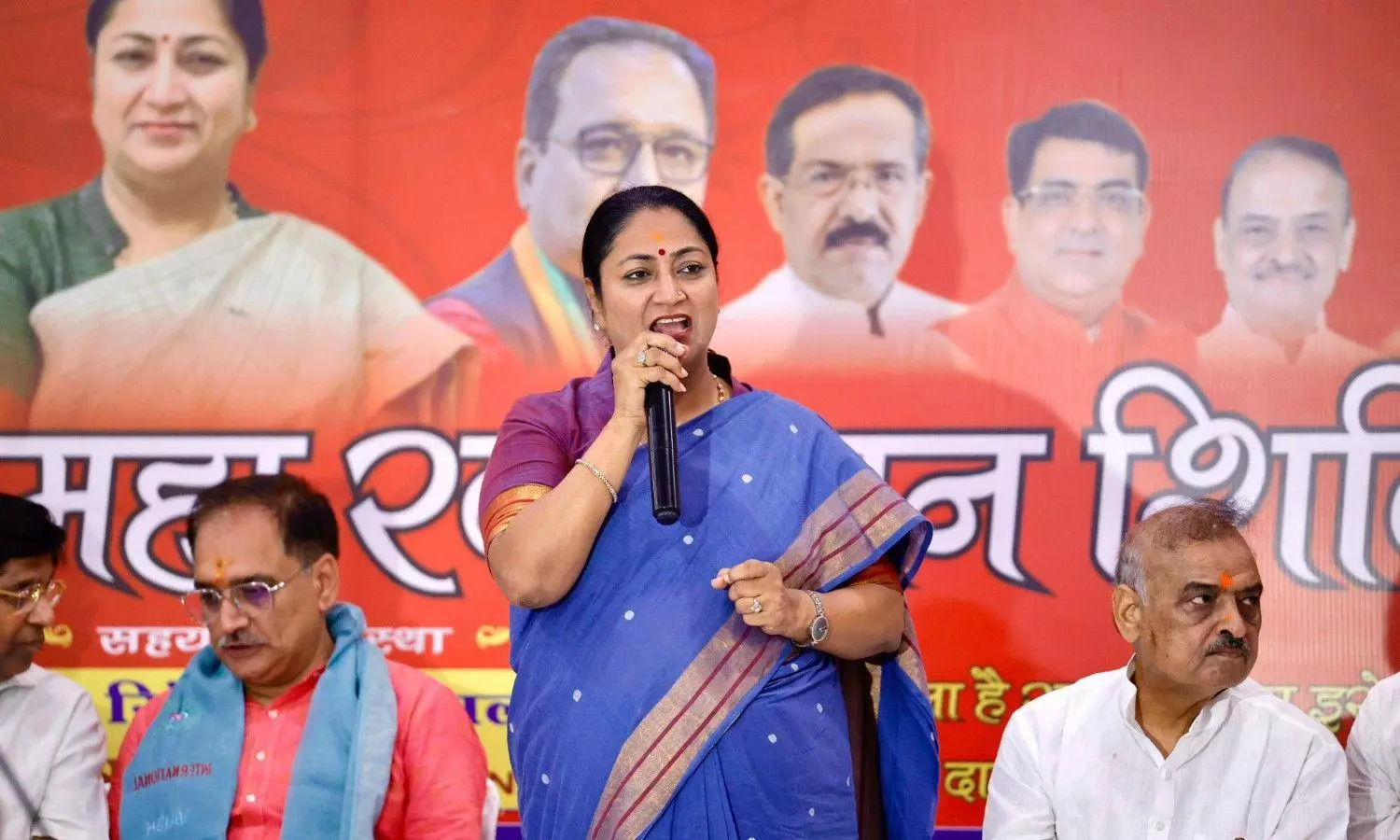
With camera crews in tow, she appeared everywhere. One day she was pulling up a private school over arbitrary fee hikes; the next, scolding civic officials on a busy road about stray cattle causing traffic snarls; soon after, attending a kirtan or gracing a felicitation in a residential colony. Sources within the Delhi BJP told The Federal that the strategy was to build her image as a “hands-on and easily accessible chief minister”; a stark contrast to former CM Arvind Kejriwal, who often accused the Centre of obstructing governance. In keeping with this approach, Gupta launched weekly jan sunwai sessions at her Civil Lines residence, inviting citizens to air grievances directly.
Overexposure brings costly gaffes
It was at one such session last August that she was heckled by a man from Gujarat upset over a Supreme Court-ordered stray dog roundup. Gupta seized the moment, declaring the “assault” an attempt to deter her from public service, one that had “only strengthened” her resolve. After briefly suspending the meetings, she resumed them under tighter security.
Yet the compulsion to remain constantly visible had its downside. Overexposure often revealed gaps, both in policy depth and rhetorical precision. Gupta’s frequent media interactions also meant she had to parry questions. It was here that the ride grew bumpy.
Veteran journalist Sushil Kumar Singh notes that since 1993, with the exception of Atishi, he has interacted with every Delhi CM, from Madan Lal Khurana and Saheb Singh Verma to Sushma Swaraj, Sheila Dikshit and Arvind Kejriwal, but none cut such a sorry figure while speaking to the press or appearing in public as Rekha Gupta has.”
Also read | Arvind Kejriwal mocks Delhi CM Gupta's 'AQI is like temperature' remark
Singh cites several televised interviews and appearances in which Gupta made baffling errors. At a convocation, she referred to freedom fighter Subhas Chandra Bose as “Netaji Subhas Palace,” a commercial complex in north Delhi. In one interview, she stumbled while explaining the Air Quality Index (AQI), calling it IQ and AIQ before the anchor corrected her. In another, she described AQI as a kind of “temperature” measurable by “any device” and suggested pollution levels could be reduced by sprinkling water. In yet another exchange, when asked about the pollution in the Yamuna, derisively dubbed a nullah, Gupta responded by saying Venice’s scenic Canal Grande was “also a nullah”.
Delivery falls behind rhetoric
Rhetorical fumbles are one thing and can be brushed off as a slip of tongue or misquote but Gupta’s track record in administration and delivery on poll promises has been no better.
Two promises had arguably propelled the BJP to its 48-seat victory in the 70-member Assembly: the Rs 2,500 monthly transfer to “every woman” in Delhi under the Mahila Samman Yojana and a vow to clean the Yamuna within a year so thoroughly that cruise tourism would become viable.
When Gupta presented her first budget, it became clear that neither of these promises were going to be fulfilled with any urgency. With an outlay of Rs 1 lakh crore, though Gupta presented the biggest Delhi budget yet, a princely sum of Rs 500 crore was set aside for cleaning of the Yamuna; a figure opposition leaders, activists and river conservation experts deemed grossly inadequate.
A larger Rs 5,100 crore was earmarked for the Mahila Samman Yojana, but Gupta clarified that eligibility criteria would first be defined by a committee. The benefit, she said, would not be universal; only “genuine Delhi citizens” would qualify.
A year later, there is little clarity on how many women have been enrolled for the scheme so far and on what criteria. The BJP maintains it is avoiding a rushed rollout. Social Welfare Minister Ravinder Singh has defended the delay, arguing that transparency and proper targeting require due diligence.
Excuses mount, progress lags
“We are not like the Congress or the AAP which used the Delhi treasury for appeasing their vote banks and to get illegal migrants, Rohingyas and Bangladeshis enrolled for government schemes so that these people could register as voters and help them win elections…I agree that there has been a delay in implementing the Mahila Samman Yojana but that is only because we want to ensure its proper rollout,” the minister told The Federal.
Asked whether the government can give any timeline for the scheme’s implementation, Singh added, “Delhi budget is going to be presented soon and the CM will give details of all our schemes… we are laying a strong foundation for Delhi’s future and to align our government’s vision and mission with the Prime Minister’s mission for building a Viksit Bharat by 2047.”
Also read | ‘Band-aid fixes won’t save Delhi’s air or the Yamuna’: Environmentalist Vimlendu Jha
On cleaning of the Yamuna, the biggest endorsement of the spectacular failure in fulfilling the promise came from the Delhi government itself, albeit unwittingly, during Chhath festivities last October. Along the banks of the Yamuna, an artificial pond, filled with piped Ganga water, was created for VVIPs to perform rituals; a move widely interpreted as an admission that the river itself remained unfit for immersion. The negative optics ostensibly led Prime Minister Modi to cancel a planned ceremonial dip; a rare forsaking of opportunity to score political points at a time when the Bihar election was days away.
Not much has changed in the Yamuna in the months since. Toxic foam continues to blanket stretches of the river; broken in parts only to reveal blackened waters laden with sewage and industrial waste. Periodic reports by regulatory bodies and NGOs warn of high ammonia levels and depleted dissolved oxygen. As recently as last month, ammonia spikes forced the temporary shutdown of nine water treatment plants across Delhi, triggering shortages across multiple localities.
Gupta routinely describes the Yamuna crisis as a “legacy issue” while her Urban Development Minister Ashish Sood insists the government “never promised an overnight solution”. Sood points to the purchase of advanced cleaning machines, installation of mist sprinklers during peak pollution months, and even cloud-seeding experiments as evidence of proactive governance. These measures, he argues, “require time to yield visible results”.
Weak opposition, limited scrutiny
The government, in short, rejects any suggestion of failure. Yet, if Gupta and the BJP continue to face limited political fallout, it is largely because of an enfeebled opposition. Despite its 22 seat tally in the Delhi Assembly, the Aam Aadmi Party has struggled to mount any sustained agitation. The raucous protests that once defined its politics have faded. AAP insiders say a large part of the blame for the party’s inability to hold the BJP to account lies with Kejriwal and his aides like Manish Sisodia, Satyendra Jain, Gopal Rai and Atishi, who are now rarely seen in Delhi.
Also read | Delhi cloud seeding fails to produce rain, but govt claims air quality improved
Arvind Kejriwal and Manish Sisodia, who had both lost their seats in the Delhi elections, are now focused on AAP-ruled Punjab, where elections are due next year. In their absence, the responsibility for countering the BJP in Delhi has fallen to Atishi, now Leader of Opposition. “There is hardly any campaign or protest that Atishi has organised against the BJP in the last year. With the exception of (former minister) Saurabh Bhardwaj, who still attacks the BJP regularly, no other senior party leader is raising his voice against the BJP’s failures. The party is totally demoralised,” a former AAP MLA told The Federal.
The Congress, which lost its Delhi stronghold to AAP in 2013 after 15 years in office, remains politically marginalised and organisationally weak.
As such, a government with a decidedly unremarkable first year faces little sustained scrutiny. The BJP continues to project a narrative of “unprecedented progress,” confident that the absence of a combative opposition will blunt accountability.
Meanwhile, Delhi’s civic infrastructure continues to crumble, the Yamuna continues to fester; pollution levels spike seasonally and welfare promises await operational clarity.
If there is one clear success Gupta can take credit for, though, it is in her and her party’s keen understanding of optics: relentless visibility and strategic framing of setbacks as inherited burdens. Whether that will remain enough in the years ahead is, however, the more consequential question.