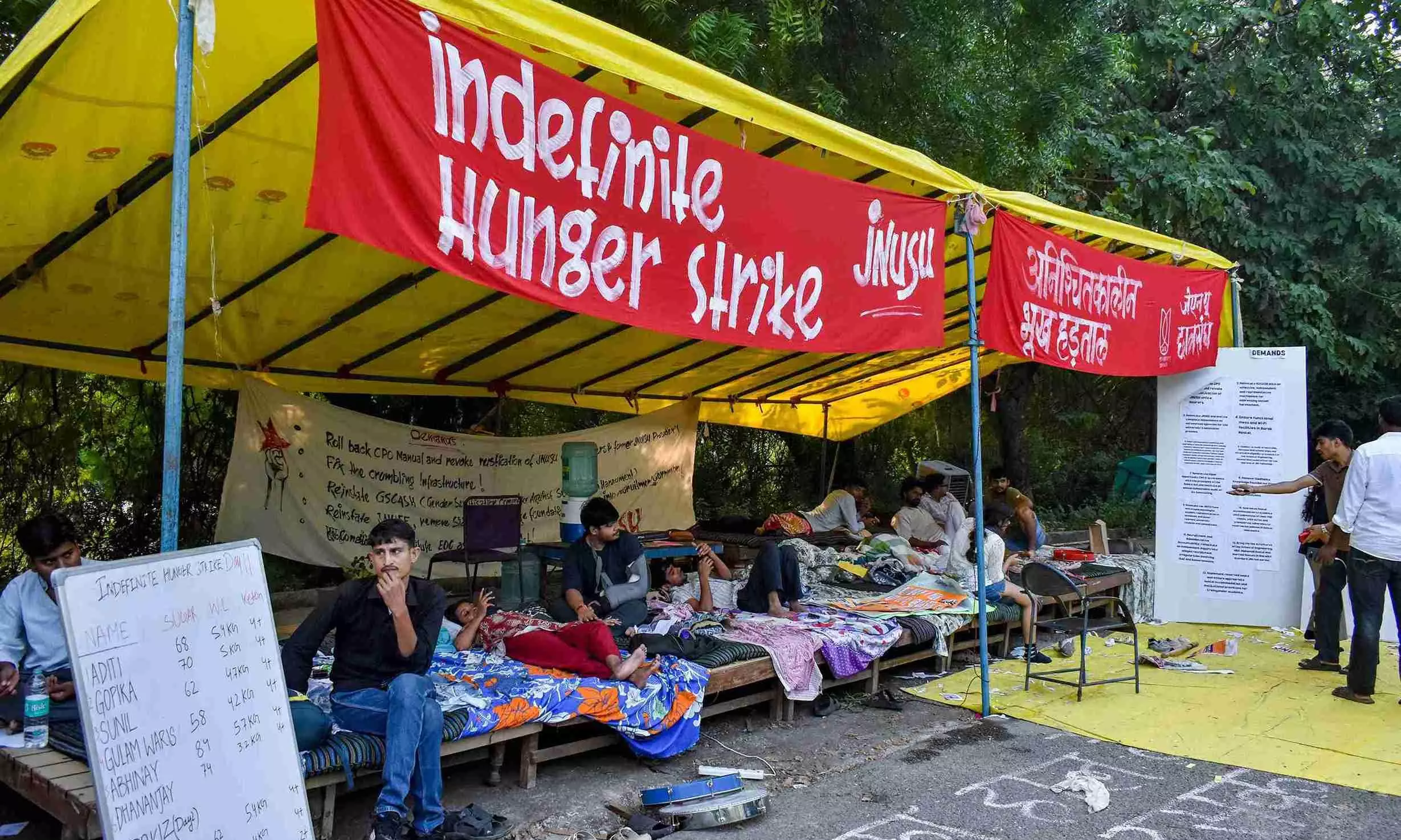
Jawaharlal Nehru University Students Union (JNUSU) Vice President K Gopika Babu along with office-bearers and students during an indefinite hunger strike over a range of demands concerning student rights, social justice, hostel facilities and the university's crumbling infrastructure in New Delhi. Photo: PTI
Why are JNU student leaders missing from Delhi’s anti-SIR protests?
JNUSU office-bearers, rusticated and declared “no longer students” by the administration, have been on an indefinite hunger strike since October 3, pressing 13 demands

As Neha Bora and Aishe Ghosh lead the charge in Delhi’s anti-SIR protests, other fierce, articulate faces of the student movement, familiar to the capital’s university circles, are conspicuously absent from the streets. Jawaharlal Nehru University (JNU) Students’ Union vice-president Gopika Babu and joint secretary Danish Ali are among them. But their absence is no mystery.
They are fighting another battle inside JNU, where an indefinite hunger strike has entered its 17th day (on October 19), with the health of the protesting students deteriorating.
Hunger strike
Gopika, who has been at the forefront of the students’ fight against the University administration, is among those on an indefinite hunger strike that entered its 16th day on Sunday (October 18). The protest, launched on October 3, involves JNUSU office-bearers and other students pressing for action on 13 demands covering democratic rights, academic policy, social justice and campus infrastructure.
Also read: Student leader Aishe Ghosh on protest politics, Left unity and Umar Khalid
The hunger strike has continued despite concerns over the health of the protesters, some of whom have reportedly required hospitalisation. Gopika, according to fellow students, has been struggling even to walk.
A wider struggle
“Student leaders like Gopika and Danish are absent from the anti-SIR protests because they are actively involved in the JNUSU struggle on campus. They are trying to force their own university administration to respond to longstanding grievances. That also is unfolding simultaneously and contributes to the larger picture of anti-establishment struggles,” says Aishe Ghosh.
The contrast is striking. The university, which has produced generations of student activists who have shaped national political debates, is witnessing a struggle in which its own elected representatives are putting their health at risk to secure a hearing from the administration.
Students’ demand
The immediate trigger for the hunger strike is the continuing disciplinary action against elected student representatives. The union is demanding the revocation of rustication orders, the withdrawal of objectionable provisions in the Chief Proctor’s Office (CPO) Manual and the restoration of the students’ ability to participate in campus affairs without what they consider punitive restrictions.
The union has also demanded the restoration of the JNU Entrance Examination (JNUEE), improvements to hostel facilities and campus infrastructure, and the restoration of the Gender Sensitisation Committee Against Sexual Harassment (GSCASH). The continuing rustication of elected representatives has emerged as a particularly contentious issue. The students argue that disciplinary action against office-bearers undermines the functioning of the union and weakens the collective voice of the student community.
Rustication row
“All the JNUSU office-bearers have been rusticated, and the university administration maintains that they are no longer students. It is refusing to initiate any talks with them. The administration is acting in line with the BJP-RSS agenda and turning a blind eye to the protests. Any struggle against these forces is part of the larger battle unfolding across the country,” said SFI president Adarsh M Saji.
Also read: TVK’s SIR contradiction: Ally CPI’s youth, student wing cadres held in anti-CEC stir
Meanwhile, the administration has not offered the comprehensive commitments the union is seeking. Following a second round of talks, the students said the assurances they received did not amount to a concrete resolution of their demands. The university has said some issues, including restoring the entrance examination, raise questions about feasibility and funding.
For Gopika, Danish Ali, JNUSU president Aditi Mishra, general secretary Sunil Yadav and the other students on strike, the question is also about whether an elected student union can effectively represent students when its office-bearers face prolonged disciplinary action.
Political solidarity
The JNU hunger strike has drawn solidarity from political leaders and student activists beyond the campus. CPI(M) general secretary M.A. Baby and Rajya Sabha MP John Brittas have extended their support, while AISA president Neha Bora and other Left student activists have visited the protesting students. Gulmohar Kaur, formerly associated with student activism and now with the Congress, has also expressed solidarity.
“As JNU students, engaging in politics does not put us in a dilemma. What puts us in a dilemma is allowing politics to be played out against us. If we have any mechanism to defend ourselves against such political manoeuvring, it must be truly and deeply political. Throughout this process, JNU will continue to show us the way, teach us and help us understand how politics is practised, why it is practised and what kind of politics we should engage in. That is my hope,'' Neha said in the solidarity meeting at JNU the day before.
The support matters because the JNU struggle is unfolding alongside a wider mobilisation in Delhi, with Left student leaders, including Neha and former JNU Students’ Union president Aishe Ghosh, at the forefront of the protests.
Also read: JNU students allege professor offered marks for sexual favours; ICC launches probe
The two struggles are happening in the same city, but their immediate demands differ. While one involves a wider political mobilisation against the government, the other concerns student representation, disciplinary action, academic policy and the administration of a central university.
John Brittas writes to President
On October 18, John Brittas wrote to President Droupadi Murmu, who is the Visitor of Jawaharlal Nehru University, urging her to intervene urgently in the continuing crisis.
Brittas expressed concern over the university administration’s failure to address the students’ longstanding grievances and warned of the consequences of the prolonged hunger strike.
In his letter, he described the protest as an “extreme form of peaceful protest” and said the administration’s failure to respond to genuine concerns had contributed to the students’ deteriorating health.
He called for the revocation of rustication orders against elected student-union representatives, the withdrawal of objectionable provisions in the CPO Manual and an expedited resolution of the students’ demands.
Campus battle
The situation is ironic. JNU has long been a focal point of student resistance, with its unions and political organisations playing prominent roles in national movements. Its students have often taken campus battles to the streets, linking university issues to questions of democracy, social justice and state power.
Also read: Watch | Neha Bora profile: The JNU scholar who says hope is infectious
The question, then, is not simply why JNU leaders are missing from the anti-SIR protests. It is why a university’s elected representatives have had to remain on hunger strike for more than two weeks to secure attention to their grievances.
As the wider student movement continues its mobilisation in Delhi, the struggle unfolding inside JNU deserves equal attention. The leaders who are absent from the streets are not absent from the fight. They are fighting another battle on their own campus, over students' right to be heard.