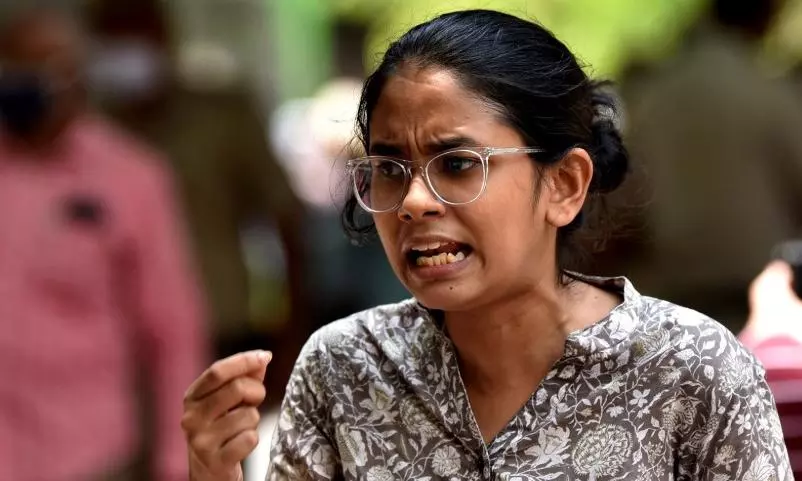
The difference between Jantar Mantar 1.0 and 2.0, she argues, goes beyond the size of the crowds. Screengrab: ANI
Student leader Aishe Ghosh on protest politics, Left unity and Umar Khalid
The SFI joint secretary discusses anti-SIR protests, alleged voter deletions, Left unity, Umar Khalid’s incarceration and the challenge of turning Jantar Mantar 2.0 into a people’s movement

Can the faces emerging from student protests help turn them into a wider people's movement? Or does the media spotlight risk reducing a collective struggle to a handful of individuals? For Aishe Ghosh, former president of the Jawaharlal Nehru University Students' Union and joint secretary of the Students' Federation of India (SFI), who has emerged as one of the prominent faces of the anti-SIR protests, the focus must remain on the movement's demands, not the individuals who lead it.
Speaking to The Federal in Thrissur, where she had arrived to receive the V Aravindakshan Memorial Award, Ghosh discussed the changing character of the protests at Delhi's Jantar Mantar, the relationship between Left organisations and the Cockroach Janta Party (CJP), and the prolonged incarceration of former JNU student Umar Khalid.
From education and jobs to voting rights
The difference between Jantar Mantar 1.0 and 2.0, she argues, goes beyond the size of the crowds. While the earlier mobilisation focused largely on education and employment, the current protests challenge the government's handling of voting rights and democracy.
“When we were raising issues such as the commercialisation of education, unemployment and communal politics in 2016, 2017 and 2018, many people were not ready to accept what we were saying,” Ghosh says. Students were routinely branded anti-national or accused of belonging to the so-called “tukde-tukde gang”.
By 2026, she believes, public frustration over inflation, unemployment, examination irregularities and the lack of permanent jobs has become more pronounced. The NEET paper leak, she says, was only the tip of the iceberg.
Also Read: Tiranga protests: Tricolours, jostling and chants: Delhi’s night of flash stirs
“Jantar Mantar 1.0 was primarily about education and employment, while Jantar Mantar 2.0 is a direct political challenge over voting rights and the functioning of democracy.”
Yet the second mobilisation has not generated the same visible mass participation of common people. Ghosh attributes this partly to the nature of the issue. Alleged electoral roll manipulation is less immediately visible than a paper leak or a fee hike. Voters who can still cast their ballots may not realise the scale of the problem.
The task, she says, is to bring forward people who allege that their names have been illegally deleted from electoral rolls, including those declared dead despite being alive. At a recent press conference, people from Karnataka spoke about their experiences.
“We need to put these real-life examples before the public and help people connect the dots,” she says.
Who becomes the face of a protest?
The prominence of individual activists has become another point of discussion around Jantar Mantar 2.0. Neha of the All India Students' Association (AISA), for instance, has emerged as one of the visible faces of the mobilisation. Ghosh cautions against equating media attention with the movement's wider organisational strength.
“The media often looks for a face to represent a movement, and Neha has certainly emerged as a prominent voice in these protests. That visibility is important because it brings attention to the issues and can inspire more people to join. At the same time, we must remember that a movement is always bigger than any one individual," she said.
"Many students and activists, including women who have faced police detention and returned to organise, are sustaining this struggle on the ground. Different organisations contribute in different ways, and our approach at Jantar Mantar 2.0 is to build on these collective efforts, keep the protests going and ensure that the demands remain at the centre,” she added.
Also Read: Delhi protests: Top CJP leaders among over 7,000 detained amid security clampdown
The challenge of building a broader movement also raises questions about unity among Left organisations. Separate demonstrations and the prominence of different groups have prompted questions about coordination. Ghosh argues that organisational differences do not necessarily mean the absence of unity, pointing to the Left's role in mass movements involving students, workers and farmers.
“The strategy for Jantar Mantar 2.0 is clear: we have to protest every day. Every organisation must mobilise with whatever strength it has, and there may be three or four protests in a single day. In Delhi, smaller Left groups may protest in the morning, followed by SFI in the afternoon, CJP in the evening, and AISA at another point. The idea is to sustain the protests throughout the day. That does not mean we are not united. We are united in our meetings and press conferences, and our collective call is clear. At the same time, we are witnessing a crackdown in Delhi.”
CJP, satire and political cooperation
The emergence of CJP has brought a different political language into the mobilisation, using memes and satire rather than conventional campaigning. Cooperation between the group and established Left organisations has been built on trust and a shared understanding of the issues.
Cooperation, she argues, does not require organisations to abandon their ideological positions. “We are working together because the issues affect everyone, not because we have abandoned our political positions,” she says.
She welcomes Rahul Gandhi's intervention as Leader of the Opposition, arguing that opposition parties should identify people affected by alleged electoral roll deletions, coordinate across states and mobilise citizens. Parliamentary interventions alone, she adds, are not enough.
Umar Khalid and the cost of dissent
The experience of the 2019-20 student mobilisation remains a warning about the risks faced by activists. Umar Khalid, the former JNU student, continues to be a prominent reference point in debates about dissent, due process and the treatment of Muslim voices.
Also Read: After ban, ‘every corner of country became Jantar Mantar’ | Activist Gauhar Raza interview
“Umar Khalid has been wronged not just as an individual, but also because of his identity. He was working in a period when the media was engaged in a relentless campaign of vilification, with little space for independent journalism or a fair hearing of the other side. I have worked with him, though we have had political differences. But this goes beyond those differences. The prolonged incarceration of a young Muslim student activist, against the backdrop of that vilification, raises serious questions about justice and the treatment of dissent. People do not have to agree with his politics to recognise that he deserves a fair and timely trial. When years of a young person's life are lost in prison while legal proceedings drag on, it should concern everyone who believes in democracy and the equal application of justice.”
She argues that the targeting or isolation of individual activists must not distract from the issues that brought people into the streets. The lesson of the earlier mobilisation, she suggests, is that movements must sustain their demands even when their participants face pressure.
What comes after Jantar Mantar 2.0?
Ghosh frames the current mobilisation as a struggle to protect citizens' democratic rights and their ability to determine the country's political future. Her call to remove the BJP from power is an explicit political position, which she says must be pursued through democratic struggle.
Also Read: Watch | Anti-SIR protests: Comeback time for Congress and INDIA bloc?
“When we talk about vote chori, some people ask why we are talking about regime change. What do they think we are doing when we come out on the streets? We are saying, ‘BJP hatao, desh bachao’. Of course, our path forward is through the democratic and non-violent methods taught by Babasaheb Ambedkar, Mahatma Gandhi, Jawaharlal Nehru, Bhagat Singh, Rajguru, Sukhdev and thousands of freedom fighters.”
For Ghosh, the immediate task is to bring more people into the struggle and ensure that it extends beyond the protest site. The test is not simply who becomes the face of the movement, but whether it can build enough public participation to make its demands impossible to ignore.