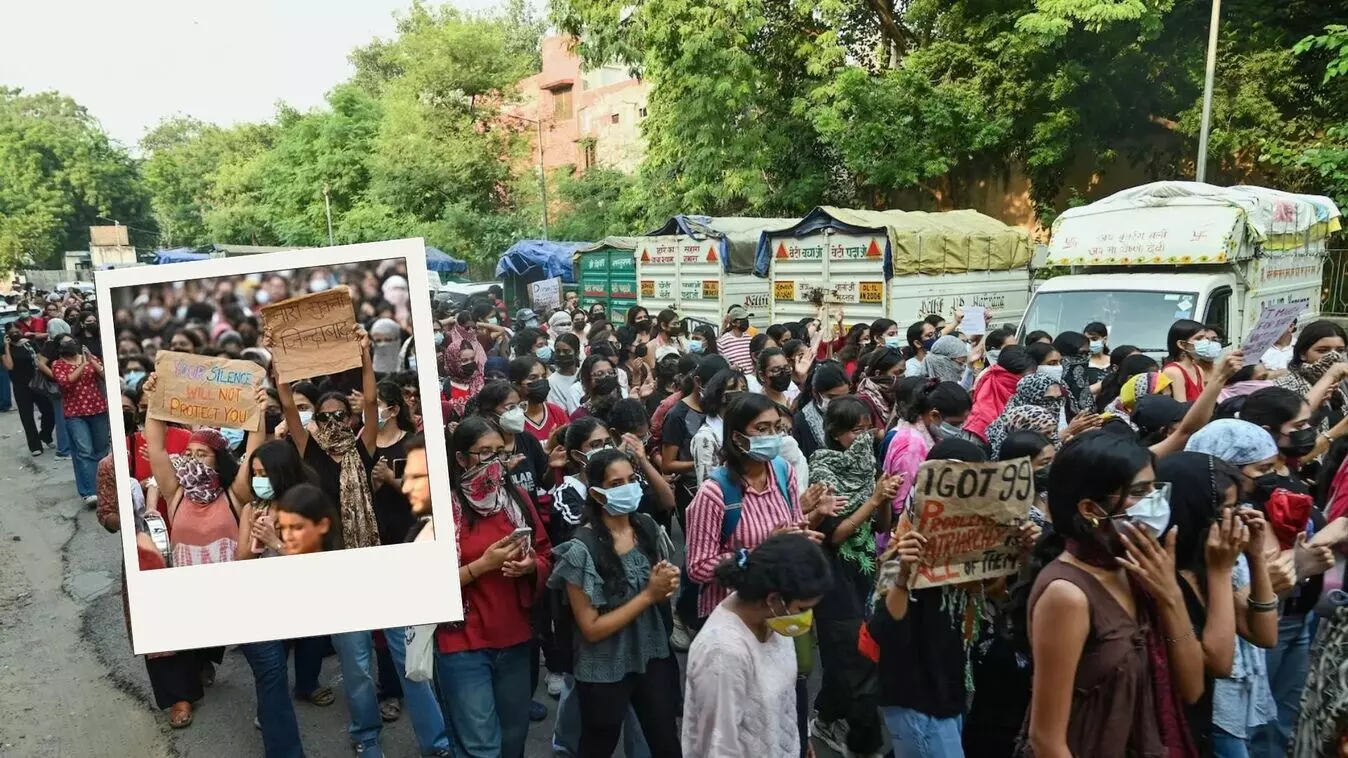
Women demand safer Delhi streets
Ground report | ‘You can’t protect women by restricting them’: Delhi students share concerns
LSR students say restricting their movement does not address the circumstances that allowed the rape of a minor to take place in a nearby park

Multiple incidents of sexual violence and harassment around educational institutions in Delhi have brought shortcomings about security, lighting and policing to the fore, say women students in the national capital. Speaking to The Federal, they say that responses to these issues, which restrict women’s movement, yield little result when it comes to addressing the problem.
Lady Shri Ram College for Women (LSR) shut down offline classes for two days following the gang rape of a minor girl in a park near the campus. The following day, entry to parks after sunset was restricted, a decision that angered many students.
LSR students said they have been hearing about incidents of harassment, including flashing, stalking, public masturbation around the college and nearby areas, since their first year. One student recalled an incident in which a person allegedly pretended to be a Delhi Police officer, held a gun to a woman’s head and raped her. Students say such incidents have resulted in a continuing sense of fear about moving through public spaces.
Everyday harassment
They further revealed that one or two middle-aged men regularly come to the area around the college, both in the morning and evening, and masturbate while provoking girls passing by. “They come and continuously masturbate and provoke the girls who are coming and going,” a student said.
Also Read: Delhi Kalkaji gang-rape survivor says accused posed as policemen: Report
Another student said that a middle-aged man followed two girls before suddenly slapping one of them.
They also pointed to a pink booth located in front of the college, which they said is not functional. Students argue that such gaps have existed for years and that complaints about them have not resulted in adequate action.
Fear outside
However, their fear is not limited to one incident or one location. One student said that she feels scared in Delhi, adding that similar incidents can happen in different parts of the country.
But on the college campus, students said they feel relatively free to dress as they want to without being objectified, adding that the situation worsens as soon as they leave the campus.
Also Read: Delhi minor allegedly gang-raped by 3 men posing as cops; one held after gunfire
“As soon as you leave the college, you enter the real world where patriarchy exists. They will stare at you, catcall you, say whatever they want and walk away, as if it is their right,” a student said.
Restrictions questioned
Students argue that restricting their movement does not address the circumstances that allowed the crime to take place. “This incident did not happen inside Delhi University. It happened in a park near LSR. I think this is a knee-jerk reaction by the LSR administration, and it is also a sign of a patriarchal mindset,” a student said.
Students say the issue is linked to the way women’s bodies are treated and to responses that place restrictions on women rather than curbing such crimes and addressing security failures.
They argue that the response is unacceptable to many students and faculty members, and that limiting access to public spaces can affect women’s education and freedom.
Dark routes
The problems around LSR are not new, students said, adding that the area behind the college, where more than a thousand girls live and frequently travel, is particularly vulnerable due to poor lighting.
“The back gate of LSR closes at 7.30 pm,” a student said, adding that students who remain on campus until around 7 pm cannot use the back gate when leaving.
Also Read: Astha Kunj Park gangrape: Delhi Police review security at Lady Shri Ram College
They further revealed that they are then forced to travel from the front gate towards the back gate, where the route is dark and deserted, with only three or four regular street lights.
Recalling a rape case in front of Moolchand Metro station in 2024, one student said she was in her first year at the time, and police vans and additional security were deployed for two or three days before the area returned to normal.
“Something happens, police vans are deployed for two days, and then people start thinking that the area is safe again,” the student said.
Police response
Students who protested after the latest incident said the police response further angered them.
They said they had received permission for a solidarity march but were stopped near the back gate for around 45 minutes. They further alleged that police officers told them that the march had to begin and end at the back gate.
Students argued that the routes they wanted to take were precisely the routes they use every day and where they had raised concerns about safety.
Also Read: Cab driver kidnaps homeless minor, murders her after rape in Delhi, arrested
“They directly told us, ‘It won’t happen in the future.’ But where were you before that?” a student said.
Students claimed that police personnel suggested they carry pepper spray and avoid going to the park or going out alone.
“They asked us, ‘Why do you have to go to the park? Why do you go out alone?’ They were saying these things directly to us,” a student said.
After an argument lasting around 40 to 45 minutes, the students said they were eventually allowed to proceed towards Moolchand Metro station, where they wanted their solidarity march to end.
Wider concerns
The concerns raised by LSR students extend beyond the college and its immediate surroundings. To examine how women’s colleges in Delhi University approach safety concerns, the discussion also turned to Miranda House, another prominent DU women’s college. Miranda House officially describes itself as a college for women under the University of Delhi.
According to students, the focus should be on improving public infrastructure and security rather than reducing women’s access to public spaces.
“The only way forward is a pushback by women students, by everybody who believes in freedom and who believes in constitutional rights that men and women were given under the Constitution,” a speaker said.
The demand, students said, is not for fake encounters but for the judiciary to function, fast-track courts and faster disposal of cases.
Security demands
Students and others involved in the discussion called for better lighting, security personnel, CCTV cameras and other security measures.
“We should not empty the streets of women. The fewer women there are on the streets, the more vulnerable the one woman who has to go out for work will become,” a speaker said.
They said the back gate of LSR should have proper security personnel and CCTV cameras, while warning that telling students not to go out or not to use particular spaces can ultimately restrict women’s education.
“While your idea is to protect women, this is not how you can protect women —by restricting women,” a speaker said.
The discussion also referred to a possible approach in which crimes of this nature would be treated as a matter for society as a whole, with the government declaring zero tolerance. The speaker said this was still being looked into and had not been confirmed.
What activists say
Delhi has witnessed repeated marches and protests against rape and sexual violence. Yogita Bhayana, an activist associated with the Nirbhaya movement, reflected on the persistence of the issue. Bhayana has been documented as a prominent anti-rape activist who was involved in the Nirbhaya movement and later headed People Against Rape in India (PARI).
Bhayana said sexual violence is not new, but argued that the persistence of such cases despite social and institutional development remains deeply troubling.
“Girls were being raped a thousand years ago, 100 years ago, and even war survivors have faced sexual violence. So, it is nothing new,” she said.
“But at the same time, when we have evolved as humans and as a society, and we have developed so much, if we get to hear about a case in the national capital of the country, I think it is a big shame,” she added.
A recurring cycle
Bhayana said she felt a sense of failure after seeing protests repeat themselves without the changes she had hoped for.
“I personally feel a sense of shame that we protested, and we did the same drill, which I have just done. It is like going back to the same time and nostalgia, but things have not changed,” she said.
Also Read: Delhi rape and murder case: Accused Meena’s family says he is innocent
She questioned why those in authority were not doing more to prevent sexual violence, asking when authorities would stop perpetrators, identify potential perpetrators and study the mindset behind rape.
“Do something. Show us something that proves you are serious about doing something,” Bhayana said. “All the restrictions are always on women. What is this?” she added.
Freedom matters
The central demand emerging from the discussion is not for women to be kept indoors but for public spaces to become safer.
Students say they want to be able to travel to college, return home, meet friends and use public spaces without having to worry about the risks involved.
The question, therefore, is not simply how women can be protected from public spaces, but whether those spaces can be made safe enough for women to use them freely.
Delhi has been asked this question repeatedly. The students’ demand is that the response should address the conditions that enable violence, rather than restricting the women who have to live with its consequences.