



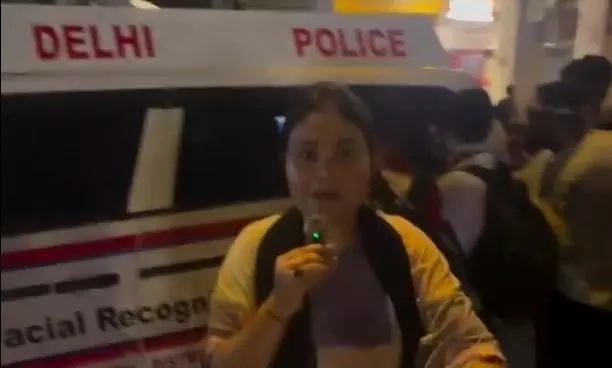
The clips, widely circulated on X and shared by the CJP, show what appears to be a live surveillance vehicle equipped with 360-degree CCTV cameras. Photo: X screengrab
Delhi Police AI facial recognition vans spark Aadhaar link questions
Viral videos showing Delhi Police's AI-enabled facial recognition system at protest site spark concerns over privacy, data use, and extent of surveillance; officials deny any link to Aadhaar

The ongoing student protests at Delhi's Jantar Mantar have ignited a fresh controversy over the use of artificial intelligence (AI) in policing after viral videos appeared to show Delhi Police using facial recognition technology to monitor demonstrators.
The clips, widely circulated on social media platform X and shared by the CJP, show what appears to be a live surveillance vehicle equipped with 360-degree CCTV cameras. A screen inside the vehicle reportedly displays photographs, names, and other details of individuals whose faces are captured by the cameras.
The videos have prompted widespread speculation that the system may be linked to the Aadhaar database. However, Delhi Police has not confirmed any such connection, and there is no official evidence suggesting Aadhaar records are being accessed.
How the AI system works
According to an Indian Express report, Delhi Police has deployed two surveillance vehicles near the protest venue. One vehicle functions as a mobile monitoring unit, collecting live feeds from CCTV cameras installed around Jantar Mantar. The second, known as the Ikshana vehicle, uses AI-powered facial recognition software to analyse those feeds and compare faces against photographs stored in a police database.
Police officials have maintained that the system is designed to identify individuals with criminal records rather than monitor all protesters.
Also Read: CJP protests expose Modi's Achilles' heel: A government unused to listening
"We have a large database of criminals, with their pictures. So, we run facial recognition on the footage... to see if it flags any face the software matches with someone on our criminal database," a senior police officer was quoted as saying.
The Ikshana surveillance vehicle was first introduced ahead of the 2023 G20 Summit as part of Delhi Police's enhanced security infrastructure.
Privacy questions persist
Despite police clarifications, questions remain over the source of the personal information displayed by the system. If the data is not drawn from Aadhaar, authorities have not disclosed which database is being used to identify individuals captured on camera.
Also Read: From slaps, social media ridicule to threats: Police brutality under fire amid CJP protests
The lack of transparency has intensified concerns among civil rights groups and privacy advocates over the scope of facial recognition technology and the safeguards governing its use.
Protesters voice fears; legal challenge underway
Several students participating in the demonstrations say the visible surveillance has created an atmosphere of intimidation. Some protesters have begun covering their faces, fearing their images could be stored and later affect future employment opportunities, particularly those preparing for government recruitment examinations.
A UPSC aspirant said many participants did not want to risk being profiled while seeking public sector jobs.
Also Read: Why CJI’s dismissal of CJP protest crackdown plea exposes gaps in suo motu rules
Questions have also been raised over how long footage recorded during the protests will be retained. Police officials have reportedly said there is no fixed timeline for deleting recordings if they could become relevant to future investigations.
The surveillance practices are now under judicial scrutiny, with a petition before the Delhi High Court alleging that continuous monitoring of protesters violates the constitutional rights to privacy and peaceful assembly. Delhi Police has defended the practice, stating that videography is being conducted solely to maintain law and order and ensure public safety, not to carry out unlawful surveillance.