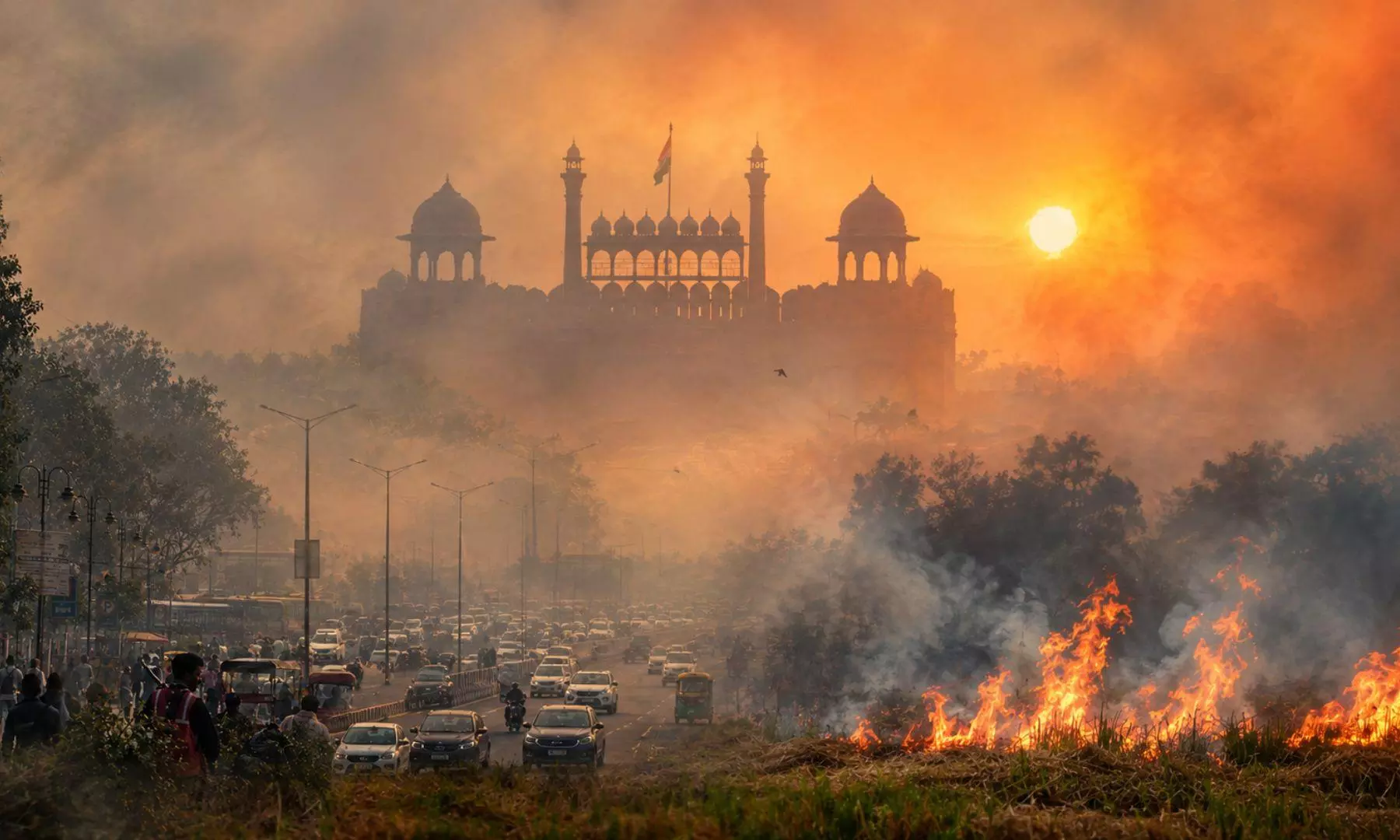
Global standards consider an AQI above 100 unhealthy for sensitive groups, whereas Delhi's average December readings exceed three times that threshold.
Delhi’s air turns toxic post-Dussehra, despite a six-year low in farm fires
Delhi’s AQI rose to 245 after Dussehra despite a six-year low in farm fires, highlighting the role of local emissions and winter weather in the capital’s pollution crisis

Delhi’s air quality has deteriorated sharply following Dussehra, with pollution levels hitting their worst post-festival mark in five years. The deterioration is particularly concerning as it comes in a year when farm fires in Punjab and Haryana fell to their lowest levels in six years.
On October 19, the day before Dussehra, Delhi’s Air Quality Index (AQI) stood at 139, falling in the 'moderate' category. As effigies of Ravan were set ablaze across the city on Dussehra, the index rose to 179 before jumping to 245 in the 'poor' category on October 21. Seven monitoring areas across the city, including Punjabi Bagh, Jahangirpuri, and Chandni Chowk, recorded AQI levels exceeding 300, with Pusa recording the highest reading at 329. Air quality remained in the 'poor' category for the subsequent two days before recent rainfall over three days brought the AQI down to 164.
Also read: Delhi winter air pollution: 10 lakh vehicles face ban from November 1
While stubble burning is widely considered a major contributor to winter pollution, data from the Indian Agricultural Research Institute recorded only 327 farm fires this year compared to 475 during the same period last year, marking the lowest count in six years.
Local pollution drivers
Three primary pollutants cause the majority of health damage during Delhi's winter. The first is PM2.5, particles fine enough to pass through the lungs and directly enter the bloodstream. The second is PM10, coarser dust originating largely from roads and construction sites. The third is nitrogen dioxide, coming mainly from vehicle exhausts and power plants, which inflames human airways.
Stubble burning represents only one factor in Delhi's overall air quality, with local urban emissions driving a significant portion of the problem. Twelve coal-fired power plants operating within a 300-kilometre radius of Delhi continuously release sulphur dioxide, nitrogen oxides, and soot, all of which cause direct respiratory damage.
Vehicular emissions form another major source of contamination, with findings from IIT Kanpur indicating that vehicles account for 40 per cent of Delhi's total pollution. Approximately 1.1 million vehicles enter and leave the capital every single day, releasing nitrogen oxides and particulate matter.
Road dust and construction activities add further to the atmospheric load, while geography compounds the severity. Delhi is landlocked, and during winter, cold air and slow winds trap pollutants close to the ground, preventing them from dispersing into the atmosphere.
Unchanging winter trends
A long-term study by the Centre for Research on Energy and Clean Air (CREA) reveals that Delhi's average winter AQI stood at 280 in 2022-23, climbed to 304 the following winter, fell to 285, and rose again to 295 last winter. After four years of tracking, the study demonstrates no consistent improvement in winter air quality.
Also read: Why Delhi’s discourse on air pollution seems to have moved from action to adaptation
Historical metrics suggest the most hazardous period remains ahead. Last December recorded the highest monthly average AQI in eight years at 343, an average index figure that obscures specific instances where local AQI readings exceeded 900 in certain parts of Delhi. Public speculation and allegations have also surfaced regarding government-installed monitoring stations manipulating AQI levels to make the air appear cleaner than it actually was.
Graded restriction stages
To manage deteriorating air conditions, authorities rely on the Graded Response Action Plan (GRAP), which tightens restrictions incrementally. Under Stage One, introduced when air quality is 'poor', measures focus on dust control, banning waste burning, restricting diesel generators, and keeping older diesel buses out of the city.
At Stage Two, when air quality turns 'very poor', offices are asked to reduce working hours, parking fees are increased, and additional metro and bus services are deployed.
When pollution reaches 'severe' levels under Stage Three, older petrol and diesel vehicles face restrictions, non-essential construction is halted, and offices are directed to function with half their staff working from home.
Severe health risks
Under Stage Four, the most extreme tier, non-essential trucks are prohibited from entering Delhi, and most students transition to online classes. However, despite GRAP being officially instituted in 2017, air quality metrics have shown little sustained recovery.
Also read: Delhi AQI enters poor category, stage 1 GRAP enforced across NCR
Health concerns remain paramount throughout this period. Global standards consider an AQI above 100 unhealthy for sensitive groups, whereas Delhi's average December readings exceed three times that threshold.
A study by the University of Chicago estimates that a Delhi resident could lose nearly 12 years of life expectancy due to sustained air pollution. Short-term risks include heart attacks, strokes, and acute asthma attacks, while long-term exposure reduces lung capacity, lowers immunity, stunts lung growth in children, and increases lung cancer incidence among non-smokers. Children, older adults, pregnant women, and individuals with heart or respiratory conditions remain the most vulnerable as the city enters its most dangerous months.