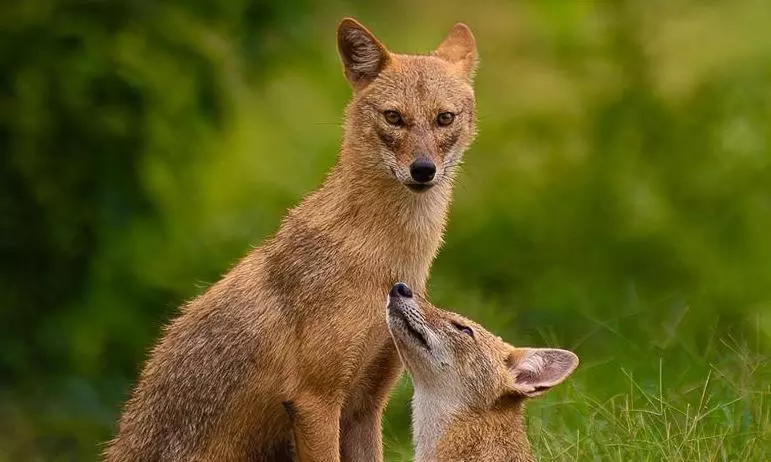
The deaths have triggered concerns among students over possible disease risks and public health concerns, though officials maintain that no single underlying cause has been identified yet. Representative image: X | @my_rajasthan
Deaths of 11 golden jackals at JNU raise concerns over wildlife safety on campus
The deaths come amid a sharp rise in the jackal population, with numbers increasing from 30 to over 130; JNUSU raises concerns about disease and poisoning risk

In an incident that has flummoxed the campus community, at least 11 golden jackals have died in the Jawaharlal Nehru University (JNU) campus during the previous month, officials told The Federal. The deaths come against the backdrop of a sharp rise in the jackal population on campus, officials said.
“While we don’t have the authority to conduct an official census, our unofficial survey says that their numbers have increased from an estimated 30-50 animals around four years ago to about 130-150 now. Earlier, they would die deeper inside the forested areas, so we wouldn’t know. Now they are coming onto the roads,” a JNU official told The Federal.
JNU’s letter to Dept of Forests & Wildlife
He said the university had even written to the Delhi government’s Department of Forests and Wildlife, regarding “the safety of golden jackals in JNU campus” on January 1, but had not received a response yet.
“I am writing to bring to your kind notice that the population of Golden Jackals has increased in large number in green zone of the University & they have started to come out of jungle area and entering residential and academic premises. The jackals are often sighted near hostel blocks, academic areas & waste disposal points in JNU,” the letter said.
Also Read: How Hyderabad Tiger Conservation Society built the human-leopard coexistence model
“While we appreciate the biodiversity, their increasing presence has led to concerns among students/residents regarding safety, and we are also concerned for the well-being and safety of the jackals themselves, given the urban environment. In view of the above, it is requested to take necessary steps as per the applicable Wildlife Act, please,” it added.
The administration had, in December, also flagged concerns over a dam inside the campus that serves as a drinking water source for wildlife, and has sought repairs from the Delhi Irrigation and Flood Control Department, without a response so far.
Public health concerns
Meanwhile, the deaths have triggered concerns among students over possible disease risks and public health concerns, though officials maintain that no single underlying cause has been identified yet.
The first death was reported on December 8, according to a JNU official, with the most recent incident occurring on Tuesday (January 6). Earlier this week, the JNU Students’ Union (JNUSU) wrote to the Dean of Students and the Chief Medical Officer (CMO) that multiple jackals had been found dead on campus over the past few days, including one on the night of January 3, after which students contacted Wildlife SOS, an NGO.
Also Read: Friends of Bandipur: Karnataka wildlife camp packs tigers, birds and all that's beautiful
“Since there is a risk of disease outbreak among the jackals with a potential risk of zoonoses and a potential risk of water contamination or poisoning due to contaminated waste or by criminal elements, we have urged the administration to notify the competent authorities and take necessary action in this regard,” the JNUSU said in a statement on January 5.
Situation being closely monitored: AWS
In another communication, it said, “The CMO talked to the ABC (Animal Birth Control) committee, chaired by Prof Piyush Pratap Singh, and the Animal Welfare Society (AWS) has taken this up and informed the District Forest Officer. The body of a jackal has been taken for a post mortem. We will wait for the results.”
In response, the AWS said jackals were a “protected and extremely shy species”, making them “difficult to monitor or capture for treatment”. It added that “JNU has no history of human-jackal conflict, disease outbreaks or zoonoses, and that the situation is being closely monitored by AWS-JNU and the ABC Committee with support from campus security, staff, and volunteers”.
Also Read: Wildlife Protection Act, 1972: A tale of conflict and controversy in Kerala
Wildlife SOS told The Federal that it had rescued only one jackal from JNU this month, and was not told about the multiple deaths at the time.
“The jackal had stomach upset and hypothermia and has been handed over to Asola Bhatti (Sanctuary),” said Neel Banerjee, Press and Communication Officer, Wildlife SOS. He added that similar hypothermia-related rescues had taken place in previous winters due to extreme cold, and that stomach ailments in jackals could have multiple causes.
‘No single pattern behind deaths’
A JNU official said there was no single pattern behind the deaths so far.
“Some have died from internal bleeding, some in accidents, and others from natural causes. The Wildlife Department has taken samples two to three times since this started, and there is no indication of any disease outbreak or poisoning at present. But we are monitoring the situation,” the official said.
Also Read: Wildlife SOS help Himalayan black bears to stay warm and well-fed during winter
Spread over 1,019 acres, JNU is part of the Southern Ridge of the Aravalli Hills and has voluntarily kept nearly 30 per cent of its campus as “reserved green”. It houses various species besides jackals, including “Common Palm Civets, Small Indian Civet, Indian Crested Porcupine, Blue Bulls, Rufus Tailed Hare, various lizards & varieties of snakes, birds & butterflies, etc.”, as per its website.