Central forces are essential for peace and security in Manipur but not enough, says Suhas Chakma.
Why does violence keep returning to Manipur? | AI With Sanket
Suhas Chakma explains why the failure to bring conflicting groups to the negotiating table remains a key reason for the ongoing crisis in the state

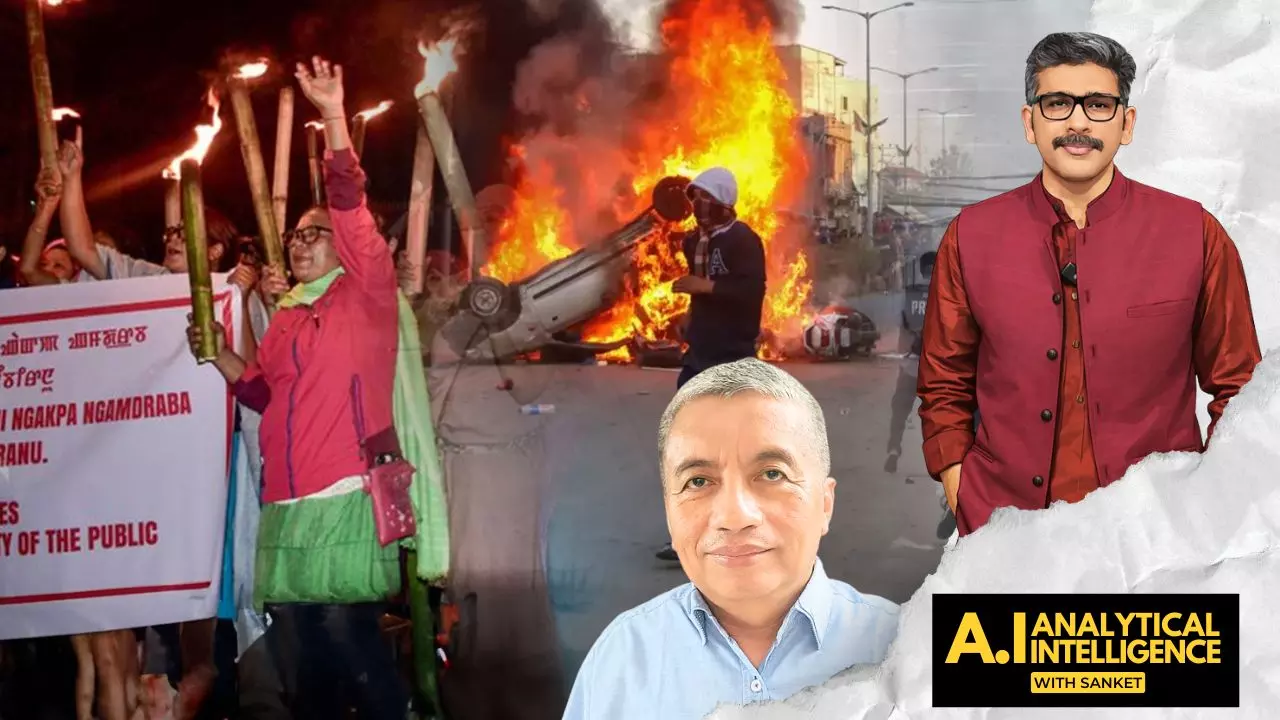
The continuing unrest in Manipur, despite heavy deployment of security forces and political interventions, points to a deeper failure — the inability to bring warring groups to the negotiating table, says an activist. As fresh violence erupted after the killing of two children on April 7, questions are once again being raised about governance, security, and political strategy in the state.
Also read: How Manipur unrest is flaring up again after deaths of children, Naga civilians
The Federal spoke to Suhas Chakma, Director of the Rights and Risks Analysis Group, on why peace remains elusive in Manipur and what the government may be missing.Why does the situation in Manipur remain volatile despite years of intervention, including President’s Rule?
I think the reasons are basically two-fold. While it would have been easy for the government to establish peace in affected areas, especially those bordering the hills and the plains, the presence of armed groups complicates the entire process.
If you look at it, whether it’s Kuki armed groups or Meitei armed groups, both sides have organisations that can vitiate the atmosphere with just one incident — firing a mortar or killing someone. The issue is existential for these groups.
Also read: Protesters clash with security forces in Manipur's Bishnupur, prohibitory orders imposed
So, it is usually these armed groups that take the initiative to disturb the situation. In other conflict zones like Bodoland, the Government of India was able to take control over time. But in Manipur, due to terrain, ceasefire agreements, and local complexities, armed groups remain very active and decisive.
Even when things come under control, one incident involving firearms can spiral the situation out of hand.
After the April 7 killings, should the administration have acted faster to prevent escalation?
Despite the presence of so many security forces, such incidents continue to happen and lead to further violence. It shows that the administration is unable to proactively respond to security needs after such incidents.
When one community is affected, it triggers protests from the other side. At that moment, security forces need to respond immediately. But they are often not able to, because their role is largely to manage peace rather than enforce it aggressively.
I often say the role of security forces in Manipur is similar to UN peacekeeping forces. They have firearms, but they cannot freely use them. If they do, and civilians are harmed, it creates another cycle of violence.
Also read: New Delhi’s Manipur script: Is administrative trifurcation the endgame?
So, security forces exercise restraint. But that also limits their effectiveness. There is also pressure not to cause civilian casualties, which further complicates the response.
Is the bigger failure then, the inability to prevent violence rather than contain it?
Absolutely. The biggest failure is not being able to bring the parties to a negotiating table.
If there had been discussions between representatives of both communities, including armed groups, it could have created an environment of trust. Even if talks don’t succeed, initiating dialogue builds confidence and reduces violence.
The lack of political initiative to bring stakeholders together is the biggest roadblock.
The government says anti-peace elements and vested interests are preventing normalcy. Do you agree?
They are partly right. There are definitely elements that benefit from instability. But at the end of the day, it is the government’s responsibility to create an environment where everyone can be brought to the table.
Also read: Manipur violence: KOHUR urges peace amid fresh violence
I recognise that the Government of India has made efforts. Incidents are not as frequent as before. But more needs to be done to initiate dialogue.
We have negotiated with far more difficult groups in the past. So, it is not impossible. It is difficult, but necessary.
How has the nature of the conflict evolved since it began?
When the violence began in May 2023, the issue was about granting Scheduled Tribe status to the Meiteis. But now, it has transformed into a much larger constitutional and territorial issue involving Kuki groups.
The demands have hardened. For some groups, autonomy has become a prestige issue. This has made the resolution far more complicated.
The Centre faces a tough challenge, but unless it brings all sides to the table or enforces stricter control mechanisms, flare-ups will continue.
Also read: How an ordinary morning in Imphal snowballed into the Manipur inferno
Meanwhile, ordinary people suffer the most. Shops are shut, economic activity is paralysed, and livelihoods are destroyed. The state is unable to fully support them.
Some groups are demanding removal of central forces. Will that help reduce tensions?
No, absolutely not. That will worsen the situation.
Given the deep polarisation between communities and concerns about the impartiality of local policing, central forces are essential. We have seen issues with the conduct of the Manipur police, including loss of arms and ammunition.
The central forces are acting with restraint, under instructions not to use disproportionate force. But their presence is necessary.
If they are withdrawn, the situation will deteriorate sharply. It would be a disaster for the Government of India.The content above has been transcribed from video using a fine-tuned AI model. To ensure accuracy, quality, and editorial integrity, we employ a Human-In-The-Loop (HITL) process. While AI assists in creating the initial draft, our experienced editorial team carefully reviews, edits, and refines the content before publication. At The Federal, we combine the efficiency of AI with the expertise of human editors to deliver reliable and insightful journalism.