



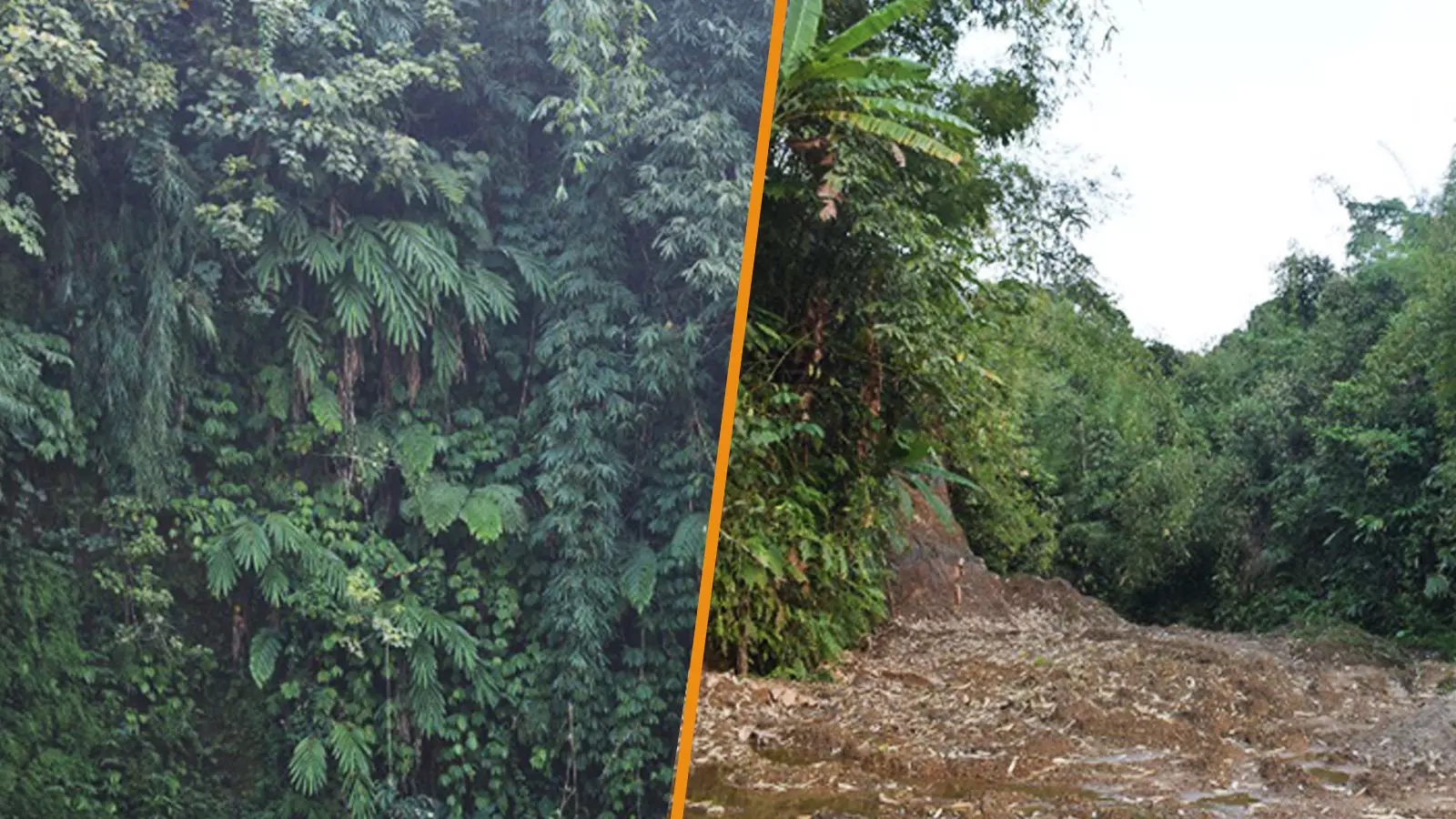
Arunachal Pradesh town loses a sixth of its forest to urban sprawl
Nirjuli's rapid urbanisation has destroyed habitat for hundreds of native plant species, including three found nowhere else on Earth

In news that should alarm India, the rapidly expanding urban footprint in Nirjuli, a small town near Arunachal Pradesh’s capital, Itanagar, has eaten away nearly 17 per cent of its forest cover in just 20 years.
The alarming loss of vegetation has raised serious concerns about the survival of rare and endemic plant species that thrive in the little-known private forest patch.
A new peer-reviewed study published in Discover Forests journal documents how the forested landscape shrank from 17.46 sq km in 2004 to 14.52 sq km in 2024.
A shocking shrinkage
“The forest area of 17.46 sq km in 2004 has declined to 14.52 sq km in 2024, which corresponds to a 2.94 sq km (16.83%) loss of area during this period,” the study's authors stated. +++ The numbers tell a stark story. Over the entire two-decade period, the researchers found that “a total of 3.13 sq km (15.9%) of forest was lost,” while just 0.22 sq km, or barely 1.2 per cent, experienced afforestation.
The forest loss also mirrors the growing dominance of concrete. Nirjuli’s built-up area more than doubled during the same period, expanding from 2.12 sq km in 2004 to 5.06 sq km in 2024.
Also read: Why fertilisers have emerged as a big enemy of farmers in Andhra Pradesh
Satellite imagery analysis shows that between 2014 and 2024 alone, 2.29 sq km of forest transitioned into built-up land, nearly double the rate recorded in the previous decade. Accuracy assessments of the satellite classification exceeded 95 per cent, lending credence to the findings.
Biodiversity hotspot outside protection
What makes the loss particularly alarming is the ecological value of this seemingly modest 19.58 sq km landscape of Nirjuli in Arunachal’s Papum Pare district.
Some rare and native plant species found in the affected forest patch: A) Vatica lanceifolia, B) Aristolochia assamica (discovered from the patch), C) Strobilanthes oxycalycina, D) Begonia griffithiana, E) Boeica arunachalensis (discovered from the patch), and F) Pseuderanthemum arunachalensis (discovered from this forest patch)
Field surveys conducted between 2016 and 2023 documented 156 native plant species within the endangered forest patch. Among them are 11 species endemic to the northeast, six species first described from this very area, and three point endemics found nowhere else on Earth.
“This level of species richness is comparable to, or even exceeds, that of protected areas of similar size, challenging the common assumption that unprotected lands lack significant ecological value,” the study noted.
Nirjuli's vanishing forest: what went wrong
♦ Built-up area more than doubled in 20 years
♦ Forest cover shrank by nearly 17% between 2004 and 2024
♦ Deforestation accelerated sharply in the decade after 2014
♦ Rare endemic species are disappearing before being fully studied
♦ Private forests outside protected areas lack any legal safeguard
♦ Urbanisation is eroding traditional ecological knowledge in communities
Nirjuli lies within one of the most ecologically sensitive regions of the Eastern Himalayas, an area globally recognised as part of the Indo-Burma and Himalayan biodiversity hotspots. Arunachal itself cradles nearly half of India’s flowering plant species.
Also read: Madhav Gadgil obit: An ecologist who refused easy binaries
Yet much of this biodiversity survives outside formal protected areas. Although the state retains around 80 per cent forest cover overall, only a small fraction falls within national parks, wildlife sanctuaries, tiger reserves or biosphere reserves. The rest, including the Nirjuli forest, exists under community or private ownership. This creates what researchers describe as a conservation blind spot.
Vanishing species
The study’s most troubling finding may not be the shrinking forest, but the plants that are no longer being found. Several species previously recorded from the area — including Piper pedicellatum, listed as 'Vulnerable' by the International Union for Conservation of Nature (IUCN) — were not encountered during recent surveys despite intensive sampling across deforested zones.
“Their absence suggests that recent land-cover changes may have directly contributed to the local decline or possible loss of these endemic and threatened taxa, underscoring a clear link between habitat degradation and biodiversity loss in the study area,” the authors warned.
How Nirjulis forest cover has diminished between 2004 and 2024. Source: Discover Forests
Many of these species occur in highly specific microhabitats, shaded understories near seasonal streams, growing on moist, loamy soil. Such niches are particularly vulnerable to clearing and fragmentation.
Also read: Why the new Aravalli definition is dangerous | Neelam Ahluwalia interview
Researchers have cautioned that even areas classified as “unchanged forest” in satellite imagery may not be ecologically intact. In some cases, primary evergreen forests have been converted into bamboo-dominated secondary growth following selective logging — a shift that retains canopy cover but reduces biodiversity complexity.
Urgent intervention
Calling for urgent intervention, the study’s co-author Dipankar Borah emphasised that the only realistic safeguard for species in rapidly urbanising forest belts such as Nirjuli lies outside shrinking natural habitats. “Establishing ex-situ conservation measures, such as dedicated botanical gardens, field gene banks, and educational conservation parks, is imperative,” Borah and his co-authors noted in the study.
The paper also argued that in semi-urban landscapes where deforestation has crossed critical thresholds, ex-situ conservation is “not only scientifically justifiable but also socially and institutionally achievable”, positioning botanical infrastructure and community-led cultivation efforts as the way forward.
Urban growth, cultural shifts
Beyond ecological metrics, the study also documented changing relationships between people and forests. Of the 156 species recorded, 56 have ethnobotanical importance, traditionally used for food, medicine or other cultural purposes.
However, researchers observed that increasing migration and urban lifestyles in Nirjuli are eroding traditional ecological knowledge.
Also read: Arunachal trade body warns of influx of Bangladeshi goods in state
Unlike older tribal settlements where communities have maintained intimate, intergenerational ties with forest landscapes, Nirjuli’s expanding population is largely engaged in salaried employment and commercial activities. Wild edibles are now often collected by specific gatherers and sold in local markets rather than harvested directly by households.
This shift, according to the authors, weakens informal conservation practices that once regulated extraction and fostered stewardship. Forests, increasingly, are perceived as accessible land or resource reservoirs rather than culturally embedded landscapes.
Discovery-destruction paradox
Arunachal Pradesh leads India in annual plant discoveries, with an average of around five new taxa described each year. In Nirjuli alone, six species have been formally described from this forest patch.
Yet, many newly discovered species remain unevaluated in terms of conservation status due to limited funding, shortage of trained botanists and logistical challenges.
The paradox is striking: species are being discovered even as their habitats are being cleared.
Without timely intervention, narrowly distributed micro-endemic species could disappear before their ecological roles are understood.
Call for ex-situ conservation
Given the pace of land conversion and fragmentation, the researchers argued that traditional in-situ conservation may not be sufficient in rapidly urbanising landscapes such as Nirjuli.
The authors recommended creating biodiversity parks and herbal gardens near urban centres, alongside community-driven seed collection and cultivation programmes. Local scientific institutions and state departments, they said, must take the lead in safeguarding plant diversity in forest patches situated near expanding townships.
In semi-urban settings where habitat thresholds have already been crossed, ex-situ strategies may be the only realistic way to prevent irreversible species loss.
Warning from Himalayan foothills
The loss of 2.94 sq km may seem minor against Arunachal’s vast forested expanse. But within a 19.58 sq km landscape, it represents the disappearance of nearly one-sixth of the habitat in just two decades.
For species confined to stream edges or shaded hill slopes, that loss can mean extinction.
Nirjuli’s shrinking forest is not merely a local land-use issue. It is a warning signal for biodiversity conservation across India’s rapidly urbanising Himalayan foothills, where ecological richness intersects with accelerating development.
