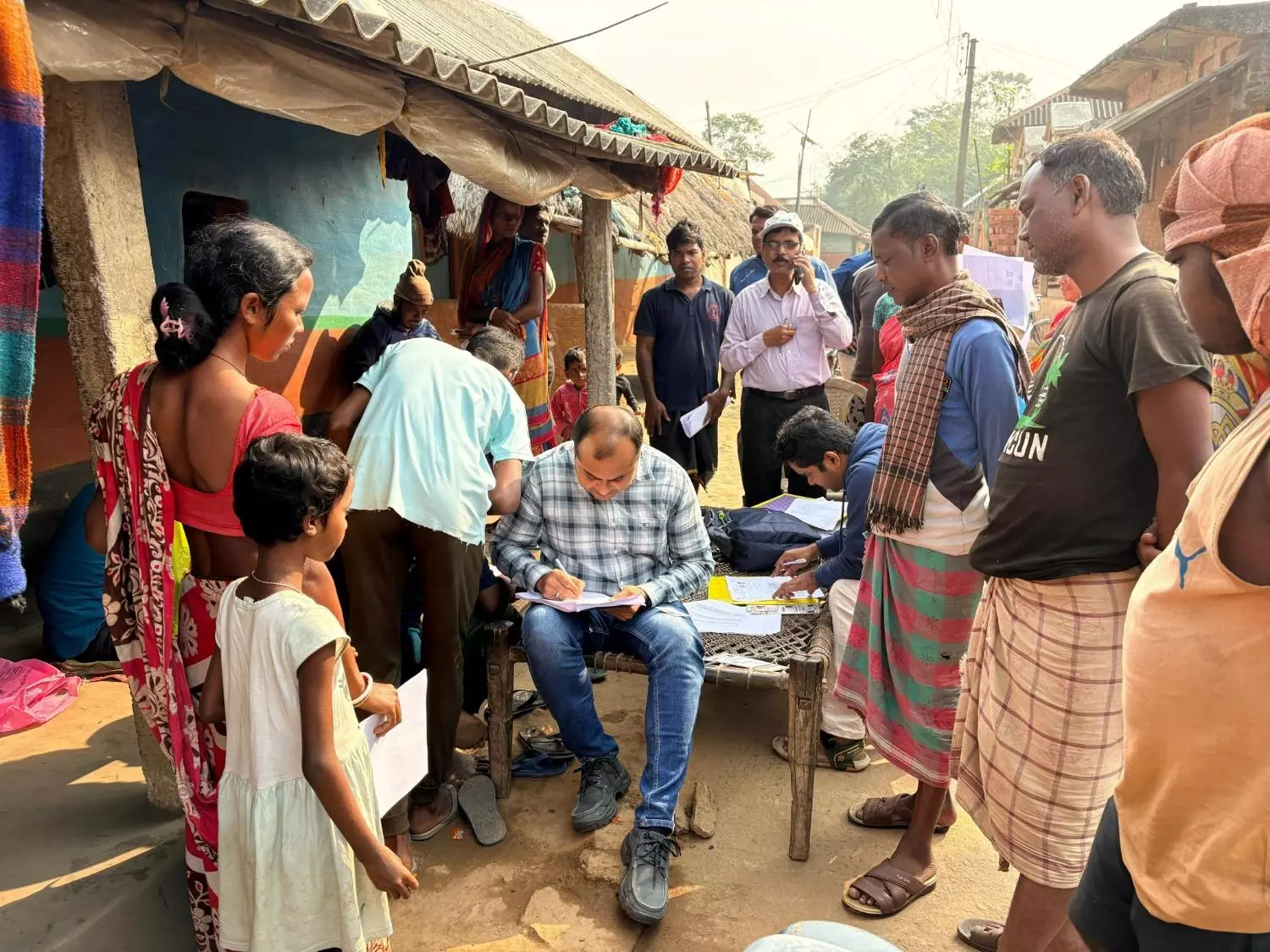
Bengal SIR at tribal village areas of Purulia district: To conduct the verification process, the EC has decided to hear at least 100 voters from each assembly constituency every day, doubling the earlier target of 50. File photo
Bengal SIR flags 1.67 crore 'suspicious' voters; scanner on 'defective' forms
EC data shows serious demographic anomalies like small age gaps between 'parent' and 'child', raising prospect of fresh verification drives, more exclusions

The Election Commission on Tuesday (December 16) published the draft electoral rolls for West Bengal, deleting a total of 58.21 lakh names, after the first round of scrutiny under the ongoing Special Intensive Revision (SIR) exercise.
The EC data shows that of the deleted names, 2.42 lakh voters have been listed as deceased, 1.99 lakh as absent, 12.20 lakh as missing, and 1.38 lakh as duplicate voters.
In addition, the draft roll has flagged 1.83 lakh as “ghost” voters, whose existence or eligibility could not be established during the verification process.
Defective, suspicious forms
However, more than the scale of deletions, what has sparked widespread concern is the fresh batches of defective and suspicious forms flagged by the EC along with the draft roll.
Also read: EC publishes Bengal’s SIR draft list; over 58 lakh voter names deleted
According to EC sources, a staggering 1.67 crore voters are likely to be categorised under this newly-flagged “suspicious” bracket, triggering renewed verification drives and the prospect of further hearings and more exclusions.
Officials maintained that most deletions in the draft roll pertain to voters found to be deceased, relocated, untraceable or enrolled multiple times. Yet, with the EC acknowledging that additional deletions may follow after hearings, anxiety persists among voters whose names appear uncertain or whose forms have been returned for correction.
Three categories
The EC has classified voters into three broad categories based on mapping with the 2002 electoral roll, the last time a SIR was conducted in the state.
Voters whose names appeared in the 2002 roll fall under the self-mapping category. Around 2.94 crore voters have been identified in this group. Those whose names were not in the 2002 list but whose parents’ or close relatives’ names appeared are categorised under progeny mapping. West Bengal has approximately 3.85 crore voters in this category.
Additionally, about 30 lakh voters fall under the non-mapping category, where neither the voter’s name nor that of their relatives appears in the 2002 roll.
All voters in this category will be mandatorily called for hearings, during which their documents and supporting evidence will be verified by the EC.
'Suspicious' category
Beyond these three groups, the commission has now flagged another large pool of voters as suspicious, citing serious demographic and relational anomalies.
Also read: Bengal SIR: CM seat sees nearly 4 times more voter deletions than Opposition leader's base
According to poll panel sources, 1.67 crore voters could fall into this category.
In some cases, the age gap between a voter and their parent is as little as 15 years. In others, voters are shown to be less than 40 years younger than their grandparents, defying expected generational gaps. In certain instances, the age difference between voters and their parents exceeds 50 years, while elsewhere more than six voters share the same father’s name, raising red flags.
Due to these inconsistencies, there will be fresh verification of this suspicious category of voters. If the verification is found to be unsatisfactory, the concerned voters will be summoned for hearings.
Other discrepancies
Apart from these cases, the EC has also identified large numbers of forms with issues ranging from spelling errors and address mismatches to mapping-related discrepancies.
For many voters, renewed verification process has heightened fears over their electoral status, particularly after the publication of the draft roll. EC officials, however, have sought to reassure voters, stressing that the majority of returned or defective forms do not indicate ineligibility but rather technical lapses.
Misspelt names, minor address inconsistencies and system-level mapping errors are cited as the primary reasons.
According to the EC's internal assessment, once corrected information is uploaded, most such voters are likely to be restored during the claims and objections phase. After document verification and hearings, the final electoral roll will be published on February 14.
To conduct the verification process, the EC has decided to hear at least 100 voters from each assembly constituency every day, doubling the earlier target of 50.
The hearings will be conducted by Assistant Electoral Registration Officers (AEROs). Ten AEROs have been appointed for each of the state’s 294 assembly constituencies, amounting to 2,940 AEROs, with additional officers being deployed where required.