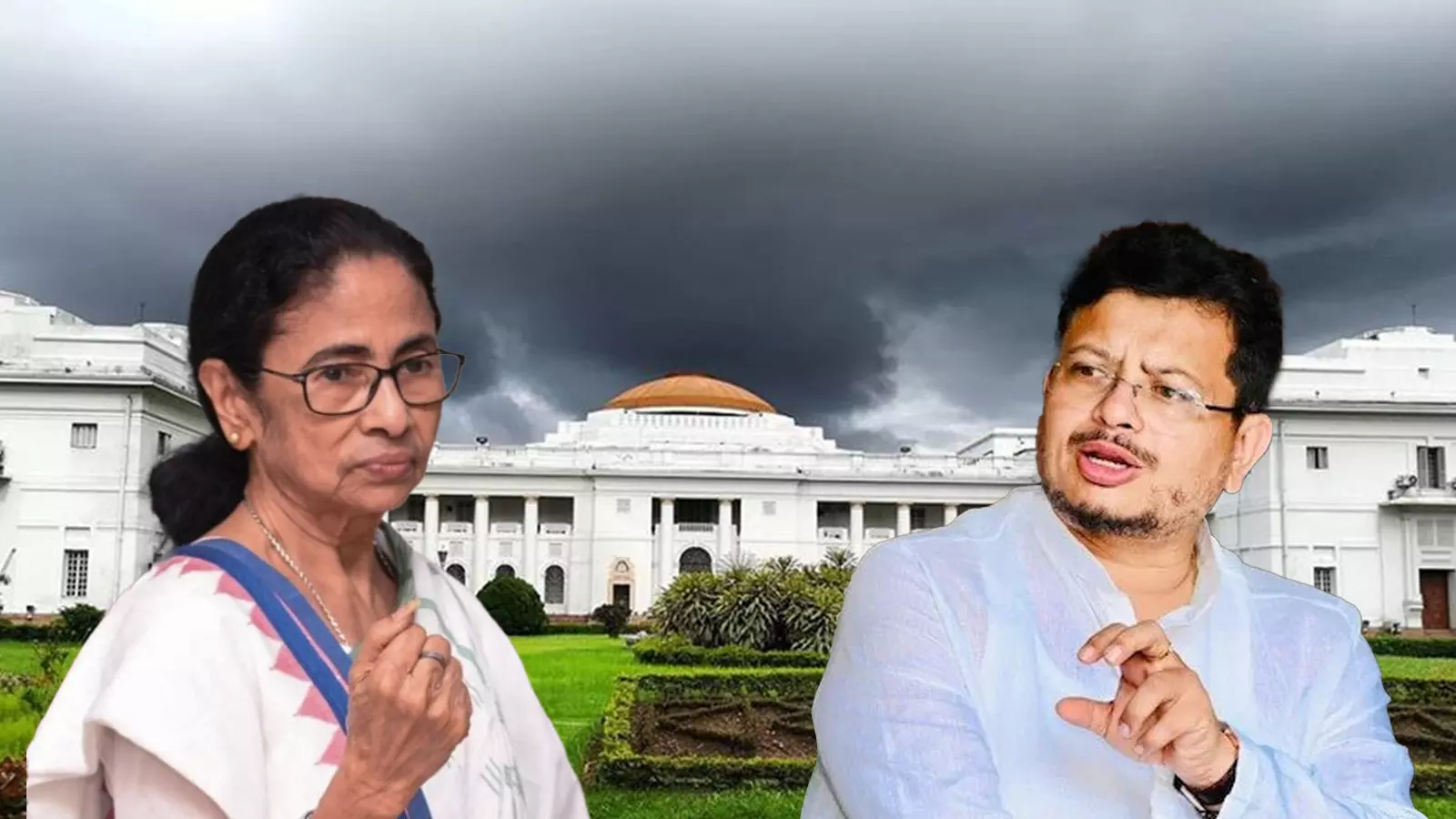
The tug-of-war in the Trinamool Congress between the Mamata Banerjee faction and Ritabrata Banerjee faction has affected the process to pick the PAC chairperson in West Bengal Assembly. Photo of West Bengal Assembly: iStock
Why PAC election is a referendum of sorts on Mamata's leadership
A routine legislative exercise turns into a high-stakes war for political legitimacy as the rebel Ritabrata camp and Mamata Banerjee's loyalists brace for a July 5 showdown

West Bengal's Assembly is headed for an unprecedented election to choose the chairperson of its Public Accounts Committee (PAC), with a split in the main opposition party, Trinamool Congress (TMC), turning a routine parliamentary exercise into a test of political legitimacy.
Also read: TMC crippled financially as cops freeze party's three accounts holding around Rs 440 cr
Committee chairpersons are rarely chosen through a contest in Indian legislatures. Parties typically agree on nominees for legislative committees, such as the PAC, with the post traditionally going to the opposition by convention.
Unprecedented polls after TMC implosion
But after rival TMC factions led by Mamata Banerjee and rebel leader Ritabrata Bandyopadhyay claimed legitimacy as the state's principal opposition force, the Bengal Assembly notified elections for four committee chairmanships, including the influential PAC.
The voting is scheduled for July 5.
The election has acquired significance because it will effectively turn into a headcount within the opposition benches.
Only opposition legislators will take part in the voting.
While the Ritabrata camp has already secured recognition from Speaker Rathindra Bose as the opposition leadership on the strength of a letter claiming the support of a majority of opposition MLAs, a victory in the committee election could further strengthen its claim to legitimacy within the chamber.
The development is the latest chapter in a long-running debate over opposition control of the PAC in Bengal.
The committee, which scrutinises government expenditure through reports of the Comptroller and Auditor General (CAG), is widely regarded as the legislature's principal financial watchdog.
Parliamentary experts note that the convention of allocating the PAC chairmanship to the opposition is intended to strengthen legislative scrutiny of the government.
While the practice is well established in Parliament and most state legislatures, its application in Bengal has periodically generated controversy.
Past controversies
In 2016, when the TMC was in power, then Speaker Biman Banerjee's decision to appoint former Congress legislator Manas Bhunia as PAC chairman despite objections from the Congress Legislature Party triggered a controversy over the convention governing the post.
Also read: From twice expelled to Bengal opposition leader: Who is Ritabrata Banerjee?
By then, Bhunia had begun moving closer to the TMC, and critics viewed his appointment as a reward for his political realignment.
The appointment also triggered questions about the government's role in determining who should occupy a position conventionally reserved for the opposition.
A similar dispute resurfaced in 2021 when the TMC government appointed the late Mukul Roy as PAC chairman, shortly after he had returned to the party from the Bharatiya Janata Party (BJP).
The BJP had proposed former chief economic adviser Ashok Lahiri for the post and argued that the spirit of the convention had been undermined because Roy had already politically aligned himself with the ruling party, despite technically remaining a BJP legislator at the time.
BJP legislators later resigned from several Assembly committees in protest.
Ironically, the latest controversy has revived questions about a parliamentary convention that the TMC itself was accused of undermining while in government.
Both the Bhunia and Roy episodes prompted opposition parties to allege that the ruling party was influencing who occupied a post traditionally reserved for the opposition.
The TMC, for its part, defended the decisions as being consistent with legislative procedure and convention.
The current dispute, however, is slightly different.
While previous controversies revolved around the choice of an opposition nominee, this time the ruling BJP stands accused of engineering a split in the principal opposition party.
Not who but which faction
As a result, the contest is no longer about who should occupy the PAC chairmanship but about which faction can legitimately claim to represent the main opposition.
The crisis emerged after the TMC's defeat in Bengal last month triggered a major revolt within its legislative ranks.
A majority of the party's legislators in the Assembly broke with Mamata's leadership and joined a rebel camp led by Ritabrata, who won from Uluberia Purba constituency in the April election.
Also read: As TMC crumbles, what's next for Mamata and the state forces she fought over the years?
The rebels subsequently secured recognition as the opposition leadership in the House, arguing that they commanded the support of most opposition legislators. The Mamata camp challenged the move through legal action, and the dispute over who constitutes the legitimate opposition remains before the courts.
According to the Assembly notification, nominations for the committee chairmanships can be filed until June 30. Scrutiny will take place on July 1, while candidates may withdraw nominations until July 2, three days before the polling.
Assembly sources said the Ritabrata-led faction is expected to back former Kolkata mayor Firhad Hakim for the PAC chairmanship, although the Mamata camp has yet to formally announce its candidate.
Constitutional experts say contested elections for committee chairmanships are uncommon because such positions are usually allocated through consultation and consensus.
Even when disputes arise, they generally involve disagreements over nominees rather than competing claims over the identity of the opposition itself.
'Election not only about who heads Assembly financial watchdog'
That is what makes the Bengal contest unusual. “The election is not merely about who will head the Assembly's principal financial watchdog. It has also become a proxy battle over political recognition inside the opposition camp,” said senior advocate Arindam Das.
Also read: TMC collapse: Has BJP solved one problem and created two new ones?
The outcome could have a larger political implication. A victory for the Ritabrata faction would strengthen its argument that it represents the majority of opposition legislators and reinforce its claim in ongoing legal and political battles over the future of the TMC.
While a victory for the Mamata camp would demonstrate that it remains a significant force despite the rebellion, few in the faction privately give themselves much chance of capturing the coveted post.
More broadly, the July 5 vote will show how legislative institutions can become arenas where rival factions compete for influence during an ongoing internal party conflict.