Why all eyes are on a Sept 7 meeting as VHP’s Durga Puja diktats draw flak
The VHP may issue its diktat but for the BJP government, changing practices deeply embedded in Bengal’s social and cultural life could carry its own risks

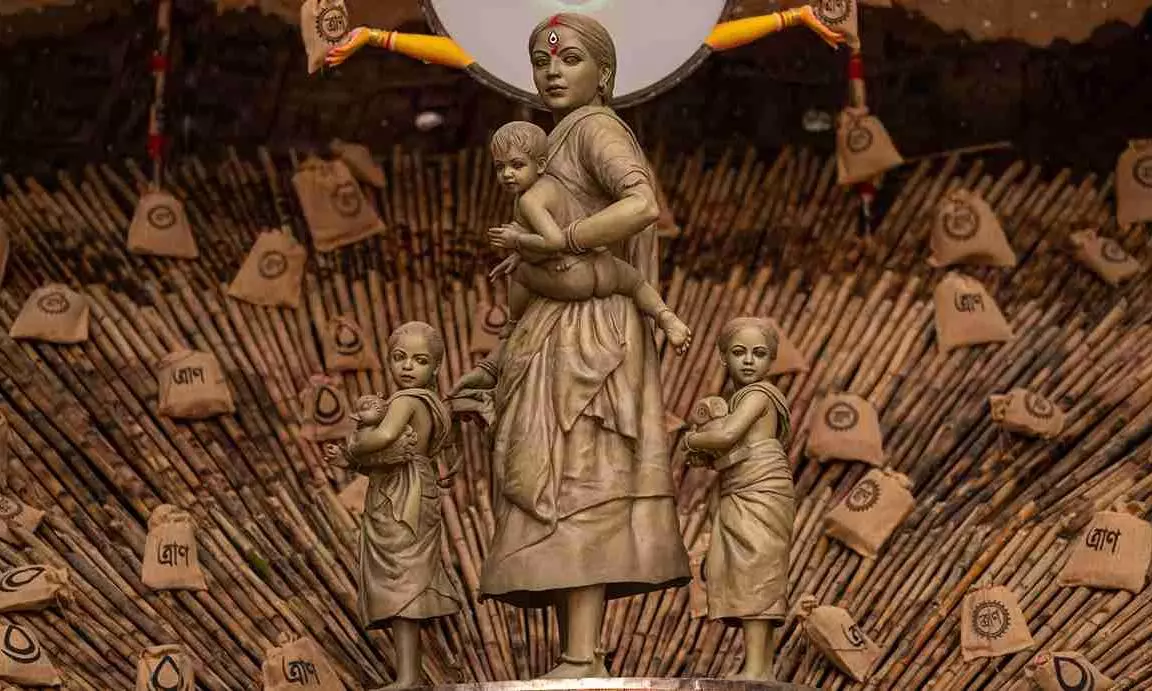
In 2020, after thousands of migrant workers walked home during the Covid-19 lockdown, a Kolkata Puja committee gave Goddess Durga an unassuming identity. The traditional idol at Barisha Club in Behala was replaced with the image of a migrant mother walking home with her children.
The following year, the club in south Kolkata returned with a sequel themed Bhager Maa (Divided Mother). This time, the migrant mother found herself in a detention camp with her children, reflecting anxieties over the possible turmoil for migrant workers if a nationwide NRC were implemented.
The two themes were part of a larger evolution of Bengal’s Durga Puja, where the goddess increasingly became a canvas for contemporary anxieties and social and political messages.
Lost freedom?
Five years later, the fate of that freedom to reinterpret the goddess hinges on the September 7 meeting, when Chief Minister Suvendu Adhikari is expected to meet Puja organisers amid the growing debate over how Durga Puja should be celebrated in Bengal.
Also read: Durga Puja becomes new battleground for BJP factions in Bengal
The debate has been triggered by a set of prescriptions from the Vishva Hindu Parishad (VHP), which has urged Puja committees to follow Sanatani and scriptural practices and ensure that idols retain the traditional form of the deity.
It has also said that Durga Puja should be organised and conducted by Sanatani Hindus, while people of other faiths may visit the pandals.
Shadow over Puja
The VHP also raised objections to non-vegetarian food being brought into or consumed within puja premises, though the organisation has since clarified that it is not seeking a blanket ban on non-vegetarian food during the festival.
The VHP’s guidelines have cast a shadow over Bengal’s long-practised Puja tradition. For decades, organisers have used the pandal and the idol not merely for worship but to engage with issues that extend well beyond the religious ritual, turning Kolkata into a vast canvas for public art.
The festival’s unique blend of religion, art, and community participation was recognised in 2021, when UNESCO inscribed Durga Puja in Kolkata on its Representative List of the Intangible Cultural Heritage of Humanity.
Clash with Puja culture
Beyond artistic expression, the VHP’s guidelines have also clashed with popular Puja culture over its insistence that the festival should be organised and conducted by Sanatani Hindus alone. This has raised questions about the festival’s traditionally inclusive character and participation across communities.
Also read: From NCC to ‘surgical strike’, how BJP is trying to reshape West Bengal’s campuses
In parts of Kolkata, particularly Kidderpore, members of the Muslim community have for decades been associated with organising community pujas. The VHP’s distinction between those who follow the faith and those who “merely” participate in the festival, therefore, sits uneasily with Bengal’s sarbojanin (for-all) tradition.
The food culture long associated with the festival is also part of the debate, with the VHP objecting to non-vegetarian food being brought into or consumed within puja premises, saying the space around the idol should retain its sanctity.
Backlash and support on social media
The guidelines have drawn strong criticism from Opposition parties and sparked a backlash on social media. Facebook user Tushar Sengupta questioned the invocation of “idol purity” by Hindu nationalist organisations, arguing that Hinduism was being used as a political instrument.
Another user, Niladri Naskar, questioned whether an organisation could redefine what constitutes an acceptable Durga Puja, while stressing that theme pujas had become an established part of Bengal’s tradition.
On X, Chiranjit Ojha reacted sharply to the restrictions, writing, “Surprise surprise. Now they want to ruin Durga Puja.”
Also read: Eggs, egos and an anti-goonda law: Bengal BJP govt's first 100 days
The reaction, however, has not been entirely one-sided. X user Sudhanidhi Bandyopadhyay defended the VHP’s position by pointing to the traditional vegetarian bhog served at many Kolkata pujas.
Soumyadip Dutta, who posts as @lofITechie, argued that the VHP’s stand should not be equated with regulating Bengali food habits. People could continue eating non-vegetarian food, he said, but such food need not be brought into the Puja premises.
Against Shakta traditions
The more important question, however, is whether the VHP’s prescriptions accurately reflect the Hindu traditions surrounding Durga worship in Bengal.
Padmanav Chakrabarty, general secretary of the Paschim Banga Rajya Sanatan Brahman Trust, said they do not.
Durga, he pointed out, is a Shakta deity, and non-vegetarian offerings are part of some traditional forms of her worship.
While about 90 per cent of community pujas now offer vegetarian bhog, he stated that around 10 per cent still offer non-vegetarian bhog.
Shakta-Vaishnava divide
Chakrabarty referred to the Hindu scripture Chandi and the Shakta belief that Durga embodies three qualities—sattvik, rajasik and tamasik. He argues that these allow for different modes of worship, including different ritual offerings, and that a strictly sattvik vegetarian form cannot be treated as the only legitimate way of worshipping the goddess.
Also read: Bengal BJP holds fish-and-rice feasts to prove non-veg is still on the menu
Even theme puja is not inherently taboo, provided the representation is rooted in devotion and is not offensive or derogatory, he told The Federal.
He also rejected the idea of imposing a Vaishnavite understanding of ritual purity on all forms of Durga worship in Bengal. The current controversy over food, he says, risks reviving an old Shakta-Vaishnava divide.
He further cited scriptural references to Durga as Viswajanani, or the universal mother, arguing that her worship cannot be confined to Hindus and that there is nothing wrong with people from other faiths participating in her puja.
Such participation, he said, has long been part of Bengal’s social and cultural tradition.
CPI(M)’s question
The Opposition has seized on the issue to attack what it sees as an attempt to impose a particular religious practise on Bengal’s Durga Puja.
CPI(M) state secretary Mohammed Salim accused the VHP of taking upon itself the authority to decide how Bengalis should celebrate Durga Puja and alleged that it was trying to “destroy the festive spirit” of Durga Puja.
Also read: How Kumartuli clay crisis has cast a shadow on Durga Puja tradition and economy
He also questioned whether people had elected the BJP government to deliver jobs, industry and education or to pursue what he called “religious purification”.
Cautious TMC
Congress leader Adhir Ranjan Chowdhury said Durga Puja was “Bengal’s identity” and its culture and tradition.
He pointed to the continuing presence of non-vegetarian food in some puja traditions and said Bengal did not need advice on its food habits.
The TMC was, however, more guarded in its reaction. Party spokesperson Kunal Ghosh urged caution in discussing the issue, while stressing that Durga Puja is a festival in which everyone can participate. He also pointed out that non-vegetarian food is traditionally not eaten inside puja pandals.
Organisers play down diktat
Puja organisers, on the other hand, preferred not to be drawn into the controversy, playing down the implications of the VHP’s guidelines.
Partha Ghosh, chairman of the Forum for Durgotsav, an apex platform of community puja organisers, said the VHP had only requested that non-vegetarian food not be served inside the sanctum sanctorum and that the puja should be conducted in a clean, hygienic and devotional atmosphere.
Also read: Visiting Kolkata for Durga Puja? Try these 10 traditional dishes of Bengal
Most community pujas, he added, do not offer non-vegetarian bhog in any case.
Ghosh also said the VHP had not explicitly issued any guideline against theme-based pujas.
Reading VHP’s guidelines
The VHP’s own statements, however, contradict Ghosh’s interpretation of its guidelines.
Parishad’s Marg Darshak Mandal member Nirgunananda Brahmachari maintained that non-vegetarian food should be sold and consumed only at designated places outside the pandal, insisting that the idol and its surroundings be kept free of such food.
He also objected to what he called “distortion of the deity” in the name of themes, saying artistic experimentation could not compromise Durga’s traditional form.
He also insisted that people of other faiths could visit pandals, but that preserving Hindu rituals, culture and spiritual traditions was the responsibility of Sanatanis.
September 7 meeting
For the BJP government, however, changing practices deeply embedded in Bengal’s social and cultural life could carry its own risks.
State government officials privately said there was no question of restricting people’s food habits and that existing puja practices were likely to continue.
Also read: Saffron tide and scarce beef: How a new political era is rewriting Bengal’s food habits
According to them, the September 7 meeting between the chief minister and puja committees is expected to signal that approach. Puja organisers, too, are awaiting the meeting to clear the air.
Saswata Basu, a prominent member of the forum and a key organiser of Hatibagan Sarbojanin, told The Federal to “wait for the September 7 meeting”, which he expected to be “very fruitful” and put to rest the misgivings surrounding the upcoming Puja.
The meeting will indicate whether the VHP’s guidelines remain suggestions or get any administrative and political backing.