Dry taps, MLA threats, eviction fears: 5,000-strong Muslim colony in Kolkata claims bias
For 2.5 months, 5,000 residents of a north Kolkata Muslim colony have survived on river water and hand-carried supplies after BJP MLA’s shocking remarks

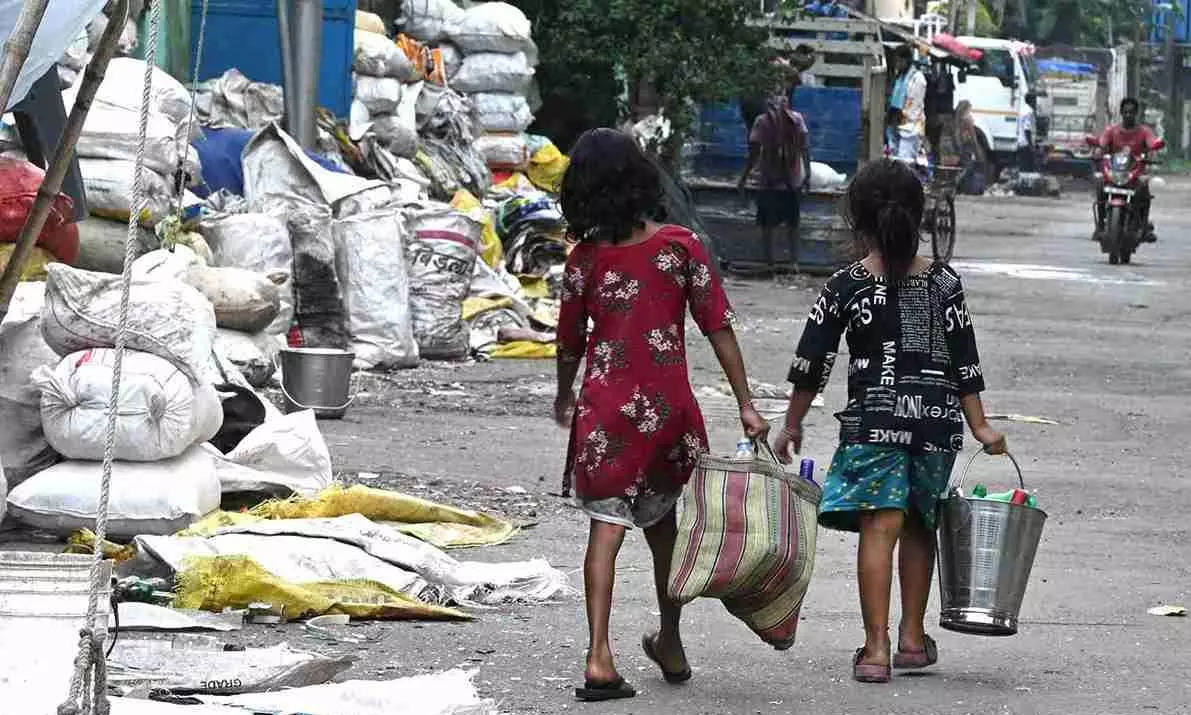
When school gives over for the day, 16-year-old Yasmin Khatun has to rush home for a much bigger task that awaits her daily—collecting water for her family. The slender teen trudges to a neighbourhood public tap, fills around 20 bottles, and carries them home. This is not once but thrice a day, and her arduous task does not end there.
She also carries the family’s bundle of clothes to the Hooghly (Ganga), which flows beside her house, to wash these before leaving for private coaching. These extra chores have become part of her routine now—forced on her because the taps in her Jyotinagar Colony have gone dry since July 29.
5,000 residents out of water for 2.5 months
This is not some remote hamlet but a north Kolkata settlement that houses more than 5,000 residents, almost all of them Muslims. And Yasmin is not alone.
Also read: BJP won Bengal promising to end TMC’s ‘jungle raj’; 5 months on, violence mounts
Her routine represents a worrisome humanitarian crisis confronting these people, who have been forced to fetch water from neighbouring areas or turn to the polluted river for bathing, washing, and, after treatment, drinking, allegedly because of their religious identity.
The BJP government took charge of West Bengal on May 9.
The Hooghly has become the fallback for bathing and washing clothes and utensils, although residents describe its water as so dirty that children have developed rashes and other skin problems.
BJP MLA’s threats and a notice
BJP MLA Ritesh Tiwari, who represents the Kashipur-Belgachia constituency, under which Jyotinagar falls, has denied responsibility for the disruption, and there is no evidence that he ordered the water supply to be disconnected. However, the “coincidence” is too stark to ignore.
After winning the elections, he publicly repudiated the constituency’s Muslim voters, saying he would work for only those who had voted for him. “Taking Baba Bholenath as a witness, I say that I will not do a single thing for them in the coming five years,” Tiwari said openly.
He even threatened that he would not issue certificates for the community, which he believes did not vote for him, and said only those who voted for him had rights over him. He spoke of doing “sabka hisaab”, a veiled warning of political retribution against those who had not supported him.
Also read: Blue-and-white to saffron: In Bengal, even the Brazil match is wrapped in politics
And very soon, an eviction notice involving the Syama Prasad Mookerjee Port arrived, giving a basic civic need a political and communal edge. Tiwari has, however, claimed that water supply is the Kolkata Municipal Corporation’s (KMC) responsibility, while the land dispute involving the residents is before the court.
KMC’s denial
For the residents, however, his words have become difficult to separate from what followed. “They have cut off the water and are directly stating, ‘We didn’t get any Muslim votes, so we will not do any work for Muslims,’” said Salima Bibi, 45, who says she has voted 11 times from the area.
The five public taps in the affected parts of the colony supplied water for most of the day before the disruption, but residents say the supply stopped after pipeline work carried out by the KMC in late July.
The KMC—which is currently under administrative control after Firhad Hakim resigned as the mayor in June—disputed the residents’ account of a pipeline disconnection. The civic body told the media that there was a problem with two roadside taps but that the water pipeline had not been severed, describing the allegation of a disconnected water line as unfounded.
The crisis has turned ordinary household chores into a daily struggle, with women and children making repeated trips to functioning taps in neighbouring areas to collect water.
Residents’ version
The situation on the ground and the residents’ accounts, however, appear to contradict the civic body’s version.
Sheikh Moinuddin, 46, who was born in the colony, said residents approached the civic authorities after the pipeline was cut and were initially assured the problem would be resolved within days.
“They told us, ‘We didn’t know about this (suspension of supply). We will get the work done within four to five days and resume the supply of water,’” he said. “Four days have turned into two months now, and we still haven’t received any water supply,” he said.
A daily struggle and health crisis
A visit to the locality by The Federal revealed the striking contrast: Fully functioning taps immediately outside the affected zone—roughly a 100-metre stretch inhabited by Muslims—where every tap has run dry.
Also read: Closure notices to 252 Bengal madrasas: 'BJP's big political message to Muslims'
The crisis has turned ordinary household chores into a daily struggle, with women and children making repeated trips to functioning taps in neighbouring areas to collect water.
Jahanara Bibi, a middle-aged woman, said she now fetches drinking water thrice a day, standing in queues before carrying the containers home. “I have to fetch water once in the morning, then again after lunch, and once more after dinner,” she said.
The Hooghly has become the fallback for bathing and washing clothes and utensils, although residents describe its water as so dirty that children have developed rashes and other skin problems. “When we bathe the young children with river water, their skin develops rashes and peels off,” Jahanara said.
Lives stripped of dignity
The dirty water has followed Yasmin to school, where she said classmates notice the stains that remain on her uniform despite washing it with Hooghly water. “When I go to school, they ask, ‘Why are your clothes so dirty? Didn’t you wash them?’” she said. “We reply, ‘Yes, we washed them, but the river water is so dirty that they don’t get clean.’”
Ritta Bibi, 40, said her family has been using Hooghly water to wash vegetables, fish and utensils and for bathing since the taps stopped working, and at times even for drinking after purifying it with alum. “By constantly bathing in it, our hands and feet have swollen, and we’ve developed skin infections,” Ritta said, pointing to what appeared to be fungal-like lesions on her feet. “I can’t even walk.”
Also read: On the voter list, yet deported? SIR throws up a new Bengal puzzle
Residents said periodic water tankers arranged with the help of CPI(M)-linked groups and the Basti Unnayan Samiti (Slum Development Committee) provide some relief, but the supply is insufficient for a settlement of this size. The tankers that come about twice in a week can hardly meet the requirements of 5,000 residents.
The KMC—which is currently under administrative control after Firhad Hakim resigned as the mayor in June—disputed the residents’ account of a pipeline disconnection. The situation on the ground appears to contradict its version.
A legal battle
The water crisis has come as a double whammy for the colony, which is already waging a separate legal battle over its right to remain on the land.
The Port owns the 3,478-square-metre plot on which the colony stands, and its estate officer issued an eviction order in February under the Public Premises (Eviction of Unauthorised Occupants) Act.
Residents challenged the order in the Calcutta High Court, which has restrained coercive action while the dispute continues. “We filed a case in the high court and secured a stay order,” said another resident, Mohammad Mofajjel Gazi.
Lives built over decades
For residents, who say their families have lived in the colony for decades, the eviction proceedings have revived fears of being forced out after generations. “Back then, no one called us Bangladeshi; back then, they didn’t drive us away,” Salima said. “Now they want to evict us.”
Also read: Bengal govt to enact UCC, then laws on ‘love jihad’, conversions in 6 months: CM Suvendu
Jahanara said her family built its home when the area was largely a wasteland and the residents gradually cleared it and created a settlement.
“When we were born here, there was nothing,” she said. “Slowly, we hauled stones and earth to build shelter and live here. And now, they want to throw us out.”
MP’s letter to the UN
Meanwhil, Rajya Sabha MP Samirul Islam has written to the UN High Commissioner for Human Rights, describing the colony’s plight as a “serious humanitarian and human-rights concern”. In his letter dated October 8, Islam said around 5,000 residents had been deprived of government-supplied drinking water since their pipeline connection was cut and not restored, a claim denied by the KMC.
He said alternative arrangements made by outside organisations were inadequate, leaving children, the elderly and other residents dependent on limited and irregular supplies. Islam also alleged that the water supply was cut because the residents were Muslims who had not voted for the BJP.
Citing the UN’s recognition of access to safe drinking water as a human right, Islam said the prolonged deprivation could not be treated as merely a civic-services issue and warned of the risk of widespread disease. He urged the UN’s human-rights mechanisms to seek an explanation from the authorities on the disruption, the immediate steps being taken to restore an adequate supply, and plans to ensure a permanent connection. He also called for measures to protect vulnerable residents, particularly children and the elderly. “Drinking water is not a favour. It is not charity,” he wrote.