



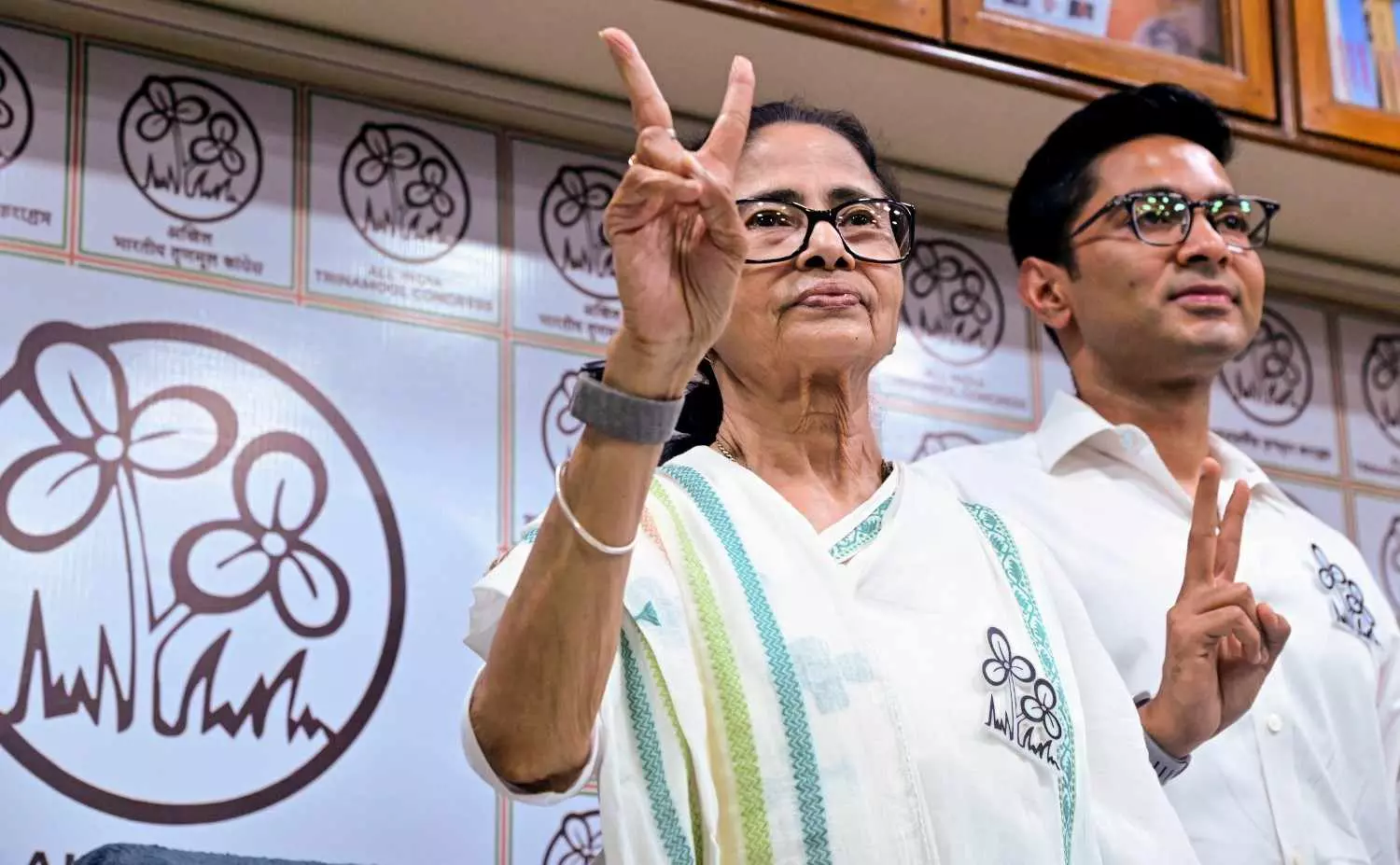
Mamata moves to curb Abhishek Banerjee’s clout amid ‘anti-Bhaipo’ revolt in TMC
The Trinamool chief has introduced checks on her nephew’s authority while attempting to contain dissent triggered by the forged-signatures row and electoral setback

Mamata Banerjee has finally moved to regain control of her party. Facing an unprecedented rebellion and growing challenges to her authority, the Trinamool Congress (TMC) chief has undertaken a sweeping organisational overhaul.
Her nephew and party national general secretary, Abhishek Banerjee, long seen as the de facto power centre in the TMC, has had his authority curtailed. Abhishek, better known in Bengal political circles as “Bhaipo”, had become a source of resentment among many party workers. He will now share organisational responsibilities with two additional national general secretaries. Rajya Sabha MPs Derek O’Brien and Dola Sen have been tasked with assisting him, signalling that his authority is no longer beyond scrutiny.
TMC overhaul sends message
The message became clear on Friday when Mamata unveiled a major organisational reshuffle. While Abhishek retained his post as national general secretary, Derek O’Brien and Dola Sen were appointed as joint secretaries.
Also read | Mamata’s ‘unlucky 13’ moment: How fortnight of rebellion pushed TMC to the brink
Both Derek and Dola are considered among Mamata's closest confidantes. Though the party officially said they would assist Abhishek, political observers viewed the move as an attempt by Mamata to rein in her nephew’s influence.
The reshuffle means Abhishek will no longer enjoy the same level of unchecked authority within the party. The inclusion of Derek and Dola introduces an additional layer of oversight, with both leaders enjoying direct access to Mamata.
Political analyst and author Sayantan Ghosh highlighted the significance of Dola Sen’s appointment. “Widely regarded as one of Mamata’s closest confidantes, she is likely to serve as her eyes and ears within the party's national organisational structure,” he posted on X.
The move effectively shifts the party towards a more collective leadership model rather than concentrating power in one individual.
Mamata rewards trusted aides
A notable change was the removal of Abhishek loyalist Trinankur Bhattacharya as president of the Trinamool Chhatra Parishad (TMCP), the party’s student wing. He has been replaced by Priyanka Adhikari.
In another key organisational change, senior leader Chandrima Bhattacharya has been appointed the new state president, a move seen as signalling both a generational shift and an organisational reset within the party. Subrata Bakshi will continue as vice-president of the National Working Committee.
The reshuffle has also brought new faces into various party wings. Sajda Ahmed, Mamata Thakur, Nayana Bandyopadhyay and Swati Khandekar have been named vice-presidents of the West Bengal Pradesh Trinamool Congress, while MP Saayoni Ghosh will continue to head the party's youth wing.
Through these appointments, Mamata has handed key responsibilities to loyalists and old-timers who have stood firmly by her side despite the intense rebellion and internal unrest within the party.
Taken together, the changes underscore Mamata’s determination to reassert control over the party at a time when it is facing its most serious internal crisis since its formation in 1998.
Rebels remain unconvinced
However, the reshuffle failed to satisfy the rebel camp led by Leader of the Opposition Ritabrata Banerjee. "Continuing to place trust in the person under whose leadership the party collapsed at the grassroots level amounts to a loss of faith in the people," Ritabrata told Anandabazar Patrika.
The comment was widely seen as a direct attack on the decision to retain Abhishek as national general secretary.
At the centre of the rebellion by Ritabrata and 57 other MLAs is the forged-signatures controversy, which has put Abhishek's role under intense scrutiny.
Ritabrata has alleged that signatures of several TMC MLAs were forged in a letter sent by Abhishek to the Bengal Assembly Speaker recommending Sobhandeb Chattopadhyay as Leader of the Opposition. The controversy became the rallying point for 58 MLAs who defied the party leadership and took control of the legislative wing.
Abhishek’s role in the episode is now under investigation by the CID.
Questions over Abhishek model
Discontent against Abhishek had been building for weeks. Following the party’s electoral setback, much of the anger and frustration within the TMC was directed at him and what critics described as his high-handed, corporate-style approach to politics.
Also read | Mamata must remain supreme leader, not adviser: Dissent surfaces in TMC rebel camp
Senior leaders, including MP Kakoli Ghosh Dastidar, argued that political consultancy firm I-PAC, brought in by Abhishek to manage the campaign, played a role in the party's poor performance by sidelining grassroots workers.
Others have made similar allegations, claiming Abhishek created a parallel power structure through I-PAC that weakened Mamata's grip over the organisation.
TMC MLA Krishnendu Choudhury told Anandabazar Patrika that Abhishek had damaged the party “bit by bit”. He claimed Mamata was aware of the developments but was unable to intervene effectively.
From candidate selection to booth-level strategy, Abhishek’s influence was visible across the organisation. For many within the party, the election defeat was therefore as much a verdict on the “Abhishek model” as it was on Mamata Banerjee’s governance.