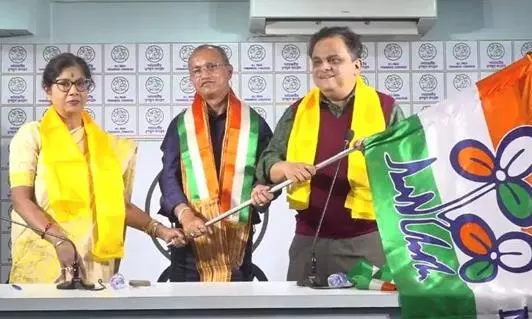
For years, the BJP built its dominance in North Bengal on a straightforward calculation: champion the statehood aspirations of the Gorkha and Rajbongshi communities, win their loyalty, and bank the seats. It worked — spectacularly so in 2021, when the party swept 30 of the region's 54 assembly constituencies. But with the 2026 elections drawing closer, that strategy is coming apart at the seams.
The resignation and defection of Kurseong MLA Bishnu Prasad Sharma to the TMC on February 19, combined with Kamtapur leader Jiban Singha's threat to field independent candidates, has laid bare a growing disillusionment among communities that feel their long-standing demands have been met with little more than carefully worded assurances.
The BJP's central leadership is now scrambling to contain the damage, but for many in the hills and plains of North Bengal, patience has run out.
Sharma’s defection has reignited questions over the BJP’s long-pending Gorkhaland assurances, electoral promises the party has reiterated since the 2009 Darjeeling Lok Sabha elections in which it emerged victorious. The poll promises, however, have seen little substantive progress so far, prompting many Gorkha groups to step up their mobilisation over the demand for separate statehood.
Why BJP's North Bengal fortress is struggling
♦ Rebel MLA Sharma defects to TMC over broken promises
♦ Gorkhaland statehood pledge remains unfulfilled since 2009
♦ Kamtapur leader threatens to field independent candidates
♦ Key Rajbongshi MP openly critical of voter roll exercise
♦ Ethnic communities losing faith in BJP's ability to deliver
♦ Delhi's last-minute outreach seen as electoral opportunism
With the appointment of Pankaj Kumar Singh, a retired IPS officer and former deputy national security advisor, as the Centre’s interlocutor for the Darjeeling Hills ahead of the West Bengal assembly elections, several local parties and hill leaders intensified their political push.
Last month, a public meeting was held in the hills to expedite a resolution to the long-standing issue, during which Gorkha leaders submitted representations urging the Centre to consider a separate Gorkhaland state or, as an alternative, a Union Territory with full legislative powers.
False promises
The Gorkha Janamukti Morcha (GJM) representatives Bimal Gurung and Roshan Giri emphasised that their demand is not separatist but rooted in constitutional federal principles.
Rebel MLA Sharma, however, accused the Centre of misleading the Gorkha community with vague assurances such as a “permanent political solution”, and described the renewed outreach as yet another “jhumla” (false promise).
Anit Thapa, president of the Bharatiya Gorkha Prajatantrik Morcha (BGPM) and chief executive of the Gorkhaland Territorial Administration (GTA), criticised the interlocutor’s recent visit as being politically timed ahead of the elections rather than aimed at a genuine resolution, adding that simply sending a mediator without firm commitments would not address local aspirations.
The unease is not confined to the hills. In the plains, another influential ethnic group has signalled a possible rethink of its support for the BJP.
Potential rebel against BJP
Jiban Singha, chief of the Kamtapur State Demand Council, which spearheads movements for greater recognition of the Rajbongshi/Kamtapuri community, has threatened to put up independent candidates in the upcoming elections, accusing successive central governments of ignoring long-standing demands for administrative autonomy and meaningful political recognition.
He is also the chief of the banned militant outfit, the Kamtapur Liberation Organisation (KLO).
Singha, though never openly extended his support to the BJP. He has been perceived as offering tacit backing to the party ever since his return from his jungle base in Myanmar in January 2023, when he and several of his cadres entered India to participate in peace negotiations facilitated by the Centre.
Political opponents, particularly the TMC, have repeatedly labelled him a “BJP stooge”, pointing to the timing and tone of his public statements, which often mirror the saffron party’s strategic interests in North Bengal. “If he eventually fields candidates in the elections, it could erode the BJP’s hold on the Koch‑Rajbongshi vote bank,” said Siliguri-based political analyst Probir Pramanik, who has been tracking the region for over three decades.
The Rajbongshi rebel
For the BJP, Singh’s threat assumed added concern as it comes at a time when its most prominent Rajbongshi face and Rajya Sabha MP Anant Maharaj has started making discomforting noises for the party, over the ongoing Special Intensive Revision (SIR) of the electoral rolls.
He has been openly critical of the SIR exercise in West Bengal, alleging that genuine voters are being harassed, due to errors by election officials and warning that ordinary citizens are “paying for ECI mistakes”. At a public programme in Sitai, Cooch Behar recently he even went on to allege that if people from his community were being treated as foreigners, then the country’s top leaders could be labelled foreigners too.
In his remarks, he provocatively claimed that the president, prime minister and home minister were “Bangladeshis”, under the same logic being applied to Rajbongshi voters in the SIR exercise, arguing that if long‑term residents had to prove their citizenship, then those enforcing the rules could likewise be questioned about their origins.
Impact on electoral stakes
The BJP’s strategy in North Bengal has relied heavily on tapping into the ethnic and linguistic aspirations of the Rajbongshi/Kamtapuri and Gorkha/Nepali communities, which have long-standing grievances over cultural recognition, economic marginalisation, and territorial autonomy.
“As these aspirations failed to materialise, local leaders lost faith in the BJP’s ability or willingness to deliver,” Pramanik added. “This disillusionment is evident in the growing unease within the Gorkha and Rajbongshi communities over their unfulfilled political demands.”
The electoral stakes of this discontent for the BJP are considerable.
In 2021, the BJP won 30 of North Bengal’s 54 assembly seats, largely because of the support from the two communities.
The Rajbongshis, the state’s largest Scheduled Caste community, is estimated to influence up to 20 constituencies across five northern districts. Meanwhile, Gorkhas and other Nepali-speaking communities form a majority in three hill seats and can influence outcomes in at least 17 additional assembly segments across the foothills.
To contain the fallout, New Delhi is now scrambling to placate the disgruntled groups.
BJP reaches out
Multiple official sources told The Federal that the Union Home Ministry, through a message conveyed to his outfit, invited Singha for a fresh round of peace talks in Delhi on February 25, to be attended by the ministry’s north-east affairs adviser Ajit Lal, a retired IPS officer.
The meeting aimed at negotiating a roadmap on the council's core demands ahead of the assembly polls.
Sources familiar with the deliberations say the outreach underscores the Centre’s concern that a ‘split” with Singha could complicate electoral dynamics in North Bengal.
A similar outreach is also being planned with Gorkha leaders later this month, sources added.