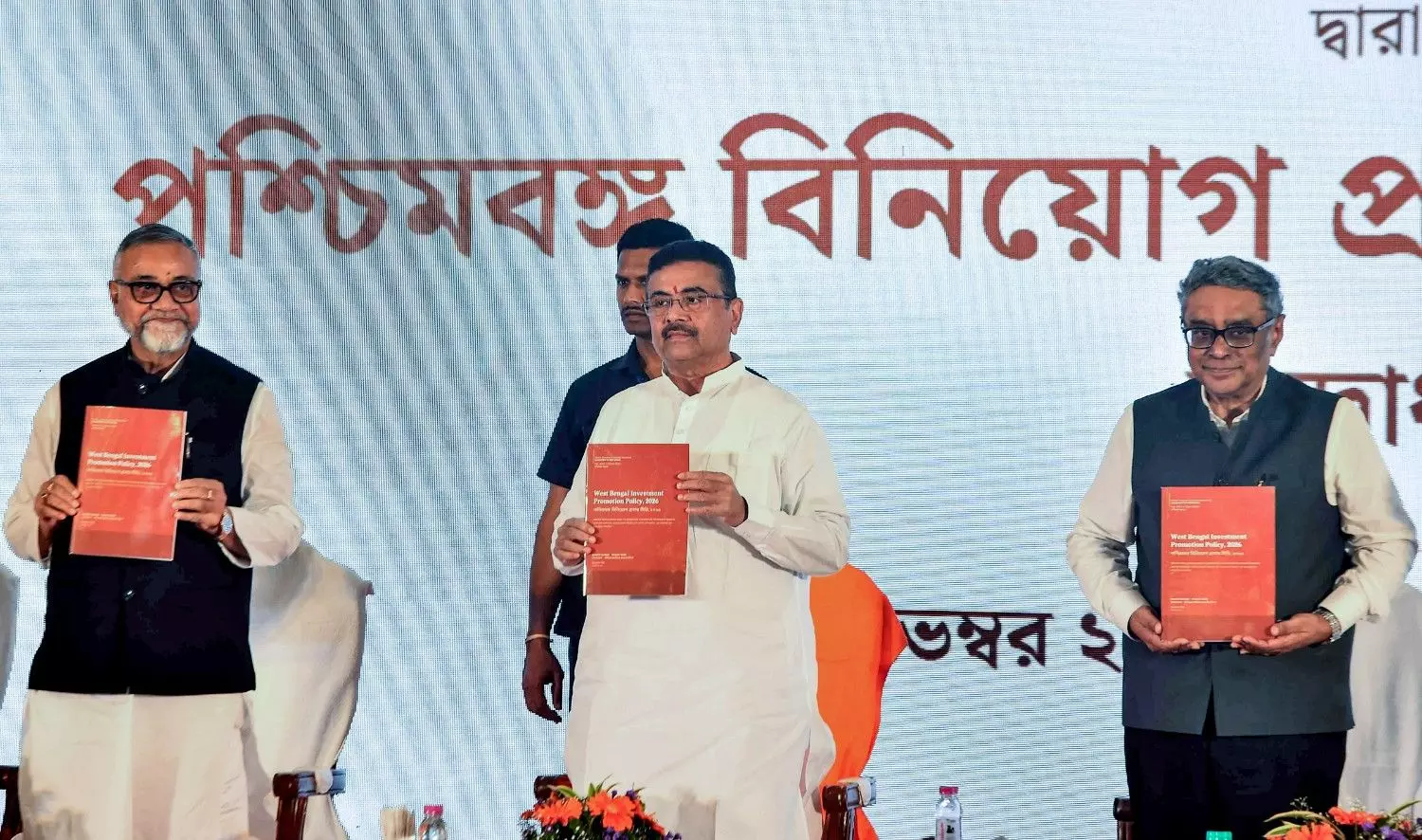
West Bengal Chief Minister Suvendu Adhikari (centre) during the unveiling of the investment promotion policy, in Kolkata, Thursday, November 5. PTI
Bengal's new industrial land policy faces test over tribal rights, environmental concerns
A massive rally was held at Patharkata in Manbazar on November 2, with tribal organisations protesting against the establishment of industries without adequate protection for tribal rights over land, forests and water.

The BJP government's industrial land procurement strategy under the West Bengal Investment Promotion Policy 2026 could face an early test in the tribal heartland of Purulia, where concerns over tribal land rights and environmental degradation have already triggered protests.
Even before the new policy was unveiled on Thursday (November 5), Opposition had emerged in Purulia over industrial projects, alongside concerns about the environmental impact of proposed mineral extraction, including rare earths.
Tribal organisations protest
A massive rally was held at Patharkata in Manbazar on November 2, with tribal organisations protesting against the establishment of industries without adequate protection for tribal rights over land, forests and water.
They were particularly concerned about proposed sponge-iron plants at Hurra and Durmut in Raghunathpur-I block, citing their potential impact on nearby tribal settlements.
Also read: Why Bengalis eat a dish of 14 seasonal greens, or Choddo Shaak, on the eve of Kali Puja
The project had separately faced protests over alleged shortcomings in the environmental public hearing, with residents raising concerns about inadequate publicity, access to project information and the area's existing pollution burden.
Apprehensions over mineral extraction in the district also prompted tribal mobilisation.
What tribal leader said
Ratanlal Hansda, a leader of the Bharat Jakat Majhi Pargana Mahal, a traditional Adivasi organisation that represents tribal communities and their customary village institutions, said tribal land had for years been acquired without adequate regard for local residents' concerns over their rights.
This traditional body is spearheading the protest.
He alleged that similar attempts were being made to establish mineral-based industries in tribal areas, overlooking concerns about pollution and displacement.
The discovery of rare earth deposits in the district, he warned, could intensify pressure on tribal land and livelihoods.
Hansda said the November 2 rally was intended to convey these concerns to the government through a peaceful demonstration, and the organisations are now awaiting the government's response before deciding on their future course of action.
Around 20 tribal organisations took part in the rally, which was attended by thousands of people.
The Geological Survey of India has estimated 0.67 million tonnes of rare-earth-bearing material, with a grade of 0.19 per cent, in the Kalapathar-Raghudih block.
Also read: Abhishek Banerjee alleges BJP attack on his Kolkata home, ‘part of conspiracy to kill me’
The Beku Rare Metal Block in Jhalda-II contains an estimated 1.78 lakh tonnes of ore, with caesium, lithium and rubidium accounting for a combined metal content of about 0.81 per cent.
Buying land directly from owners
As these proposed projects and mineral deposits have raised concerns among tribal organisations about their environmental impact and implications for local communities, attention has turned to whether the government's new land policy can address such concerns while overcoming West Bengal's longstanding difficulty in assembling land for industrial projects.
To facilitate industrial land procurement, the Suvendu Adhikari government’s new policy envisages buying land directly from owners, marking a shift from the TMC government’s approach of relying on private land purchases by investors rather than state-led acquisition.
The policy also emphasises recovering unused industrial plots allotted to companies while also exploring land pooling to consolidate fragmented holdings for industrial use.
The TMC government's policy to leave land procurement largely to investors proved a major hurdle to industrial expansion.
With landholdings in the state fragmented into small parcels, companies found it difficult to negotiate with numerous individual owners and assemble large, contiguous plots required for industrial projects.
CM rules out forcible land acquisition
Invoking the political lessons of Singur and Nandigram, Adhikari ruled out forcible land acquisition and said his government was exploring a land-pooling model under which landowners would receive 25-30 per cent of the developed land and shares in industries set up on the pooled plots.
Also read: Can AI end paddy procurement disputes in West Bengal? Farmers, millers divided
A senior government official said the new government was working on a more attractive compensation package than the previous TMC government's arrangement, which offered 1.5 times the market rate.
However, the detailed terms and implementation mechanisms are yet to be announced.
The government's move to take a more active role in securing land for industry and offer landowners better returns may not, by itself, overcome the inherent difficulties of industrial land procurement, experts cautioned, however.
Amal Sarkar, a political commentator and author of the Bengali book Jamir Ulat Puran (The Reversed Saga of Land), which chronicles the land movements that led to the ouster of the Left Front government, while welcoming the state's intention to facilitate industrial access to land, warned that models adopted in Haryana, Andhra Pradesh and Uttar Pradesh might not work equally well in Bengal.
With a population density of 1,127 people per square kilometre, Bengal has little surplus non-agricultural land for large projects.
Its average operational landholding is only 0.77 hectares, according to the state agriculture department, making it difficult to bring together contiguous plots without negotiating with numerous owners.
How will govt arrange funds?
Referring to the land-pooling model being explored by the West Bengal government, Sarkar said even an arrangement along the lines of Andhra Pradesh's could prove difficult to implement in Bengal.
Under the Amaravati scheme, landowners voluntarily pool land in return for developed residential and commercial plots, annuity and other benefits.
Sarkar said Bengal's fragmented holdings could require pooling considerably more land than a project needs to provide developed plots to all participating owners.
Development costs and compensation could also be substantial. “Where will the government find so much land and money?” he asked.
How the state would finance such an exercise is particularly pertinent. According to official sources, the state government is exploring funding arrangements with HUDCO, NABARD and the Asian Development Bank to finance land purchases and build a land bank.
The state has a debt burden of around Rs 8 lakh crore, while outstanding industrial incentive liabilities are estimated at Rs 50,000 crore.
Deep emotional attachment to land
Beyond these constraints, the government would also have to contend with concerns over land rights and the deep emotional attachment of communities to their land.
Even the ability to offer lucrative compensation packages may not be enough to secure land for industrial projects, Hansda cautioned.
“Adequate compensation is welcome, but it would be too optimistic to expect tribal people to give up their land merely for a lucrative package. Proper public hearings are essential, whether the land is acquired by the government or a private party. Tribal communities have a deep attachment to nature, and access to natural resources at any resettlement site is equally important. They would not accept environmental degradation,” he said, flagging the challenges the government could face in implementing its new policy.
Industry bodies had previously called for measures to improve industrial land availability.
The Bengal Chamber of Commerce and Industry recommended unlocking unused land held by public sector undertakings (PSUs), while the Confederation of Indian Industry (CII) proposed a GIS-enabled land bank to help investors identify available plots. The Bharat Chamber of Commerce, meanwhile, stressed transparent land administration and integrated industrial hubs.
The new policy addresses several of these demands. It proposes a GIS-based inventory detailing land ownership, plot size, permitted use, connectivity and available utilities.
The proposal to unlock unused PSU land has also found a place in the policy, with the government planning to recover idle industrial plots and identifying more than 5,000 acres of unused land belonging to central PSUs for possible inclusion in the land bank.
Congress leader questions new policy
However, economist and Congress leader Prasenjit Bose questioned whether the new policy marked a substantive departure from the previous government's approach.
He described it as a rehash of the TMC government's failed policy, with some modifications but no fundamental rethink.
The previous government, too, had claimed to have a land bank, but this had failed to attract private investment, he pointed out.
The government should first publish a white paper detailing how much land was available to investors and how much it actually held in its land bank, he added.
The question of how much land the government can actually make available is also linked to the practical difficulties of converting land-bank proposals into investment-ready plots, said political commentator and Commonwealth Fellow Debasish Chakrabarti.
“The policy has addressed some longstanding concerns over industrial land availability, but translating these proposals into investment-ready land will require more than administrative reforms,” he added, pointing to the financial constraints, fragmented landholdings and competing claims over land rights that the government would have to contend with, particularly in areas where industrial expansion has already triggered local resistance.