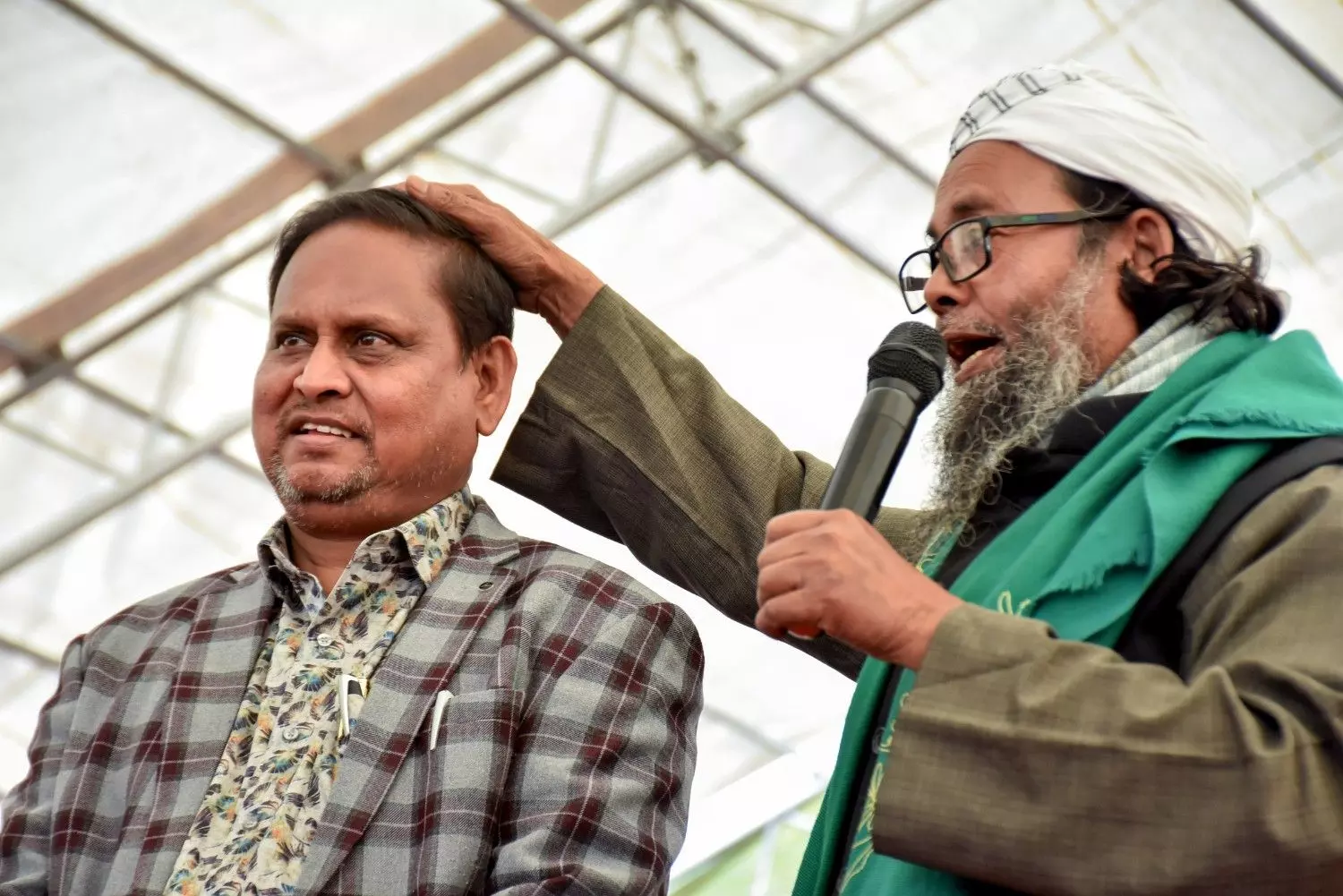
West Bengal MLA Humayun Kabir (left) during a public meeting in the state’s Mursidabad district after he floated a new outfit, Janata Unnayan Party, on December 22, 2025. Photo: PTI
More Humayun Kabirs, more votes? The curious case of rebel Bengal MLA
Disgruntled Bengal MLA launches new party, fields namesake candidates

In Bengal politics, names suddenly matter more than ever.
The ruling Trinamool Congress's (TMC) suspended MLA from Bharatpur, Humayun Kabir, on Monday (December 22) launched his own party in West Bengal's Murshidabad district, christening it the Janata Unnayan Party.
Four 'Humayun Kabirs' out of nine in list
More than the party’s name, what attracted attention was the presence of several candidates named ‘Humayun Kabir’ in the first list for the state's 2026 Assembly elections that was announced on the occasion. Out of the nine names in the initial list, four were ‘Humayun Kabir’, giving a dramatic political twist to the Shakespearean adage, ‘What’s in a name?’”
Also read: Modi dodges Matua citizenship issue in virtual Bengal rally
Kabir seems to believe that in politics, a name can be luck, strategy, and a ticket to victory, all at once.
The controversial legislator himself will contest from Bharatpur and Rejinagar, while a businessman Humayun Kabir will fight it out in Bhagawangola, a doctor Humayun Kabir will contest Raninagar, and yet another Humayun Kabir has expressed his desire to contest elsewhere. All these constituencies are located in the Murshidabad district.
The Kabir, who got the nomination from Raninagar, had also been a candidate for the TMC in the 2016 Assembly elections but failed to win.
Asked why the same name appears repeatedly, the party boss simply told The Federal over the phone, “Humayun Kabir means lucky.”
Also read: Bengal SIR: CM seat sees nearly 4 times more voter deletions than Opposition leader's base
More Humayun Kabirs, more luck, or at least that appears to be the underlying idea. But there is more than meets the eye.
The multiple candidates named 'Humayun Kabir' are part of a broader strategy that blends symbolism with pragmatism.
'Personal brand recognition'
“It is not just about confusing voters at the ballot box. It is about projecting an image of dominance and personal brand recognition,” political commentator and writer Md Saduddin said, underlining the almost theatrical element of Kabir's electoral strategy.
Kabir said he is aiming to win at least 90 seats in the 2026 Assembly elections to emerge at least as a “kingmaker.”
According to him, if either the TMC or the Bharatiya Janata Party secures a simple majority, they would block his plans, including the contentious proposal to build a mosque named after the founder of the Mughal Empire – Babur — in Beldanga, Murshidabad.
Also read: Modi dodges Matua citizenship issue in virtual Bengal rally
Kabir also released his party’s manifesto and unveiled the party flag, a striking combination of yellow, green, and white.
Also read: Humayun Kabir lays foundation of Babri Masjid replica in Murshidabad
The leader's growing differences with the TMC leadership over the past year saw him openly criticising the party for ignoring local issues and sidelining grassroots leaders, especially in the minority-dominated districts of Murshidabad, Malda, and North Dinajpur.
The mosque’s recent foundation-stone ceremony in Beldanga, which he carried out despite warnings, became the final straw for the party, leading to his suspension.
Yet, Kabir turned that suspension into a public launch pad for his new party, signalling that he intends to be a disruptive force in Bengal politics.
Hindu candidates fielded too
While the party is largely seen as a minority-focused platform, Kabir has also fielded Hindu candidates such as Manisha Pandey from Murshidabad and Nisha Chattopadhyay from Ballygunge, signalling a broader attempt to project inclusivity and attract wider support.
Also read: Humayun Kabir’s Babri Masjid plan risks reversing Muslims’ hard-won restraint
This move indicates Kabir is aiming to balance communal and cross-community appeal in an otherwise polarised political landscape.
Kabir’s timing may also be strategic. Although the next state Assembly elections are still a few months away, releasing the first list of candidates allows him to consolidate supporters, organise candidates, and generate media attention well before the campaigns officially begin.