







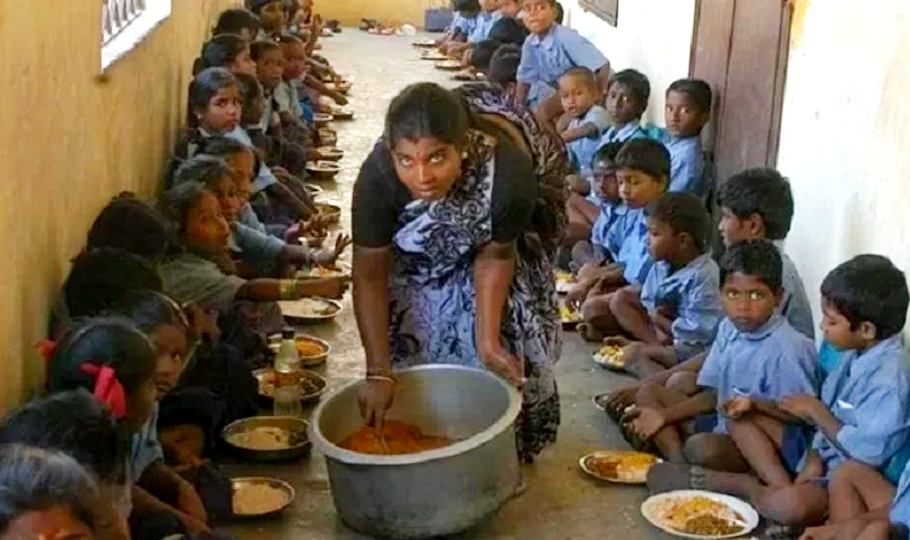
Eggless mid-day meals: Bengal BJP government faces first major cultural storm
A pilot scheme outsourcing school lunch preparation to ISKCON triggers opposition protests over the alleged imposition of vegetarianism on children

The West Bengal government's decision to remove eggs from the mid-day meal scheme by introducing ISKCON-cooked vegetarian meals in Kolkata has ignited a political and social debate, with opponents accusing the ruling Bharatiya Janata Party (BJP) of attempting to impose vegetarianism on students under the guise of reform.
The proposal was unveiled by the state's finance minister, Swapan Dasgupta, while presenting the Suvendu Adhikari-led government's first Budget in the Assembly on Monday (June 22). Under the new policy, ISKCON (International Society for Krishna Consciousness) will prepare and supply cooked meals to schools in the Kolkata Municipal Corporation (KMC) area through a pilot project that excludes eggs from the menu.
Also read: Why Bengal’s trend of ‘egg justice’ may not be as harmless as it looks
The controversial decision has even given birth to a new term in Bengal’s political discussions – “Dimocracy” (dim in Bengali means egg).
While the government has substantially increased the material cost allocation for primary school meals from Rs 6.78 to Rs 10 per student, critics argue that the nutritional gains may be undermined by the removal of eggs, long considered a key source of protein for children. Implementation of the programme is expected to begin within the next one to two months after ISKCON establishes the necessary kitchen and logistics infrastructure.
Govt defends vegetarian menu
Chief Minister Adhikari defended the move in the Assembly, dismissing concerns over the involvement of a religious organisation in a government welfare scheme.
"We are giving the responsibility of cooking mid-day meals to ISKCON. You will get good and pure food," he said.
Also Read: Rahul slams Modi, MP CM over mid-day meals served on newspapers in Sheopur school
State School Education Minister Dipak Barman also rejected the argument that eggs are indispensable for children's nutrition. According to him, a well-planned vegetarian diet can provide all essential nutrients needed for physical growth and development.
Papiya Adhikari, a BJP MLA, also refuted the allegations saying the opposition was protesting for the sake of it, a Bengali news outlet reported. She said earlier, mid-day meal food was served in unhygienic ways and drastic improvements in quality would be seen under ISKCON.
The BJP has described the initiative as a reform aimed at improving hygiene, food quality, and efficiency in meal preparation.
Opposition alleges cultural imposition
The opposition, however, has launched a sharp attack on the government, with both factions of the Trinamool Congress criticising the move. Leader of the Opposition Ritabrata Banerjee argued that animal protein has traditionally been part of Bengali diets and warned that replacing eggs with a strictly vegetarian menu would be inconsistent with Bengal's food culture.
Also Read: TN mid-day meals: Nutrition is paramount, says judge as activists oppose centralised kitchen idea
TMC Rajya Sabha MP Derek O'Brien accused the BJP of pursuing an ideological agenda, alleging that the move amounted to imposing vegetarianism on schoolchildren.
The controversy also revives a major political issue from the recent Assembly elections, when the TMC accused the BJP of seeking to alter Bengal's food habits and cultural identity. The BJP had strongly denied those allegations at the time.
ISKCON cites experience, educators raise concerns
Responding to the criticism, ISKCON vice-president Radharaman Das said the organisation already serves mid-day meals to nearly 12 lakh students across more than 20 cities in eight states. He maintained that the proposed menu, which could include rice, dal, khichdi, vegetables, soya chunks, and rajma, would meet nutritional requirements while accommodating local tastes.
He also said in the early 2010s, his organisation served midday meals in schools of north Kolkata under Shashi Panja, a key minister of then then TMC government, NDTV reported.
However, several educators remain unconvinced. Debabrata Panti, headmaster of a primary school in Maheshtala, Kolkata, said eggs were among the most popular items under the scheme and often boosted student attendance on the days they were served.
Also Read: Tamil Nadu’s new breakfast scheme pushing up school attendance: Report
Teachers have also expressed concern that introducing unfamiliar food items may reduce acceptance among students and parents. Some have questioned whether the policy prioritises changing food habits over improving nutrition.
Others fear the move could affect local women employed as cooks under the existing decentralised system, potentially threatening a modest but important source of income for thousands of workers if the model is expanded beyond Kolkata.