ABVP finds footing in Jadavpur varsity, eyes Bengal campuses after BJP’s win
As party seeks stronger foothold to strengthen organisation across Bengal, ABVP aims to enrol 10L students across state by December, including 2L in Kolkata alone

Until this week, Avishek Patra, an engineering student in the architecture department at Jadavpur University, had never been associated with student politics.
He enrolled as a member of the RSS-affiliated Akhil Bharatiya Vidyarthi Parishad (ABVP) only a day earlier (July 14), a decision he said would have been difficult to imagine until recently.
“Earlier, the campus was almost entirely dominated by the extreme Left. Students with different political views hardly had any space to organise or even express themselves," said Patra, who joined the university last year. “Now, after the change in the government, the ABVP's presence has started becoming visible.”
ABVP asserts itself as Left leaves
The sentiment was echoed by Tapan Das, a PhD scholar in comparative literature, who said he had long identified with the ABVP's ideology but chose to remain on the sidelines.
“I believed in the organisation's ideas, but I was never actively involved because there was always a fear whenever the ABVP tried to organise a programme,” Das said. “The atmosphere has changed after the political transition. We can now function much more openly."
Also read: What Subhasgram church attack reveals about Bengal's political crossroads
Another student, Subhajit Saha, said the organisation's growing visibility was evident on campus.
“There are more meetings, more students enrolling and greater discussion around the ABVP than before. Students are fed up with the corruption and the stranglehold of the SFI and other Left organisations. Earlier, many were reluctant to express their political preferences openly. Now there is a greater sense of openness, and more students are joining us," said Saha, an ABVP functionary at the university.
Mega membership drive
For decades regarded as one of the Left's most influential ideological strongholds, Jadavpur University rarely figured in the BJP's organisational landscape.
The growing visibility of the ABVP at the university appears to be part of a wider effort by the organisation to expand its footprint across educational institutions in West Bengal.
Until recently, the ABVP's organisational presence in West Bengal was largely confined to districts where the BJP had made electoral gains, particularly in north Bengal and western districts such as Purulia and Bankura.
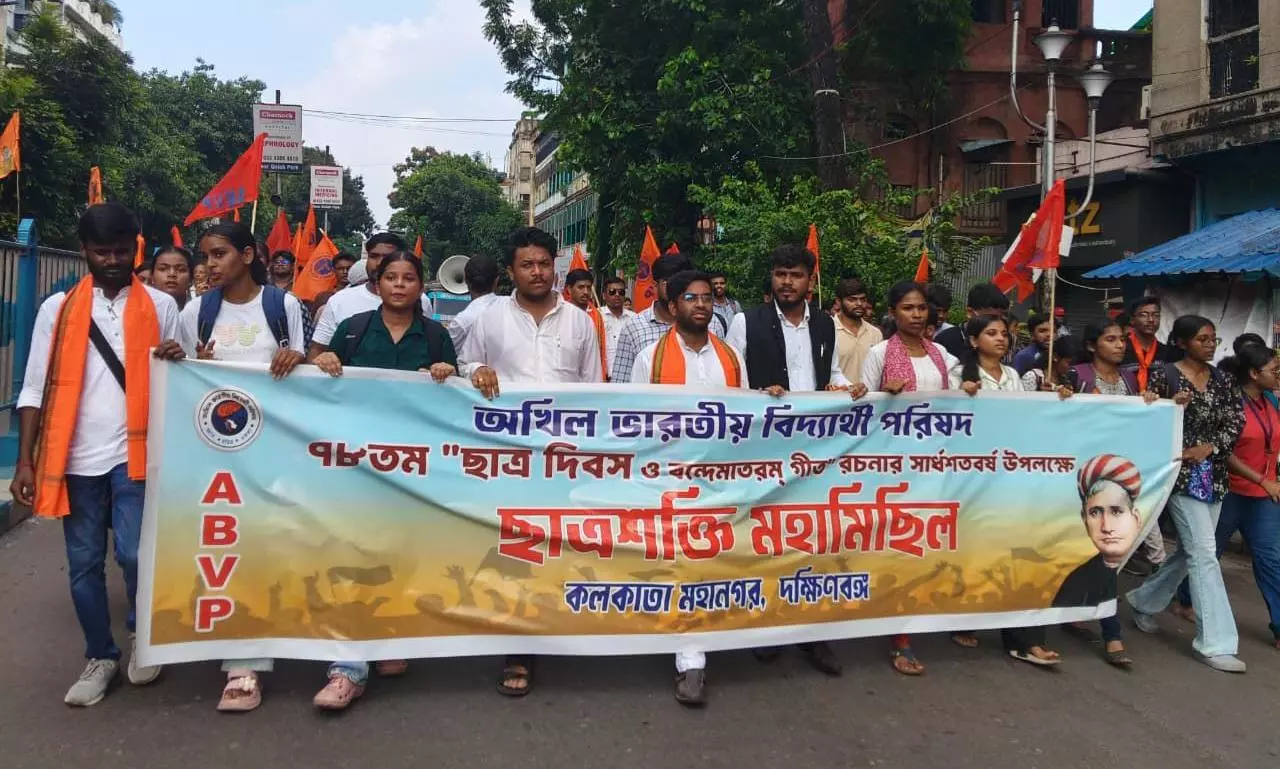
The organisation has started a state-wide membership drive on July 9. On Tuesday (July 14), the organisation sought to showcase that expansion by bringing thousands of students from colleges and universities across Kolkata to a rally and convention on College Street to mark its 78th Foundation Day.
Also read: Bengal BJP govt’s renaming drive sparks row over history and public memory
"We received an overwhelming response. More than 10,000 students from the Kolkata region participated in the programme," said Ananta Barui, the ABVP's West Bengal media in-charge.
Barui said the organisation had launched a campaign to enrol 10 lakh students across West Bengal by December, including a target of two lakh members in Kolkata alone.
‘More students join as threat culture ends’
Between July 9 and July 14, he claimed, the ABVP had already enrolled more than 2.5 lakh students across the state. The organisation had around 75,000 members in West Bengal until last year.
"Many students were reluctant to associate with the ABVP because of the threat culture created by supporters of the previous ruling party. That hesitation has begun to disappear after the political change," Barui told The Federal.
He added that the ABVP currently has organisational units in around 100 colleges and universities and aims to expand that network to more than 500 campuses.
The parishad has also renewed its demand for the immediate revival of democratic student union elections in colleges and universities across West Bengal.
Call for student union polls
Student union elections have not been held regularly in most universities and colleges for years. As a result, student organisations have largely been confined to membership drives, protests and campus campaigns rather than electoral contests.
Barui said a key focus of the expansion was universities in Kolkata and its suburbs.
Also read: Why Bengal’s oft-cited cultural supremacy might be on a decline
Until recently, the ABVP's organisational presence in West Bengal was largely confined to districts where the BJP had made electoral gains, particularly in north Bengal and western districts such as Purulia and Bankura.
The current drive marks a shift towards campuses in and around Kolkata, institutions that had long been regarded as Left strongholds before coming under the influence of the Trinamool Chhatra Parishad (TMCP).
The BJP's organisational push stems from the fact that, despite winning power, many of the institutions that have traditionally sustained governments in West Bengal remain outside its political influence.
Addressing the convention, ABVP national general secretary Virendra Singh Solanki said the BJP's victory in West Bengal had created "an opportunity for positive transformation in the education sector" and that the organisation would work to build educational institutions into centres of academic excellence and expand its engagement with students across the state.
Much beyond BJP’s grasp
The push on campuses is only one part of the BJP's bid to strengthen its organisation across the state after ending the Trinamool Congress's 15-year rule in West Bengal.
The party is also seeking a stronger foothold in panchayats still dominated by the TMC and welcoming defections in municipalities.
The BJP's organisational push stems from the fact that, despite winning power, many of the institutions that have traditionally sustained governments in West Bengal remain outside its political influence.
Also read: Bengal heist: How BJP captured the state by hollowing out democracy
When the Left Front came to power in 1977, it was backed by a vast network of student unions, trade unions, teachers' bodies, peasant organisations and local committees.
After defeating the Left in 2011, the TMC gradually built its own organisational network through panchayats, municipalities, neighbourhood clubs and the TMCP.
Behind BJP’s campus push
Winning the assembly election has given the BJP control of the government, but much of the state's grassroots political machinery remains outside its influence. That is the gap the party is now trying to bridge.
"In West Bengal, universities have long been more than centres of higher education. They have served as incubators of political leadership, ideological debate and grassroots mobilisation," said political columnist and Commonwealth Fellow Debashis Chakrabarti, explaining the significance of the ABVP's campus push.
"Student movements in the state have often shaped wider political developments, while student unions have produced generations of legislators, ministers, party organisers and ideological cadres," he added. "That explains why campuses have remained politically significant across successive governments."
Will there be compromises?
Jadavpur University professor Manajit Mandal, who has been associated with the TMC, said the ABVP's visibility on campuses had increased. He said it is something that was expected after the BJP came to power in the state.
Also read: Whose Martyrs' Day is it anyway? Bitter battle to claim Bengal's July 21 legacy
"But more important than which organisation gains control of the campus is whether the university can maintain a healthy academic atmosphere," he said. "That will become clear only when the long-pending student union elections are finally held."
Whether the ABVP's growing membership reflects a lasting ideological shift or simply the changed political climate, however, may become clear only when student union elections are eventually held.