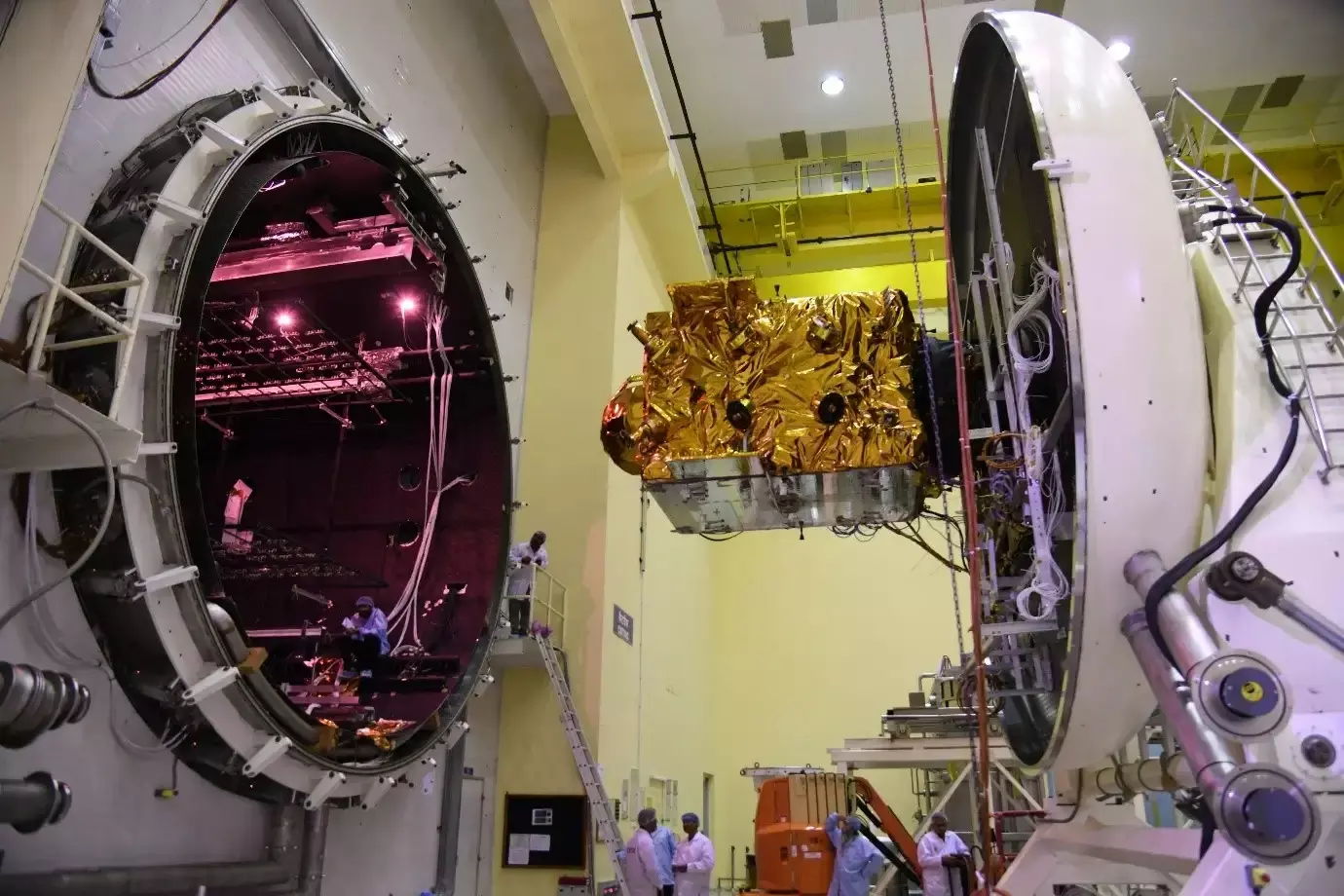
NVS-02 loading to Comprehensive Assembly and Test Thermo-Vacuum chamber (CATVAC) for thermovac test. File photo: ISRO
ISRO's dilemma: Should NVS-03 satellite go with open or closed pyro valve?
Not wanting to risk failure similar to the NVS-02 satellite, ISRO is looking at the option of flying the satellite with its pyro valve open, sources say

Should India's NVS-03 navigation satellite be launched with its pyro valve open or closed?
That is the question currently being debated among experts in the Indian Space Research Organisation (ISRO), with the satellite being the third of the second-generation navigation satellites, multiple sources told The Federal.
Not wanting to risk another failure, similar to NVS-02 satellite, ISRO is looking at the option of flying the satellite with its pyro valve open, sources said.
Also read: World Space Week 2026: How Rocket Revolution is reshaping exploration
Studies are being conducted to assess the possibility of flying NVS-03 with an open pyro valve. Based on the results, sources in ISRO told The Federal that a decision will be made on whether the satellite should be launched in that configuration.
Apex committee recommendations
The question is significant because of what happened to NVS-02, the second satellite in the second-generation series last year.
After the NVS-02 failure, ISRO said an Apex Committee had recommended measures to enhance the redundancy and reliability of pyro-system operations. The space agency subsequently said that all corrective actions had been implemented in the CMS-03 spacecraft and that its pyro systems performed satisfactorily.
If ISRO has already implemented corrective measures for the pyro system, why is an open-valve configuration being considered for NVS-03, is the question that some experts posed to The Federal.
Some space technology experts believe ISRO should stick to its time-tested practice of launching satellites with a closed pyro valve rather than risk a mission by keeping it open.
Also read: Medicine Nobel 2026 goes to 3 scientists for breakthroughs in brain cell control
They are concerned that an open pyro valve could increase dependence on the downstream Isolation Latch Valve and raise questions about leakage, vibration and pressure conditions during the high vibrations experienced by the rocket during ascent.
In February 2026, ISRO said the disengagement of at least one contact in both the main and redundant paths of a connector had led to the failure of NVS-02.
"With an open pyro valve, the leaked gas/fuel will be at the Isolation Latch Valve, which also faces the leak risk," a space sector expert told The Federal on the condition of anonymity.
"If the latch valve doesn’t open in space, then the mission will be a failure," the expert added.
The NVS-02 shadow
NVS-02 was launched on January 29, 2025, aboard the Geosynchronous Satellite Launch Vehicle (GSLV-F15). The 2,250-kg satellite was placed in Geosynchronous Transfer Orbit (GTO) but could not raise itself to its designated geostationary orbit because the required oxidiser flow to the engine was not established.
The orbit-raising failure occurred because the drive signal did not reach the pyro valve of the oxidiser line of the engine.
In February 2026, ISRO said the disengagement of at least one contact in both the main and redundant paths of a connector had led to the failure of NVS-02.
Also read: How ISRO’s AstroSat space observatory has transformed our understanding of the universe in 11 years
ISRO said an Apex Committee constituted to review the incident concluded that “the most likely cause for the observation is the disengagement of at least one contact (in each of the main and redundant paths) of the connector.”
"It seems both Main and Redundant command signal lines were passed through a single connector instead of two separate connectors as the normal practice. Main and Redundant signals never share a common connector," a retired ISRO senior official told The Federal, preferring anonymity.
Soon after it became known that the satellite's oxidiser flow had been blocked, experts had pointed out to this writer that a faulty electrical connector could be the possible cause.
Weighing 2,250 kg, NVS-02 remained stranded in GTO because the failure to establish oxidiser flow prevented the liquid apogee motor (LAM) from carrying out the required orbit-raising manoeuvre.
Retired ISRO officials described the incident as an unprecedented failure for the agency, which has successfully orbited numerous Earth observation and communication satellites.
Notably, NVS-02 was carried on the 100th rocket launched from the Sriharikota spaceport.
ISRO has not explained how the contacts in both the primary and redundant paths became disengaged.
However, ISRO had said: "The committee has provided a set of recommendations aimed at enhancing the redundancy and reliability of pyro system operations for future missions. In line with these recommendations, all the corrective actions were successfully implemented in CMS-03 spacecraft launched on November 2, 2025, by LVM-3 M5, and the pyro systems performed satisfactorily, placing the satellite in the intended orbit. Further, this set of recommendations will be followed for all future missions, as applicable.”
Pyro valve vs latch valve
In a satellite, a pyrotechnic valve (pyro valve) is a one-time-use valve. It contains a small pyrotechnic actuator that, when electrically fired, opens the flow passage.
"Pyro valve by definition is a closed valve which opens one time with pyro action and remains open thereafter. So what they may be looking at is a normal valve with latch in place of pyro valve," another satellite expert told The Federal.
Experts having reservations on an open-valve configuration are concerned that flying a satellite with the pyro valve already open points to the possibility of leakage or other problems under launch vibration and changing pressure conditions.
Once the pyro valve is opened, propellant/oxidiser can flow through the downstream propulsion system, including any latch valve provided in that flow path.
A pyro valve is commonly used when a spacecraft needs a highly reliable, positive isolation or release of oxidiser or fuel during a particular stage of the mission.
Prior to and during launch, the valve keeps the propellant or gas isolated. At the appropriate command, the pyrotechnic device operates the valve and establishes the flow path.
As said earlier, once the pyro valve is opened, it cannot be closed again.
A latch valve, on the other hand, can be electrically commanded open or closed and can control the flow path during satellite operations.
Why ISRO is taking another look
The NVS-02 failure has therefore forced attention on the configuration of the propulsion system for NVS-03.
Experts having reservations on an open-valve configuration are concerned that flying a satellite with the pyro valve already open points to the possibility of leakage or other problems under launch vibration and changing pressure conditions.
The question is not simply whether a pyro valve can be opened before launch. It is whether the alternative configuration provides an adequate level of reliability throughout the launch and subsequent operation of the spacecraft.
‘Several hundred crore rupees at stake’
Speaking about the NVS-03 satellite, a space industry expert, who preferred anonymity, told The Federal: “With several hundred crore rupees at stake, it is better for ISRO to be late than sorry. ISRO can replace the existing pyro valves if they belong to the batch used on NVS-02 with new ones. It is not just the rocket and satellite that are at stake, but also the nation’s security.”
The expert also expressed concern that other missions, including Gaganyaan and the Technology Demonstrator, could face similar risks if the same type of pyro-valve configuration is retained.
The issue is particularly sensitive because NavIC is not merely another satellite programme. It is a strategic navigation system intended to provide positioning, navigation and timing services for India.
NavIC's shrinking constellation
Originally known as the Indian Regional Navigation Satellite System (IRNSS), the system was renamed as Navigation with Indian Constellation (NavIC). It was designed to provide accurate PNT services across India and up to 1,500 km beyond its borders.
Its Standard Positioning Service (SPS) offers accuracy better than 20 metres and timing precision within 40 nanoseconds.
The original NavIC architecture required seven satellites — three in geostationary orbit and four in inclined geosynchronous orbit.
Given the series of failures of NavIC satellites, replacement launches have not kept pace with the need.
It may take another 15-18 months for India to partially augment its severely depleted strategic satellite constellation NavIC, it is surmised after reading a Parliamentary Committee report that was submitted recently.
The Department-Related Parliamentary Standing Committee on Science and Technology, Environment, Forests and Climate Change gave its report on the Demands for Grants for the year 2026-27. The report was presented to the Rajya Sabha and laid on the table of the Lok Sabha on March 25, 2026.
“The replacement satellites NVS-03, NVS-04, and NVS-05 will be launched over the next 15-18 months,” the report notes.
Of the 11 navigation satellites launched so far by India, only three — IRNSS-1B, IRNSS-1I, and NVS-01 — are currently capable of providing position, navigation, and timing (PNT) services, and even these are not consistently reliable.
An ageing constellation
The situation is further complicated by ageing hardware.
IRNSS-1B, launched in 2014, has exceeded its 10-year mission life, while IRNSS-1I, launched in 2018, is approaching the same threshold.
On March 13, 2026, ISRO confirmed that IRNSS-1F had completed its mission life, and its onboard atomic clock had failed, though the satellite continues limited operations for messaging services.
While NVS-01, launched in 2023, is operational, NVS-02 encountered a major setback in 2025 and remains stuck in transfer orbit due to propulsion-system issues.
Since the beginning of the NavIC programme, six of the 11 satellites launched have encountered failures or major technical problems, with several of the early failures linked to atomic clocks. Despite this, replenishment has been slow and inconsistent.
In its report, the Parliamentary Committee urged India's Department of Space to ensure the timely replacement of non-functional satellites and to adopt appropriate measures for improving the reliability and operational readiness of the NavIC constellation so that this strategic national asset can function at its full potential.
Currently, the NavIC constellation consists of:
Three satellites providing PNT services
Five providing limited messaging applications
One satellite that has been lost
One that has completed its mission life
One — NVS-02 — stranded in geostationary transfer orbit due to technical issues
Why NVS-03 cannot afford to fail
The second-generation NVS series — comprising NVS-01 to NVS-05 — was intended to modernise NavIC with enhanced capabilities, including L1 band signals to improve adoption in consumer devices.
While NVS-01, launched in 2023, is operational, NVS-02 encountered a major setback in 2025 and remains stuck in transfer orbit due to propulsion-system issues.
That makes NVS-03 particularly important.
The decision on whether to launch NVS-03 with an open or closed pyro valve comes against the backdrop of an already depleted navigation constellation, the NVS-02 failure, and the need to replenish NavIC quickly.
For ISRO, the choice is therefore not simply between an open valve and a closed valve. It is about how much risk can be accepted for a strategic satellite when the agency has already identified measures to improve the reliability of pyro-system operations.
ISRO Chairman Dr. V Narayanan did not comment on the issue when contacted.