



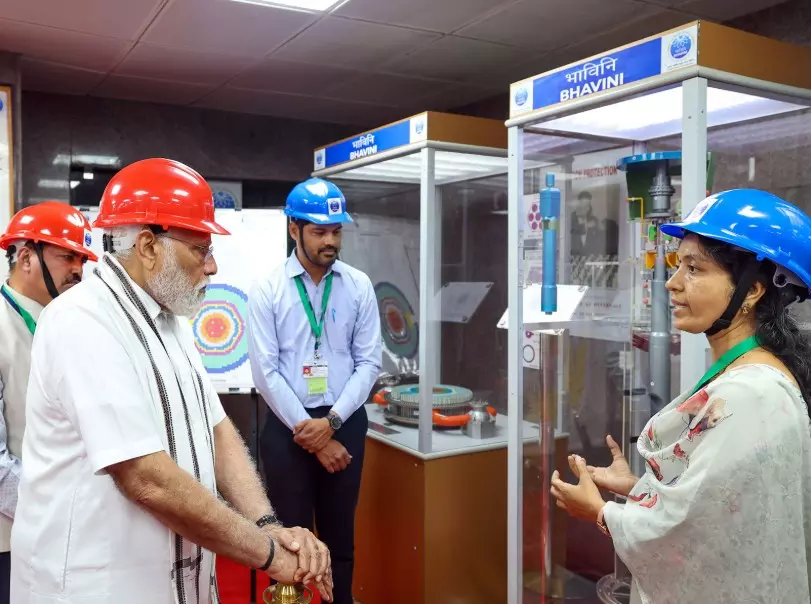
PM Modi said that the achievement is a decisive step towards harnessing India's vast thorium reserves in the third stage of the programme. Screengrab: ANI
India’s fast breeder reactor at Kalpakkam achieves criticality, 'defining step', says PM Modi
The Prototype Fast Breeder Reactor marks a key milestone in India’s three-stage nuclear strategy, bringing the country closer to harnessing its vast thorium reserves.

India has achieved a significant breakthrough in its civil nuclear programme with the Prototype Fast Breeder Reactor (PFBR) at Kalpakkam in Tamil Nadu attaining criticality. With this, the reactor reaches a stage of sustained nuclear fusion chain reaction, which brings it close to attaining full operation.
What PM Modi said
The announcement was made by Narendra Modi on Monday (April 7), stating that the milestone marks a decisive step towards harnessing the country’s large thorium reserves in the third stage of the programme.
Also Read: Safety before production: Minister Jitendra Singh on India's nuclear plants
“Today, India takes a defining step in its civil nuclear journey, advancing the second stage of its nuclear programme. The indigenously designed and built Prototype Fast Breeder Reactor at Kalpakkam has attained criticality. This advanced reactor, capable of producing more fuel than it consumes, reflects the depth of our scientific capability and the strength of our engineering enterprise,” stated PM Modi in a post on X.
“It is a decisive step towards harnessing our vast thorium reserves in the third stage of the programme. A proud moment for India. Congratulations to our scientists and engineers,” he added.
Long development and technical design
The 500 megawatt electric Prototype Fast Breeder Reactor (PFBR), a sodium-cooled system, has taken shape over more than two decades, reflecting the kind of long-gestation effort typical of India’s atomic energy programme.
Its development has drawn on complex fabrication processes and materials handling challenges that have tested both design and execution within the country’s nuclear establishment.
Also Read: Work on 10 more nuclear reactors underway in country, parliamentary panel told
Unlike conventional reactors that largely depend on uranium as fuel, fast breeder reactors operate on a different principle. They use plutonium in the core and are configured to generate more fissile material than they burn, converting uranium-238 into plutonium-239 in the process. This ability to “breed” fuel is what sets them apart from standard reactor designs.
Energy targets and policy direction
The development comes against the backdrop of India’s stated energy transition plans. The government has set a target of expanding nuclear power capacity to 100 gigawatts by 2047, positioning it as a key component of a lower-carbon energy mix.
Also Read: Kalpakkam nuclear reactor: Expert views on concerns, delays
“The Union Budget 2025-26 outlines a significant push towards nuclear energy as part of India's long-term energy transition strategy. The government has set an ambitious target of 100 GW nuclear power capacity by 2047, positioning nuclear energy as a major pillar in India's energy mix,” PM Modi had stated earlier.
“This development aligns with the broader objectives of Viksit Bharat, ensuring energy reliability and reducing dependency on fossil fuels. To achieve this goal, strategic policy interventions and infrastructure investments are being undertaken, with an emphasis on indigenous nuclear technology and public-private collaborations,” he added.