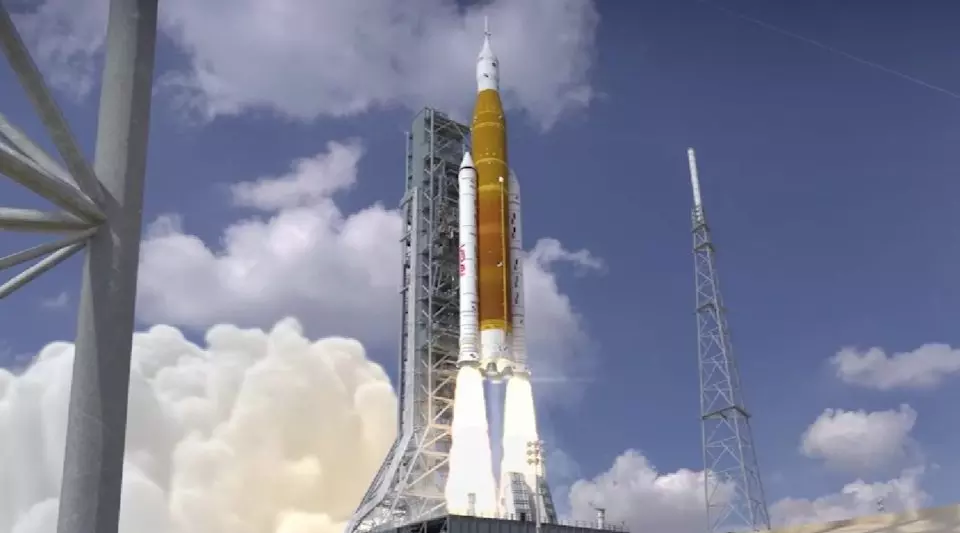
Artemis II mission marks return of humans to Moon’s vicinity after decades
First crewed lunar mission since 1972 will test SLS and Orion, paving the way for future Moon landings and long-term human missions to Mars

The Moon, Earth’s only natural satellite, has long fascinated observers with its waxing and waning phases. Located about 384,000 km from Earth, it is once again at the centre of global space exploration efforts.
NASA is now preparing to send American astronauts to orbit the Moon under its Artemis programme. The mission is scheduled for launch on April 1 at 6:24 pm US time (April 2, 3:54 am IST) from the Kennedy Space Center at Cape Canaveral, Florida.
This will be the first time humans return to the lunar vicinity in 54 years, the last time being in 1972.
Also read | India-US space partnership expands from satellites to Moon, Mars
The goals of this long-term mission include:
* Establishing a permanent human settlement on the Moon.
* Testing the new Space Launch System (SLS) rocket and the Orion spacecraft.
* Using the Moon as a "test bed" for deep space travel, including the first human mission to Mars.
Artemis mission explained
This is NASA's major space initiative, consisting of three main phases:
* Artemis 1: An uncrewed test flight successfully completed in November 2022.
* Artemis 2: Astronauts will orbit the Moon. This mission begins on April 1, 2026.
* Artemis 3: Landing humans on the Moon (planned for 2027).
Why NASA chose ‘Artemis’?
In Greek mythology, Artemis is the twin sister of Apollo and the Goddess of the Moon. NASA chose this name for its new era of lunar exploration and scientific discovery.
Why the South Pole matters
India's Chandrayaan-1 was the first to discover evidence of water ice at the Moon's South Pole. NASA plans to conduct extensive research here because:
* Water: Frozen water exists in deep, dark craters. This can be processed into drinking water.
* Fuel: Water can be split into oxygen (for breathing) and hydrogen (for rocket fuel).
* Power: Some high peaks at the South Pole receive constant sunlight, which is perfect for solar power.
Moon as a gateway to Mars
Scientists believe it is easier to launch missions to Mars from a base on the Moon. Notably, India's Chandrayaan-3 was the first to successfully land a spacecraft in this region. Now, NASA aims to land humans there.
Inside the Artemis II Mission
Four astronauts will travel in the Orion spacecraft for a 10-day journey, covering about 1.1 million km.
Meet the Artemis II Mission
* Reid Wiseman (Commander): A US Navy pilot leading the mission.
* Victor Glover (Pilot): The first Black astronaut to go to the Moon.
* Christina Hammock Koch (Mission Specialist): The first woman to go to the Moon. She already holds the record for the longest single spaceflight by a woman (328 days).
* Jeremy Hansen (Mission Specialist): Representing the Canadian Space Agency (CSA), he is the first non-American to join a lunar mission.
SLS rocket and Orion spacecraft
* SLS rocket: The world’s most powerful rocket, standing 322 feet tall (like a 30-storey building). It generates 8.8 million pounds of thrust—15% more than the legendary Saturn V.
Also read | Chandrayaan-3 reveals new data on electrical environment in Moon’s south pole
* Orion spacecraft: A modern capsule designed for the crew. It features a high-tech heat shield to endure extreme temperatures during re-entry.
Re-entry and splashdown
After 10 days, Orion will re-enter Earth’s atmosphere at 40,000 km/h. Friction will create heat up to 2,760°C. A series of parachutes will slow the craft down to just 30 km/h before it splashes down in the Pacific Ocean near California, where Navy teams will recover the crew.
How astronauts are training
The astronauts have been training for over 18 months:
* Simulations: Practicing how to handle engine failures or communication loss.
* Underwater training: Using giant pools to mimic the weightlessness (microgravity) of space.
* International cooperation: This mission is a global effort involving Europe (ESA), Japan (JAXA), and Canada (CSA).