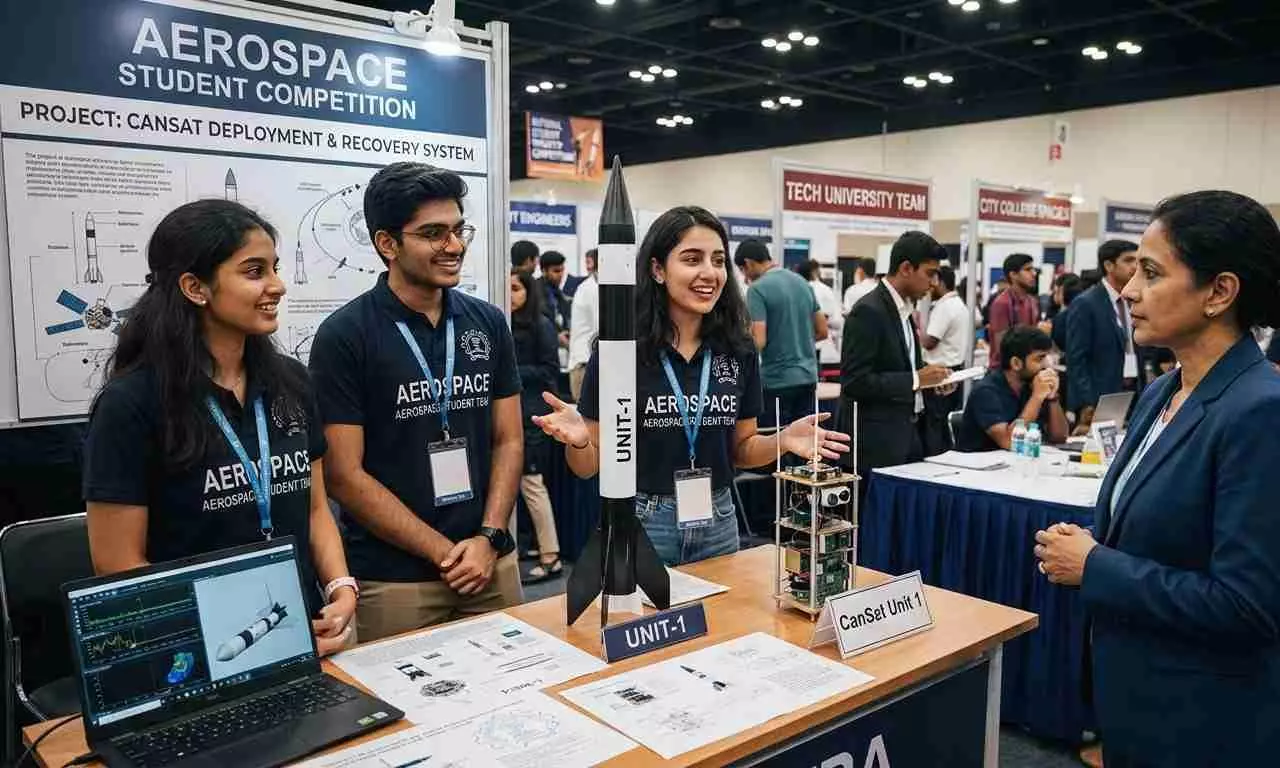
The model rocketry challenge requires teams to launch a rocket carrying a one-kilogram payload to an altitude of one kilometre. AI-generated image for representative purpose
Student teams compete to power India’s space ambitions
Shortlisted from 115 registrations, 77 teams will compete in rocket and miniature satellite challenges in Kushinagar, alongside an employment fair

India’s efforts to build a skilled workforce for its expanding space industry will get a practical test this week, as 77 student teams compete in national rocketry and miniature satellite challenges designed to develop engineering talent and connect graduates with potential employers.
The teams have been shortlisted from 115 registrations for the 2026 IN-SPACe Model Rocketry and CAN-7USAT India Student Competition. The four-day grand finale, known as the Rashtriya Narayani Rocket Cup, will run from October 31 to November 3 at the Narayani Model Rocketry Launch Pad in Pipraghat, Kushinagar, Uttar Pradesh.
Building space skills
Organised by the Indian National Space Promotion and Authorization Centre (IN-SPACe), in association with the Indian Space Research Organisation (ISRO) and the Shrinarayani Science Development Foundation (SSDF), the competition focuses on practical engineering skills relevant to India's space ecosystem.
Also read: World Space Week 2026: How Rocket Revolution is reshaping exploration
The model rocketry challenge requires teams to launch a rocket carrying a one-kilogram payload to an altitude of one kilometre. Participants must demonstrate flight stability, safe payload release and successful recovery, testing their ability to integrate multiple engineering systems under defined mission requirements.
The CAN-7USAT challenge centres on miniature satellite development. Teams must build a can-sized satellite weighing less than one kilogram, equipped with functional power, instrumentation and telemetry systems, as well as controlled-descent capabilities.
Bridging the skills gap
The challenges are intended to bridge the gap between academic engineering and the practical demands of aerospace development. As private companies take on a larger role in India's space sector, the availability of engineers with experience in designing, integrating and operating space systems is becoming an important consideration for industry growth.
IN-SPACe Chairman Pawan Goenka said the competitions allow students to apply engineering knowledge to practical problems, understand mission design and execution, and develop skills relevant to the space sector.
Connecting students with employers
Separate evaluation committees comprising experts from ISRO, IN-SPACe, the Defence Research and Development Organisation (DRDO), academia and the aerospace industry will assess the teams. The committees include former ISRO Associate Directors Roy M. Cherian and Dr. Surendra Pal.
The event will also feature the Antariksh Employment Mela 2026 from November 1 to 3, creating opportunities for participating students to engage with potential employers across launch vehicle technology, satellite manufacturing and aerospace research and development.
Also read: India's first private rocket to place tech payloads, postcard from PM into orbit
The choice of venue reflects an effort to extend access to space-technology initiatives beyond established urban and institutional centres. Shashank Mani Tripathi, the Member of Parliament from Deoria, Uttar Pradesh, said hosting the competition in the region could encourage young people to pursue technical careers and explore applications of space technology in local development.
Growing competition
The 2026 event marks the second edition of the model rocketry competition and the third edition of CAN-7USAT.
IN-SPACe was established in June 2020 as an autonomous agency under the Department of Space to promote, authorise and supervise private-sector participation in India's space industry, including launch vehicles, satellites, space-based services and infrastructure.
The competition brings student engineering projects and employment opportunities into the same setting, offering a potential pathway from academic training to careers in India's space industry.