Capital Beat | RSS registration row: Transparency demand or political battle?
Priyank Kharge's demand for RSS registration and financial disclosures has triggered a sharp debate, with RSS leaders rejecting the move as political

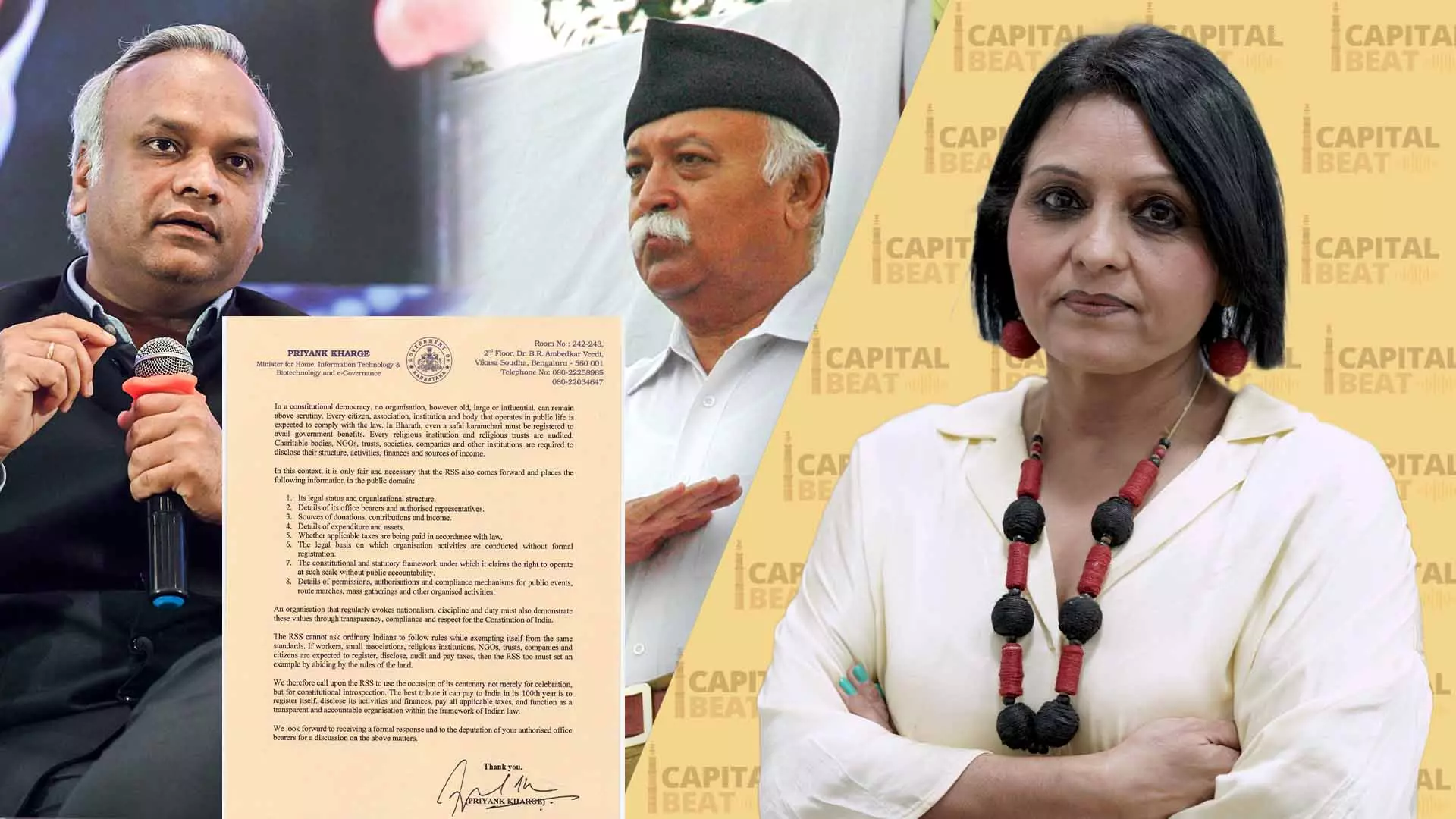
RSS chief Mohan Bhagwat’s refusal to respond formally to Karnataka Home Minister Priyank Kharge’s demand for registration and financial disclosures has intensified a debate over transparency, accountability and the legal status of the Rashtriya Swayamsevak Sangh (RSS).
The controversy erupted after Kharge wrote an open letter asking the RSS to disclose its legal status, organisational structure, sources of income, expenditure, assets and tax compliance details. Bhagwat dismissed the demand as “politics”, arguing that the RSS has functioned openly for nearly a century and has nothing to hide.
In this episode of Capital Beat, The Federal spoke to Dr Ratan Sharda, author and RSS member, and Vivek Deshpande, senior journalist and political commentator, to understand whether the issue is merely political posturing or a larger question about transparency and accountability.
RSS defence
To begin with, Sharda rejected the comparison between the RSS and conventional organisations. He argued that the RSS functions more as a voluntary association and family-like structure than a formal institution.
He said Bhagwat’s reference was to “Hindu dharma” rather than “Hindu religion”, adding that dharma does not fit into a conventional Western understanding of religion. According to him, the RSS similarly cannot be force-fitted into standard organisational categories.
“The RSS is self-financed and volunteer-driven,” Sharda said. “It does not seek government funds. Organisations associated with the RSS that require registration are registered, audited and compliant with legal requirements.”
Also read: RSS chief Mohan Bhagwat backs dialogue with Pakistan, says focus is on people
Sharda maintained that government agencies have repeatedly scrutinised the RSS over the decades and have never found grounds to force registration or prohibit its activities permanently.
Political motive?
Asked whether Kharge’s letter was politically motivated, Sharda argued that successive governments had attempted to target the RSS.
He said information regarding RSS activities, office-bearers and organisational structures is already available publicly through annual meetings and public reports.
According to Sharda, local RSS units obtain permissions wherever required and maintain communication with authorities. He described the current controversy as an attempt to divert attention from governance issues.
“The information is available. Governments have examined the RSS repeatedly. This is political gimmickry,” he said.
Demand for scrutiny
Deshpande disagreed sharply with that assessment. He argued that because Kharge issued the demand in his official capacity as a minister, the matter should be treated seriously.
He said the Congress had historically allowed the RSS to function without adequately questioning its legal status and registration.
Also read: RSS at 100: How Hindu nationalism drew from Mussolini’s fascist model
“If everything is out in the open, then what is the problem with registration?” Deshpande asked. “The refusal to register naturally raises questions.”
According to him, registration would subject the organisation to the same scrutiny that applies to many other entities, including cultural and charitable organisations that do not receive government funding.
Registration debate
Deshpande argued that numerous organisations are required to register and disclose financial details even when they operate independent of government funding.
He questioned why the RSS should be treated differently if it claims to be a normal social organisation.
The journalist also referred to historical debates around the RSS constitution following the assassination of Mahatma Gandhi, noting that the organisation adopted a written constitution that affirmed allegiance to the Constitution of India.
For Deshpande, the key issue is consistency. If other organisations must comply with disclosure and registration requirements, he argued, similar standards should apply to the RSS.
Possible action
On whether Karnataka could take punitive action, Deshpande said the first step would be determining whether existing laws require an organisation such as the RSS to register.
He argued that authorities would have to define the RSS’s legal status before pursuing any enforcement action.
Also read: RSS doesn't practice Hindutva politics, believes in nation building: Mohan Bhagwat
While acknowledging that compelling registration may be difficult, especially under the current political climate, he said Kharge would need to pursue the matter to its logical conclusion if he intended the exercise to be more than a symbolic gesture.
Sharda dismissed suggestions that the RSS could face serious consequences. He maintained that courts and governments have repeatedly examined the organisation and allowed it to continue functioning.
Broader implications
The debate eventually expanded beyond registration to the RSS’s broader role in public life.
Deshpande argued that the organisation has significant influence on India’s political and social landscape and therefore deserves closer scrutiny.
He linked the registration debate to wider concerns about social harmony and accountability, claiming that organisations with substantial influence over public discourse should not be exempt from oversight.
Sharda countered by pointing to recent statements from Bhagwat emphasising social unity and coexistence. He argued that critics often ignore such positions while focusing only on historical criticisms of the RSS.
Also read: India already a Hindu Rashtra, no need to declare it: RSS chief Mohan Bhagwat
As the discussion concluded, both panellists remained firmly divided. While Sharda described the controversy as an unnecessary attempt to target the RSS, Deshpande insisted that scrutiny was justified because of the organisation’s influence and reach.
With Kharge publicly demanding disclosures and the RSS refusing to alter its position, the confrontation has opened a larger debate about transparency, accountability and the legal framework governing influential socio-cultural organisations in India.
(The content above has been transcribed from video using a fine-tuned AI model. To ensure accuracy, quality, and editorial integrity, we employ a Human-In-The-Loop (HITL) process. While AI assists in creating the initial draft, our experienced editorial team carefully reviews, edits, and refines the content before publication. At The Federal, we combine the efficiency of AI with the expertise of human editors to deliver reliable and insightful journalism.)