







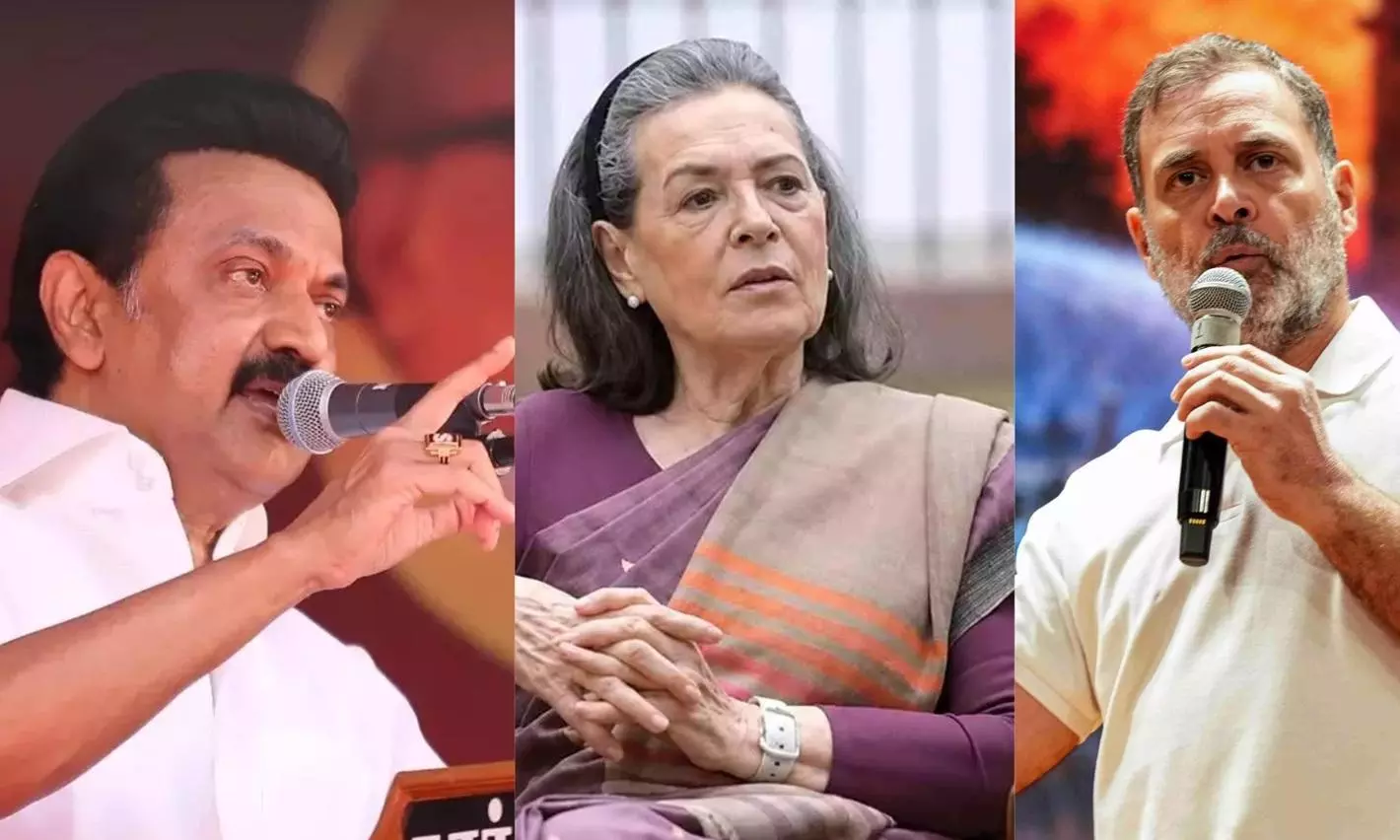
Can Sonia Gandhi fix broken Congress-DMK ties? What N Ram says
In her memoir Belonging: A Journey of Love, Sonia recalls the pain of allying with the DMK. N Ram says today’s Congress under Rahul lacks her pragmatism

In 2004, Sonia Gandhi set aside deep personal misgivings, recounted in her new memoir Belonging: A Journey of Love, to bring the Congress into an alliance with the Dravida Munnetra Kazhagam (DMK). More than two decades later, after the 2026 Tamil Nadu Assembly elections, that partnership stands broken.
However, senior journalist N Ram doubts whether a "semi-retired" Sonia Gandhi will step in behind the scenes to salvage the relationship now, while blaming the current breakdown on Rahul Gandhi.
In an interview with The Federal, Ram contrasted Sonia Gandhi’s pragmatic coalition-building during the UPA era with the present Congress leadership’s handling of allies. He pointed out how the party abruptly walked out on MK Stalin to join hands with C Joseph Vijay’s Tamilaga Vettri Kazhagam (TVK), the ruling party in Tamil Nadu.
‘Semi-retired’
Given the mutual respect between Stalin and Sonia Gandhi, some within the Congress have reportedly floated the idea of her stepping in to mend fences, much like she revived the alliance in 2004. Ram, however, believes such an intervention is off the table.
"Yes, I think some Congress leaders I know have floated this idea, though they haven't gotten very far with it," Ram said. "I know that MK Stalin respects Sonia Gandhi very much, because they had a very good relationship when she was the chairperson of the UPA, and I think she has maintained that rapport."
Yet, Ram pointed out that Sonia Gandhi’s role within the party has fundamentally changed. "Now that she is no longer Congress president — I don't know if you can call it semi-retired, though that is what it is in substance, even though she remains head of the Congress Parliamentary Party — given her fragile health and the fact that she is tired of all this, I don't think she wants to get too involved," he added.
With Mallikarjun Kharge serving as Congress president and Rahul Gandhi actively driving the party’s electoral strategy, Ram noted that stepping in to override their decisions would cross an institutional line.
Also read: ‘The political masala you expect from Sonia Gandhi’s memoir is largely missing’
Coalition pragmatism
To underscore what is missing in the Congress today, Ram pointed back to 2004. In her memoir, Sonia Gandhi admits that when she called then-DMK chief M. Karunanidhi to forge an alliance, she worried she might be betraying her late husband, Rajiv Gandhi.
Her anguish stemmed from Rajiv Gandhi’s 1991 assassination by the Liberation Tigers of Tamil Eelam (LTTE), the Sri Lankan Tamil militant separatist group. The 1997 Jain Commission report inquiring into the assassination had accused the DMK leadership of tacitly supporting the LTTE.
Ultimately, she set those painful memories aside to keep the BJP and the RSS at bay, going on to build a warm rapport with Karunanidhi and later with Stalin. Ram contrasted that realism with the current leadership's approach in states like Uttar Pradesh—where the Congress has been "very difficult with the SP"—and Bihar.
"I think Sonia Gandhi was a much better coalition builder and leader than the present lot in the Congress," Ram said. "She doesn't boast about it, but she notes [in the book] that while others wanted to go it alone, she was very clear that the party had declined and that they had to build alliances. Sometimes these compromises weighed heavily on her conscience."
Alliance breakdown
Dismissing any notion that the Sri Lankan Tamil issue plays a role in today’s political rift, Ram noted that the chapter has long closed. Instead, he attributed the current bitterness to unrealistic seat-sharing and power-sharing demands, as well as the inputs guiding Rahul Gandhi.
"I think the present rift and bitterness stem from something else — because the Congress wanted more seats and wanted a share in the government," Ram explained. "The DMK's long-standing policy has never been to share power in Tamil Nadu... Certainly, when the DMK was in power, there was no coalition of any kind, even when the party didn't have a majority at one point. So, this rift came from something else, and from certain inputs that seem to have gone to Rahul Gandhi, who I think is largely responsible for this turn of events here."
Ram highlighted the abruptness of the split ahead of the Assembly elections, noting that without even consulting Stalin, "it suddenly appeared on the screen that the Congress had joined the TVK alliance and would contest the elections, including local elections. Imagine the bitterness that must have followed between the two parties."