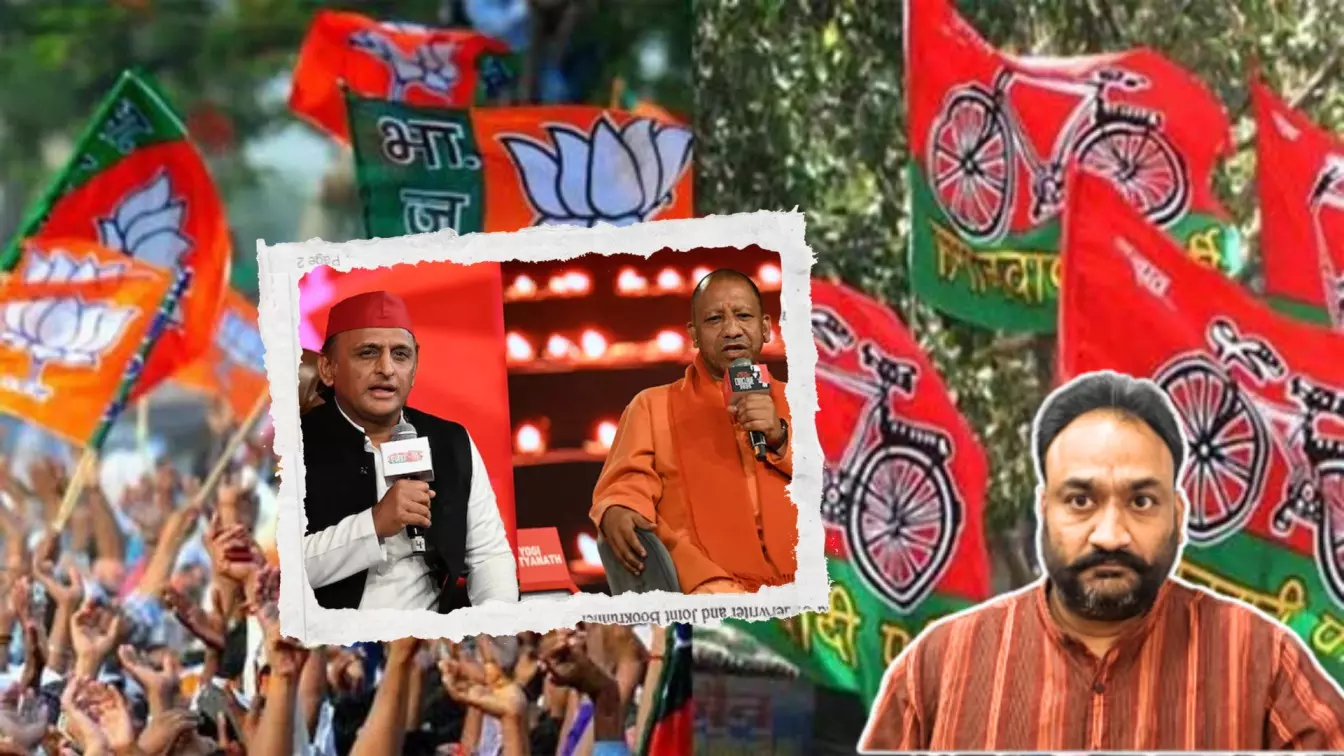
MLC polls: 'BJP’s Varanasi setback, Congress’s dismal show come with hard lessons'
As MLC poll results expose vulnerabilities for BJP in key strongholds, and organisational crisis for Congress, Puneet Nicholas Yadav unpacks key takeaways, political implications for upcoming assembly elections

The recent Legislative Council elections across Uttar Pradesh, Bihar, Karnataka, and Maharashtra exposed significant ground-level vulnerabilities for the BJP in key strongholds like Varanasi, Gorakhpur, and Lucknow, while also signaling a severe organisational crisis for the Congress despite its street agitations.
As the results to these polls spark intense political debate, questions are rising over what these specialised contests reveal about party organisation and voter discontent. Puneet Nicholas Yadav, Political Editor at The Federal unpacks the key takeaways, the demographic shifts behind the votes, and the political implications for upcoming state assembly elections.
The MLC elections have largely been on the margins of political discourse, but the latest polls attracted unprecedented attention, with even Prime Minister Narendra Modi actively posting on social media about it. What explains this shift?
Primarily, it is the circumstances under which these elections were held. There is considerable unrest against the BJP, coming largely from a demographic directly involved with these elections: unemployed youth and candidates worst affected by examination paper leaks. Many participated in large numbers in recent agitations over the Special Intensive Revision (SIR) and paper leaks, whether in Delhi in July during the paper leak and Cockroach Janata Party (CJP) protests, or over the last month against the Special Intensive Revision (SIR) of electoral rolls.
The MLC election is a limited franchise, not a universal franchise like an assembly, local body, or parliamentary election.
In this election, voting occurred across two specialised categories: graduates and teachers. Graduates' constituencies consist strictly of voters enrolled with a graduate or postgraduate degree. Teachers' constituencies require an elector to have been a full-time teacher in a secondary school or above for at least three years preceding the election. The electorate is thus much smaller and specialised.
Also read: MLC election results: Do they reflect political mood? What experts say
However, this exact demographic is the most severely affected by paper leaks, unemployment, mass disenfranchisement, and broader socio-economic frustrations. With the BJP being the common target of these grievances, the party naturally made a massive fuss about winning 13 out of the 28 seats up for grabs.
Beyond the background, the specific constituencies that went to poll added immense gravitas. You had major seats like the Varanasi graduates and teachers’ constituencies, as well as Gorakhpur, Mathura, Agra, and Lucknow, and Nagpur in Maharashtra. While some have gone overboard calling the loss of Varanasi a massive loss of face for the prime minister, that interpretation is only partially correct. An MLC constituency for teachers or graduates spans six to eight adjoining districts—like Allahabad-Jhansi or Nagpur—making it structurally distinct from a single Lok Sabha constituency.
Nevertheless, losing Varanasi remains a setback because it is a seat the BJP should have nursed much better after losing it six years ago. Despite holding power at the Centre and in the state with a massive election machinery, the party failed to win back a constituency identified with the prime minister. In Gorakhpur, the party barely managed to pull through, largely because an independent candidate split the opposition vote. All these factors made this round of MLC elections exceptionally compelling.
Looking at the overall results across four states, the BJP won 13 of 28 seats, with the NDA reaching 16 seats, while the Congress had a disappointing showing. What verdict do these outcomes give on both parties as they engage in a fierce public face-off?
There are crucial lessons to be learned for all parties involved. For the Congress, there is a major cause for concern. At a time when Rahul Gandhi, Priyanka Gandhi Vadra, and the broader party are out on the streets daily raising issues affecting students, employment, and SIR, voters directly impacted by these issues still did not choose Congress as their first preference. There is something fundamentally wrong with how your message is getting across at the grassroots.
The Congress remains a very top-heavy outfit. While everything flows down from the top leadership, the state, district, and assembly-level leadership must be held accountable for why grassroots mobilisation failed so completely that voters did not cast their first-preference votes for the party. MLC elections rely on preferential voting, and barring the significant win in Nagpur, voters in different states chose the BJP, JD(S), or Jan Suraaj instead of Congress.
Also read: PM Modi mocks Congress after zero seats in MLC polls despite use of paper ballots
For the BJP in Uttar Pradesh, there is an equally undeniable setback. Despite wielding an unmatched election machinery, state power, and a high-profile leadership, you lost two key seats, including the constituency synonymous with the prime minister, lost Lucknow—which is synonymous with Defence Minister Rajnath Singh —and nearly lost Gorakhpur, the home turf of chief minister Yogi Adityanath.
Furthermore, the BJP’s victories in UP came almost exclusively from teachers' constituencies rather than graduates' constituencies. The electoral college in graduates' constituencies is broader, more diverse, and less susceptible to governmental influence, whereas teachers' constituencies can be more easily mobilised through government school and college networks. Losing the graduate seats signals real trouble ahead of the UP assembly elections in four months.
For the Samajwadi Party, these results appear to be a major psychological victory. What impact does this have on the party, and what lessons should it draw moving forward?
It is certainly a morale booster for the Samajwadi Party. Just as it hammered the BJP over Ayodhya for two and a half years following the 2024 Lok Sabha results, it can now spend the next few months highlighting how the BJP lost Varanasi and nearly lost Gorakhpur.
The Samajwadi Party also has substantial ammunition regarding counting irregularities in Gorakhpur, where the process was artificially slowed down, round-by-round figures were withheld, and candidate representatives were roughed up at counting centers. This provides visible evidence of unrest against both Narendra Modi’s and Yogi Adityanath’s leadership.
However, the greatest risk for the Samajwadi Party is becoming complacent. It must not sit back and celebrate so much that it loses focus on the much larger, more intense assembly election facing it in four months. Akhilesh Yadav rightly advised cadres against premature celebrations, as the upcoming battle will require sustained organisational effort.
How do you read the election results in Bihar in light of the emerging political dynamics there?
In Bihar, the results present serious concerns for the BJP, the Congress, and even the RJD. While the RJD unseated the BJP’s 30-year sitting MLC Nawal Kishore Yadav in the Patna teachers' constituency, the loss is a double whammy for the saffron party. It comes right on the heels of the BJP losing Nitin Nabin’s sitting Bankipur assembly seat in a recent by-election to Prashant Kishor’s Jan Suraaj.
Also read: UP Legislative Council polls: BJP wins big, but SP wins where it matters
For the Congress, losing its sitting Darbhanga teachers' seat to Jan Suraaj means Prashant Kishor’s party now holds representation in both houses of the Bihar legislature. The fact that young voters, students, and graduates preferred a fledgling outfit like Jan Suraaj over traditional parties like the Congress or RJD warrants deep introspection.
Even though Tejashwi Yadav leads the RJD as a young leader who should naturally appeal to anti-BJP voters, Jan Suraaj managed to capture those crucial votes. This indicates a clear need for established opposition parties to evaluate their ground appeal.
In Karnataka, the ruling Congress drew a blank while the NDA swept the seats. What does this reveal about their organisational strength, and how do the results in Maharashtra compare?
The Congress central leadership needs to read the riot act to DK Shivakumar, Siddaramaiah, and other state leaders in Karnataka. Being in power, you were in a position to deliver on promises and win voter trust. Instead, you managed to lose a sitting seat along with three others.
Defending the performance by claiming the opposition merely retained their seats is an absurd argument. Electors in Bengaluru voted against the Congress due to widespread anger over irregularities in the KPSC, the Bidar township scandal, and ongoing governance delays caused by internal squabbles between Siddaramaiah and DK Shivakumar. With assembly elections approaching in a year and a half, the Karnataka Congress must urgently get its act together.
Also read: MLC polls: Congress retains Nagpur Graduates’ seat; why Abhijit Wanjarri's win is significant
Conversely, Maharashtra provides a positive model for the opposition Maha Vikas Aghadi (MVA) alliance. Unlike Bihar, where parties fought separately, or Uttar Pradesh, where the Congress sat out, the MVA fought cohesively and won three of the five seats in Maharashtra.
The Congress’s victory in the Nagpur graduates' constituency is particularly historic. That seat had been a BJP stronghold for nearly six decades, represented previously by Nitin Gadkari from 1990 until his move to the Lok Sabha, and before him by Devendra Fadnavis’s father, Gangadharrao Fadnavis. Retaining Nagpur despite the ruling Mahayuti government's power gives the Congress a strong precedent to emulate across other states.