INDIA bloc drifts into inertia after monsoon session but BJP begins to regroup
Despite united pushback that stalled Modi’s agenda, Opposition allies admit to having no dialogue since Aug 13 adjournment, leaving BJP space to reset strategy

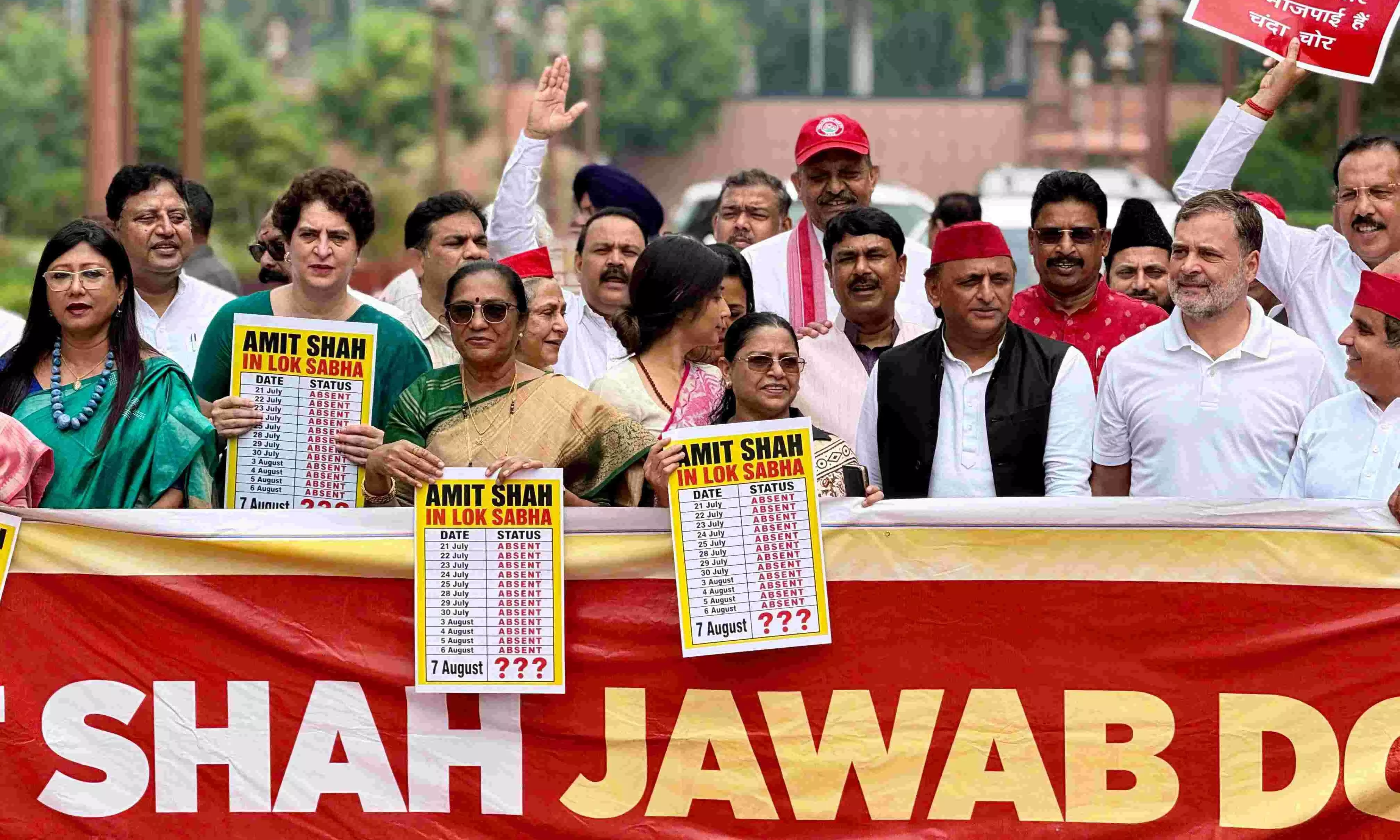
Earlier this month, despite its strength depleted by defections, the INDIA bloc’s sustained and united assault pushed the Centre on the back foot, derailed Prime Minister Narendra Modi’s key legislative agenda and forced a washout of Parliament’s monsoon session. A fortnight on, as the ruling BJP initiates measures to recover from those setbacks, has the Opposition coalition sunk back into its characteristic inertia?
Leaders across various INDIA bloc constituents whom The Federal spoke to confirmed that there had been “no meaningful dialogue or consultation” among the coalition’s top leadership since Parliament was adjourned sine die on August 13. More importantly, there is no clarity yet on when the Opposition group’s top leadership will meet for its next conclave.
At their last meeting, held on June 8 at Delhi’s Constitution Club, INDIA bloc leaders had resolved to “meet every two months”. Congress president Mallikarjun Kharge had announced that the next meeting “will be held in Hyderabad in August”.
With August at an end, INDIA bloc constituents are “still awaiting a call” from the Congress president to finalise the alliance’s next meeting, said a senior Trinamool Congress MP. A senior leader from the Samajwadi Party and an MP from the Rashtriya Janata Dal (RJD) also said there had been “no communication” from the Congress, the alliance’s largest constituent, about the next INDIA bloc meet.
Centre’s ploy to push Bills through?
The lack of communication is particularly surprising as practically every issue on which the Opposition found common ground during the monsoon session, from examination reforms and police brutality against agitating students to donation theft at Ayodhya’s Ram Mandir and the Delimitation Bill, remains relevant.
Also read: Opposition pushback forces Centre to rethink Lok Sabha expansion, delimitation Bills
Furthermore, with no order yet from President Droupadi Murmu to prorogue the monsoon session, speculation continues over a fresh bid by the Centre to push through Bills for reconfiguring the strength of Lok Sabha and state assemblies and reconstituting constituencies through delimitation, once Modi is confident of securing the two-thirds majority required for a constitution amendment.
Ordinarily, a Parliament session is prorogued within days of the two Houses being adjourned sine die. That no notification has been issued even 12 days after the Houses were adjourned means the monsoon session is, technically, still open. If the government seeks to bring legislation, it could do so without convening a special session.
In April, the Budget Session was similarly extended by three days beyond its previously declared “last sitting”. But, the extension ended in a setback for the Centre when its attempt to pass the Constitution (131st Amendment) Bill failed on April 17, with the government securing only 298 votes in favour against the 360 required.
The shortcoming
On Sunday (August 23), pointing to the “abnormal delay” in proroguing the monsoon session, senior Congress MP Jairam Ramesh wondered if Amit Shah was “still in search of his tainted 2/3rd majority to get the Constitutional Amendment Bill on Delimitation passed in a Special Session”.
A senior Congress Lok Sabha MP told The Federal that, irrespective of whether the Centre was planning a special session, “it is imperative that our leadership, the INDIA bloc leadership, meets regularly to strategise its next steps”.
Also read: How Pradhan’s resignation reshaped politics for Modi, Opposition and India’s youth
“During the last meeting (on June 8), every leader present agreed that we have to sit together more regularly; that is why the joint statement read out by the Congress president after the meeting said we will meet every two months,” the Lok Sabha MP said. “We seem to have forgotten all about that now and it is very unfortunate because the monsoon session showed that despite the defections that some of our allies suffered, we were still strong enough to push the government into a corner.”
Another Congress functionary said that while Lok Sabha’s Leader of Opposition Rahul Gandhi had succeeded in “keeping up the pressure” on the Centre after the monsoon session, the lack of communication among allies was “preventing a coordinated strategy”. “It is a major shortcoming,” the functionary said, adding that issues raised by Rahul Gandhi should not be seen “merely as his issues or issues of the Congress”; rather, the whole INDIA bloc should raise them in a coordinated manner.
Onus on Congress
Congress allies, however, maintain that the initiative to bring the alliance’s top leadership together will need to come from Kharge and Rahul. “They are leading the alliance in all but name,” said a CPI leader. “The next meeting was also supposed to be in Hyderabad, where the Congress is in power and would be the host; obviously, it is their responsibility to ensure the commitment we made on June 8 is fulfilled.”
An MP from the CPM echoed this view. “Maybe they were busy with their internal matters because they had a CWC meeting (on August 19) and Rahul had his Pune rally (on August 22),” the CPM MP said, adding, “They could have discussed some date after these events, if not within August then maybe in early September. Since Parliament ended, there has just been no communication from them.”
Alliance leaders said there were “multiple issues” on which the INDIA bloc should collectively finalise a blueprint of activities for the months leading up to the winter session.
Also read: A warning shot for 2029? Why Delhi protests hold key for Opposition too
“The Delimitation Bill is still a challenge,” said an SP leader who has attended previous INDIA bloc meetings. “Due to the defections from Trinamool, AAP and Shiv Sena-UBT and the DMK moving away from the Congress, we have lost a large chunk of our MPs in Lok Sabha to the NDA. The numbers are no longer as unfavourable for the NDA as they were in April if they bring the constitutional amendment again.”
The SP leader said the Opposition needed to be “absolutely sure about where each of our allies stand on delimitation”, particularly as some parties had not categorically opposed it and “the Centre was actively engaging with them”.
Multiple issues on plate
The SP leader also said the alliance must “come together to strongly reiterate our position on the caste census”, after the Centre announced that caste enumeration for Census 2027 would be “open ended”.
On August 14, the Centre notified 40 questions for the Census questionnaire. While citizens are required to mention their caste, INDIA bloc constituents such as the Congress, SP and RJD say the open-ended format “sabotages” caste enumeration.
“We wanted a drop-down menu as this would have provided granular data of people across different castes and sub-castes,” SP MP Dharmendra Yadav told The Federal. He argued that an open-ended format could result in people identifying themselves only as forward caste, backward caste, SC or ST, while some may not even know their caste status, whereas, “if you include a drop-down menu, the enumerator can cross-check the caste name in the list and select the relevant option”. The data collected in open-ended format “will not just be misleading but useless,” he added.
Also read: Parliament Monsoon Session: Productivity among lowest; LS recorded 19 pc business
On August 20, Kharge and Rahul, in a jointly signed letter to the Prime Minister, asserted that under the open-ended format “it will not be possible to accurately count castes” and demanded that “the current questionnaire should be cancelled” and a new one prepared based on a verified list of castes.
Need for strategy
Opposition leaders also believe the INDIA bloc “needs a united strategy” to tap into the “visible frustration” among students and youth. At its June 8 meeting, the alliance backed students’ protests against examination paper leaks and demanded the resignation of Dharmendra Pradhan as education minister.
While Pradhan’s eventual exit from the Union Cabinet was largely credited to pressure built on the government following public outrage over police brutality against agitating students in Delhi on July 20, the Opposition believes its support for the youth had been timely. The challenge now is to sustain that momentum.
“We raised the issue in Parliament while the youth raised it on the streets and that joint pressure made Modi buckle,” said an RJD MP. “Now we need to chart the next steps, for which our leadership should sit together and brainstorm.”
BJP in regroup mode
The RJD MP added that the alliance had also faced challenges with the youth in Jharkhand and needed to discuss how to respond to such agitations in INDIA bloc-ruled states. “There is no doubt that the youth have done more damage to Modi’s image and the perception of the government than the Opposition could do in the last 12 years and we should learn from that; we can’t be seen to be on the wrong side in this,” the MP said.
Also read: Congress emerges as INDIA bloc’s fulcrum amid criticism and fragile unity
While INDIA bloc constituents sit in wait for the Congress leadership to “call for a meeting”, the BJP has already begun its efforts to regroup. Last week, BJP national president Nitin Nabin reshuffled his party organisation, infusing it with a sizeable chunk of younger leaders as a clear bid to reach out to a demography that seems to be fast slipping out of the party’s grasp. Modi, too, has been nudging his cabinet colleagues to engage more aggressively with Gen Z while a reshuffle of his Cabinet is reportedly on the cards.
Whether these efforts help Modi restore some of the saffron sheen he and his party have lost in recent weeks is to be seen but waiting for that to happen before it can plan its counter-strike is a folly the INDIA bloc can’t afford.