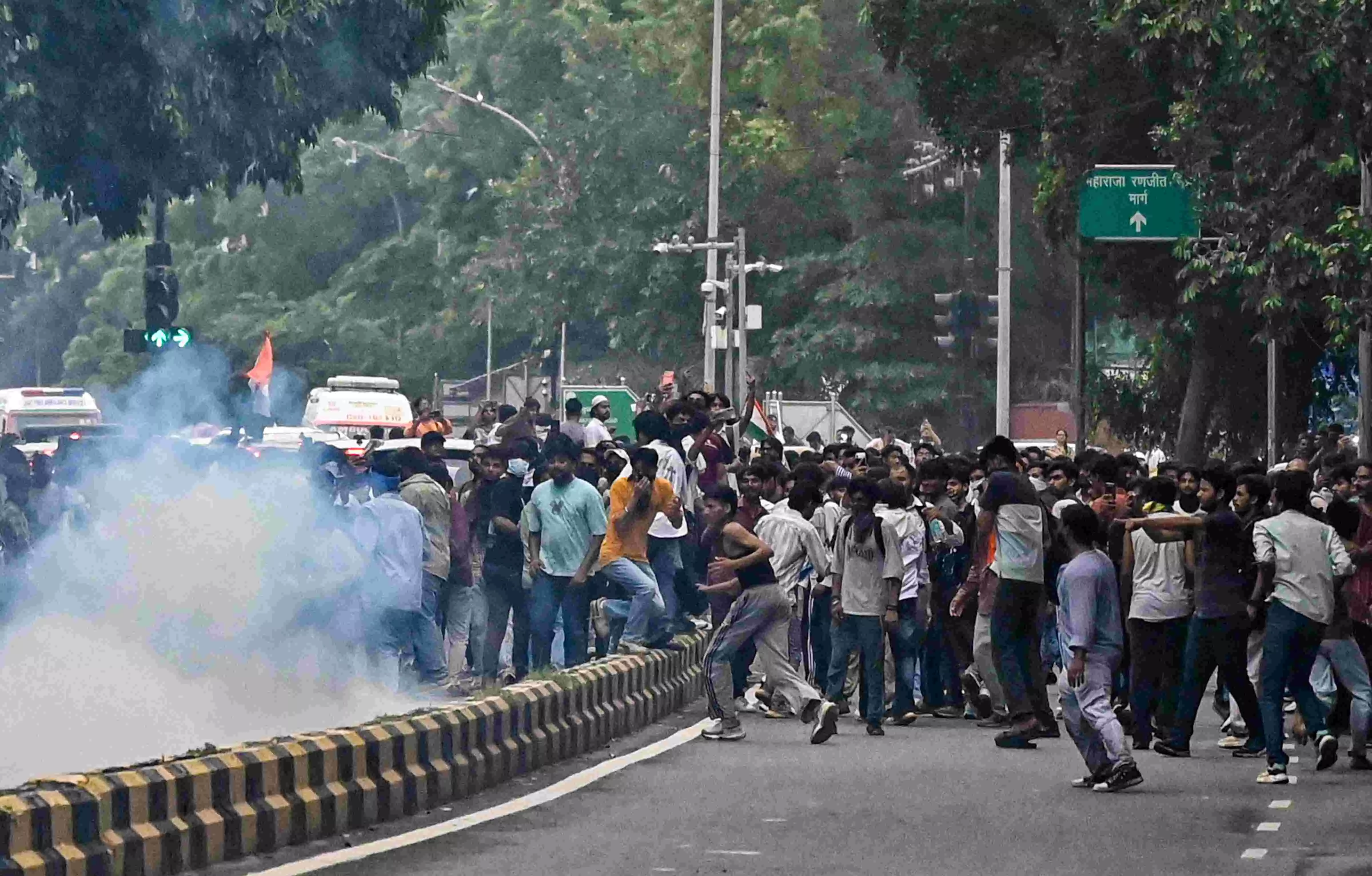
The Union Home Ministry has instructed Delhi Police to start booking protestors under various penal offences. Photo: PTI
A warning shot for 2029? Why Delhi protests hold key for Opposition too
Beyond its organisers, Delhi's Parliament march reflected a broader surge in youth anger over education, unemployment and government accountability

They came. Students, unemployed youth, common citizens of all age groups, activists and political workers; they all came. Despite the disappointment over Geetanjali Angmo's late Sunday announcement about her husband, activist Sonam Wangchuk’s willingness to break his indefinite hunger strike if politicians called on him and agreed to discuss education reforms in Parliament, they still came. They came wading through the blockades and barricades installed by the Delhi Police.
For six hours beginning around 10 am on Monday (July 20), the national capital witnessed a protest at a scale it hadn’t since Anna Hazare’s India Against Corruption protest of 2011 and 2012 and the mass mobilisation demanding justice for Nirbhaya in late 2012. Those, however, were protests under a different government, the Congress-led UPA, and not the current one led by Prime Minister Narendra Modi with its reputation for stomping out any dissent with brute force and retribution.
This is not to say that the Modi government hasn’t seen its share of rousing public protests. It has, and on numerous issues, but none that came so close to the doorsteps of Parliament. The year-long farmer agitation was halted on the fringes of Delhi. The protests by women wrestlers had remained confined to Jantar Mantar.
Those who came on Monday, by the thousands, defied the terms of protest that the Modi regime had normalised over the past decade. They came risking life and limb to demand accountability for the country’s rotting education system that has claimed over two dozen lives in the last few months; children who died by suicide after question papers for various exams they had been preparing for were leaked.
Leaderless but resolute
No one expected the regime would simply allow them to march to Parliament, which convened Monday morning for its monsoon session, and press their demands for Union education minister Dharmendra Pradhan’s resignation and reforms in the education system. Yet, they came, and they began to march from Jantar Mantar, where Cockroach Janata Party members and Wangchuk had been protesting on the exam paper leak issue for the past month. It did not matter to them that the protest, hereon, was without a leader.
Also Read: Why CJP’s protest stands apart from previous mass movements
Wangchuk was confined to Safdarjung Hospital. CJP founder Abhijeet Dipke chose to stay put at the Jantar Mantar protest stage instead of leading the march for which he had given a call and whose resounding success he now claims his own. Other known CJP faces, Saurav Das and Ashutosh Ranka, too quickly made themselves scarce, citing a call for talks from the government, though their meetings with Union minister JP Nadda only took place at 2 PM and then at 4 PM. Vijeta Dahiya, the other CJP spokesperson, was absent throughout; videos of him wandering about a Metro station evading questions about his absence from the March have since gone viral.
As such, what was originally pegged as a CJP protest evolved quickly into a protest led jointly by thousands of faceless, nameless citizens; all in their own way aggrieved by an examination system that leaks question papers like water from a colander and by growing joblessness. It is for this reason that dubbing Monday’s non-violent mutiny against a government that fancies itself above accountability as a CJP protest or purely a political one would be grossly unfair. It was, quite simply, a protest by ‘them’, which neither the police barricades nor lathi charge nor tear gas could hold back.
Opposition falls in line
The Opposition had been slow to extend support to the CJP’s protest. It joined ranks once Wangchuk’s indefinite hunger strike began capturing national imagination; only piqued further by the government’s decision to evict him from Jantar Mantar and move him to Safdarjung Hospital on July 18.
Not only did Opposition MPs turn up on Monday, but they also brought with them hordes of their party cadres; swelling the ranks of a protest that had organically become much bigger than Wangchuk and Dipke, who until Saturday night seemed desperately in search of an exit route from a protest that failed to evoke any response from the Centre.
Also Read: ‘Is this not our country’: What CJP protesters said as they defied police crackdown
The entire galaxy of AAP leaders, from former CM Atishi to Manish Sisodia and Gopal Rai who were rarely seen in the national capital since their party’s rout in the 2025 Delhi polls, turned up to support Dipke, once a key AAP social media manager himself.
Mahua Moitra of the Trinamool Congress was present too, as was Azad Samaj Party chief Chandrashekhar Azad. The Samajwadi Party sent a contingent of its MPs, with Dimple Yadav, Ruchi Veera and Priya Saroj at the forefront. Congress’s Renuka Chowdhury also turned up.
What happened in Parliament
By the time Parliament proceedings began, reports of the police crackdown on protestors began trickling in – first of pushback, then of lathi charge and finally tear-gas shelling.
Also Read: CJP’s Parliament march: From clashes to talks with ministers, key developments
In Lok Sabha, the Opposition forced repeated adjournments with its demand for Pradhan’s resignation, among other issues. In Rajya Sabha, Leader of Opposition and Congress president Mallikarjun Kharge thundered, demanding answers from the regime on the examination paper leaks and questioning the barbaric police crackdown, only to be abruptly cut short by Rajya Sabha Chairman CP Radhakrishnan, who promptly adjourned the House.
Crackdown intensifies
By noon, as protestors continued their march towards Parliament braving the clampdown, the Parliament complex resembled a fortress readying to ward off an insurrection. Entry Gates to the complex were shut down. Quick Reaction Teams were deployed near all gates with their snipers at the ready. Shots of tear gas being fired repeatedly at protestors less than a kilometre away could be heard near the Makar Dwar of Parliament.
Also Read: CJP protests in pictures: The day ‘Chalo Sansad’ march turned Delhi into a battlefield
The police began clearing out Jantar Mantar by 5 PM, while the crackdown against protestors still on the streets leading to Sansad Marg was also slowing down.
The State’s retribution will begin now. Sources say the Union home ministry has instructed Delhi Police to start booking protestors - those already detained on Monday and others who can be identified - under various penal offences, including rioting, stone-pelting, disturbing public order and incitement to violence.
Government holds firm
While Nadda did meet Das and Ranka, sources in the government say the Centre is in no hurry to accept any of the CJP's three demands. Aside from reiterating their demand for Dharmendra Pradhan's resignation, Das and Ranka have urged the Centre to allow Wangchuk's release from Safdarjung Hospital and for Rs 1 crore in compensation to be paid to families of NEET aspirants who died by suicide after the examination's paper leaked earlier this year.
The matter of Wangchuk's discharge from Safdarjung Hospital is already pending in appeal before the Delhi High Court, which allows the Centre to claim it would go by the court's decision. Pradhan's immediate resignation is ruled out too, say sources in the government, adding that Modi would "never allow anyone to dictate such terms" to him.
As for compensating the families of students, the government is likely to tell the CJP that it is considering the demand but can't give an assurance straight away as doing so could open the floodgates for similar demands from kin of anyone who dies by suicide blaming the Centre.
Centre caught off guard
Yet, BJP sources do concede that the government's decision to designate Nadda to hold talks with the CJP duo after paying no heed to the CJP protest for the past month signalled that it had not anticipated Monday's march to draw such a massive turnout.
"Irrespective of what the political or social affiliation of the protestors may be, the fact is we had not expected this kind of a gathering. The police crackdown, the visuals of students and youth being beaten up and still continuing the march despite broken skulls and bones... it's a very powerful image that damages our image globally. The government had no option but to step in immediately and claim tempers and that is why Nadda met the CJP members. Now we have to see how this issue evolves; whether it was just a days' demonstration or if the protest sustains in some other form and spreads to other parts of the country," a Union minister told The Federal.
Also Read: What are the CJP’s 3 demands of the govt?
According to Dipke, Wangchuk, who had reportedly continued his hunger strike even at Safdarjung Hospital and was scheduled to end it after Monday's protest, has decided not to break his fast as a mark of protest against the police crackdown on the peaceful agitators. Dipke, who had gone on an "indefinite hunger strike" after the police whisked Wangchuk away from Jantar Mantar on Saturday, was, however, quick to break his fast on Monday; ostensibly at Wangchuk's request.
Nonetheless, by Monday night Dipke and Ranka told people who had begun to gather again at Jantar Mantar that they now want the government to come to them at the protest site for any future talks since Nadda had not responded to their demands. Clearly, the massive turnout for the protest has left Dipke emboldened to position his CJP as the spearhead of a public agitation neither he nor his colleagues like Das, Ranka and Dahiya choose to actually lead.
The police's lathis, tear gas and stones as well as the legal action that is to follow have all evaded the CJP leadership for now; perhaps giving the Centre a bargaining chip to exploit in its engagement, if any, with Dipke's lot at a later stage.
Beyond one day's protest
With the Centre and its Delhi Police demonstrating their appetite for using brute force to curb dissent, whether the protests continue to grow or revert to the thin crowds that Dipke drew in the early days of his sit-in dharna at Jantar Mantar is now to be seen.
What Monday's protest has demonstrated, though, is that the public anger, particularly among the so-called Gen Z and youth, on issues like paper leaks and unemployment isn't purely in the imagination of the Opposition. It has been simmering over time and needs only a catalyst to turn into full-blown anti-establishment rage despite the threats of police action, incarceration and court battles. That's anger the Opposition too can tap into in the run-up to the 2029 Lok Sabha polls and the over all, a dozen assembly polls that are to be held before that, beginning with Uttar Pradesh, Uttarakhand and Punjab early next year.