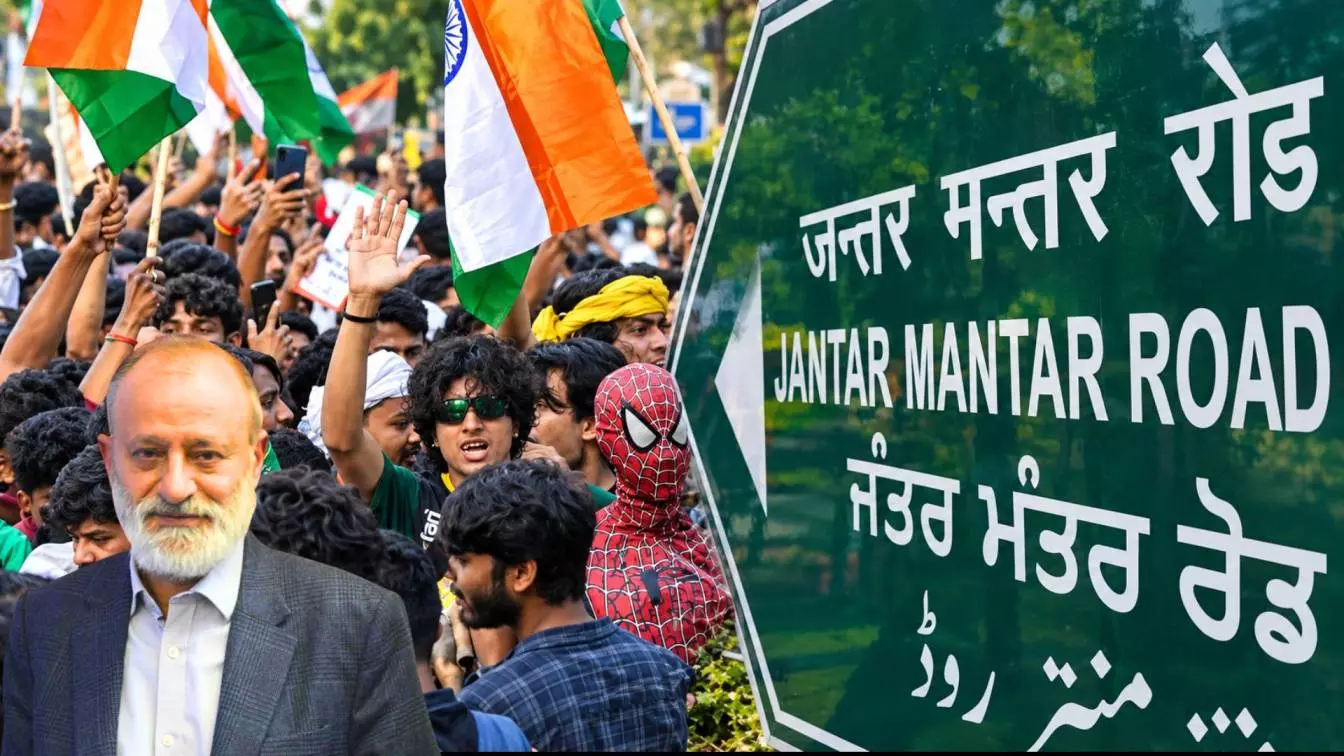
After ban, ‘every corner of country became Jantar Mantar’ | Activist Gauhar Raza interview
Protests cannot be stopped by changing venues, says Gauhar Raza, who compares current climate to Emergency and calls the ban a blow to constitutional freedom

Following the Union Home Ministry’s decision to de-notify Jantar Mantar as a designated protest venue and relocate demonstrations to alternative grounds in Delhi, questions are mounting over the shrinking space for democratic dissent and the disenfranchisement of voters under the Special Intensive Revision (SIR).
The Federal spoke to Gauhar Raza, poet and social activist, about the government’s crackdown on anti-SIR demonstrators, the historical parallels with the 1975 Emergency, and the rising political consciousness among India’s youth.
‘Protest cannot be killed’
Condemning the move to de-notify Jantar Mantar as a protest site, Raza said the decision reflects an attempt to curb dissent but would not diminish the spirit of protest in a democracy. “By changing the site of protest, the protest cannot be stopped. The protest cannot be killed,” he said, arguing that public resistance would continue regardless of venue restrictions.
Also read: Foreign hand in anti-SIR protests? Prove it, or drop it, Mr Nabin
Raza described the move as an attack on democratic rights, claiming that Jantar Mantar, like other public spaces, belongs to the people rather than any government. “When they stopped people from coming to Jantar Mantar, every nook and corner of the country became Jantar Mantar,” he said. According to him, protests cease only when governments pursue “correct policies”, not by restricting protest sites.
‘Governments inconvenience people’
Rejecting the argument that demonstrations inconvenience residents, Raza alleged that it was governments, not protesters, that had disrupted public life through security restrictions and road closures. “This time, I have not seen protesters blocking the roads. It is the government which has blocked the roads,” he said.
While supporting designated protest sites in principle, Raza argued that citizens should be free to protest in any public space as long as they do not impede others’ rights. He termed the restriction on access to Jantar Mantar a “fascist action”.
Parallels with Emergency
Drawing a comparison with the 1975 Emergency, Raza said the current situation differed in important ways. While calling the Emergency a “black period” in India’s history, he alleged that the present climate involved a gradual expansion of restrictions on sections of society and political opponents.
Also read: ‘Why is Delhi jailed?’: Rahul accuses Modi of protecting Gyanesh, says protests won't stop
Referring to the SIR exercise, he described the exclusion of crores from the voters’ list as an assault on democratic rights. “My voting right decides which government is going to sit in Parliament and run this country. And I am told that I can’t vote,” he remarked.
Raza also alleged that dissenters, activists and journalists were facing growing hostility and violence, claiming he had personally witnessed protesters being attacked. “The people of India are going to stay; governments will come and go,” he said, maintaining that democratic protest could not be extinguished by administrative orders.