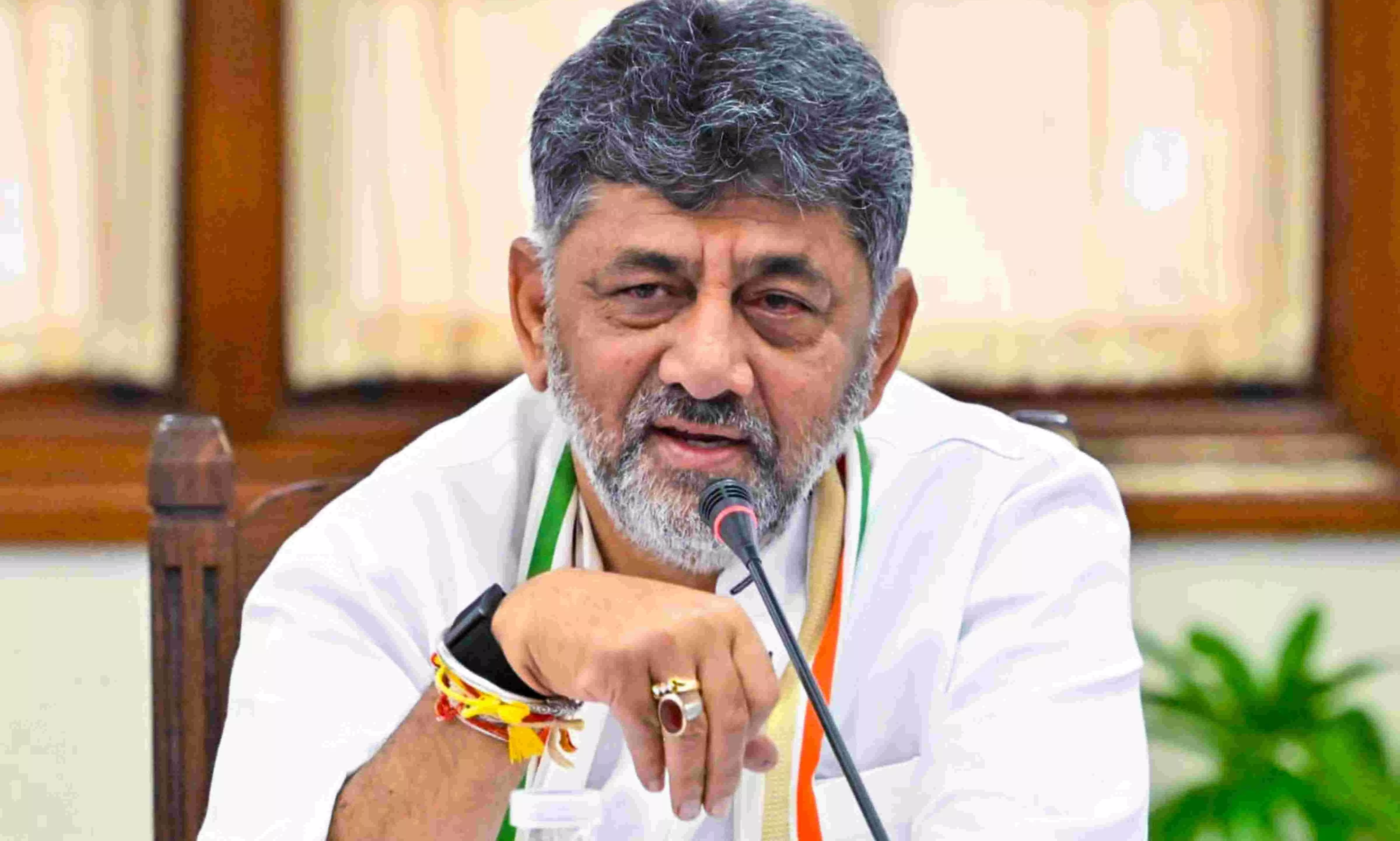
It will require an extraordinarily serious and committed effort than mere dreams and aspiration to ensure Shivakumar’s vision doesn’t turn into wishful thinking, at Bengaluru’s expense. Photo: PTI
Few can quibble over DK Shivakumar’s vision for Bengaluru, but there’s an unbridgeable gulf between plans on paper and what can be realistically achieved
It’s the big and grandiose that attracts newly sworn-in Karnataka Chief Minister DK Shivakumar. Under his administration, Bengaluru may well witness the launch of a slew of contentious mega projects – most of which face resistance from civil society.
The foremost among them is the Bengaluru 17-km tunnel project that is estimated to cost anywhere between Rs 18,000 to Rs 40,000 crore, by the time it is fully done. It is arguably the city’s most expensive infrastructure project. The tunnel will literally cut through the innards of the city, threatening to disturb the sensitive geological makeup and intruding on heritage sites like the iconic Lalbagh Botanical Garden.
Going by the way projects are executed in Bengaluru, it is unlikely the city will see light at the end of the tunnel anytime soon, though on paper it is scheduled to complete in less than five years. What is most plausible is that the project will turn Karnataka’s already-exhausted capital into a nightmarish “work in progress” for years, nay, decades.
Steamrolling resistance
Despite opposition from various well-meaning sections of people in the city, Shivakumar, as the deputy chief minister, steamrolled the resistance, floated the tender for construction, and selected the Adani group to execute the project.
This choice has effectively shut protests from the opposition BJP, given the group’s head Gautam Adani’s widely acknowledged proximity to the Modi government. But, independent groups continue to express reservations over the usefulness of the project, and whether it will serve the stated purpose – of decongesting Bengaluru’s infamous and meme-friendly traffic.
Also Read: Bengaluru's AI City: Here is everything you need to know
An association of disparate student organisations recently submitted a memorandum to the Greater Bengaluru Authority chief demanding that the project be dropped fearing, among other things, a disruption to the city’s sensitive ground water systems. But, going by Shivakumar’s eagerness to implement the project, it’s going to be difficult for the city’s residents to prevent it from taking off.
Cut from a different cloth
Unlike Shivakumar, his predecessor Siddaramaiah was more focussed on social justice and welfare schemes. In response to popular opposition, for instance, Siddaramaiah scrapped big-ticket projects, including the proposed 1,777-acre high-tech defence and aerospace project in the city’s suburb near Bengaluru. His government also scrapped the proposal to build a sports stadium near Mysore on land used by silk reelers, after opposition from over 1,000 families that would have been uprooted from their traditional occupation.
But Shivakumar is cut from a different cloth. His outlook is pro-business. He was close to former chief minister SM Krishna, and watched how his mentor provided the support that turned Bengaluru into India’s IT hub some three decades ago. Krishna’s success probably influenced Shivakumar’s futuristic vision for Bengaluru.
Other big-ticket projects
Among other big-ticket projects he had proposed, as deputy chief minister, was a 114 km-elevated corridor to complement the 17 km tunnel road, double-decker flyovers, and new roads spanning a length of 700 km.
Few can quibble over Shivakumar’s vision, as this is how major cities around the world expanded and developed. And, on paper, and in the dressed-up presentations within glitzy auditoriums, the projects appear viable.
Also Read: Bengaluru tunnel road project: DK Shivakumar faces big test over Adani bid
But, there’s an almost unbridgeable gulf between plans on paper and what can be realistically achieved. All one needs to do is check out some earlier projects, what they promised, and what has become of them.
Fate of earlier flyovers in Bengaluru
The Jayadeva flyover across the arterial Bannerghatta road, built around 2005, was demolished to make way for a multi-level flyover, including one swathe for a metro station. The old flyover had taken around four years for construction. A so-called “magic box” underpass, built in 2008, adjoining the posh Palace Orchards, that was touted as the solution to Bengaluru’s problems now lies shut and abandoned. By all accounts, it is considered an engineering failure.
Also Read: Bengaluru-Tumakuru Metro project moves ahead: All you need to know
The Hebbal intersection, on the way from the airport into the city, has been built, partly demolished, and rebuilt with modified flyovers and traffic realignments. Yet, all this does not seem to have made much of a difference. And, Shivakumar has come up with another of his projects – a combination of tunnels and flyovers to sort out the severe traffic congestion radiating from the intersection.
Reports quoting mobility experts say that the tunnel-flyover, when completed, will result in more traffic congestion underground while the sharp curves will make it dangerous to manoeuvre. But the Rs 2,250 crore project is already underway.
Some underpasses – death traps
Some of the existing underpasses at crucial junctions have turned into death traps when it rains. Despite constantly claiming to set right the underground drainage, each time it rains heavily, the underpasses get flooded.
In one tragic incident three years ago, at KR Circle, a stone’s throw from the state legislature, a car along with its occupants was submerged in the flooded underpass, killing one of its occupants. Even now, the underpass is barricaded when it starts to rain as the government has been unable to rectify its drainage system.
Delayed timelines
A chief minister or even a deputy chief minister certainly has the power to push through projects. Now that Shivakumar is finally at the apogee of the state’s ruling hierarchy, he is bound to use his position to implement his dream projects. But given the city’s underwhelming experience with infrastructure building, it can only send shivers down the spine of the common Bangalorean.
For, project timelines are never honoured. The Ejipura flyover – less than 2.4 km long - that was to have “eased” traffic in the city’s busy start-up hub Koramangala, was launched in 2017. It has been under construction for nearly a decade, and is yet to complete.
Reported corruption in local administration
Over the years, Bengaluru has justifiably acquired the reputation of never completing public infrastructure projects on time. Reports regularly expose corruption in local administration. The Karnataka State Contractors’ Association, during the erstwhile BJP government of SR Bommai, accused politicians of demanding a “40 per cent commission” to clear projects. It made a similar accusation against the succeeding Congress government under Siddaramaiah.
Also Read: Bengaluru’s water crisis deepens as cases of contaminated drinking water surge
The irony is that, for Bengaluru, which has grown exponentially in the last five decades, infrastructure expansion is necessary. But the administrative culture that Shivakumar is familiar with and now inheriting, does not seem to be in any position to deliver on his promises and projects.
New projects
Nevertheless, more is on the way. There is talk of a new mega international airport to supplement the existing one that is slated to reach saturation in the next few years. Shivakumar is pushing for a mega township project towards the city’s southern suburb of Bidadi, triggering opposition from a section of farmers. He is also talking of yet another expressway between Bangalore and Mysore.
Also Read: Mohandas Pai: ‘Bengaluru’s infrastructure is lagging 10-15 years behind’
On Day One, the new chief minister sanctioned Rs 2,000 crore, no less, for the city’s roads. Until now, several crores have routinely been sanctioned to upgrade these very roads, eliminate potholes, and make travel easier. The money has most likely been spent, but the condition of roads remains the same, if not worse.
At the risk of sounding pessimistic, it will require an extraordinarily serious and committed effort than mere dreams and aspiration to ensure Shivakumar’s vision doesn’t turn into wishful thinking, at Bengaluru’s expense.