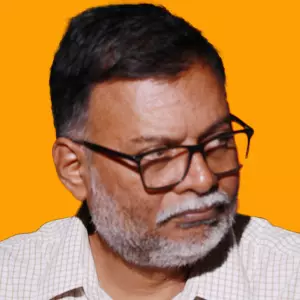
Is China hijacking BRICS? | Ex-diplomat TS Tirumurti interview
Tirumurti says India has a crucial balancing role as BRICS expands, but warns against turning the grouping into an anti-West bloc

BRICS was originally created to give emerging economies a greater voice in global institutions, not to build an anti-Western bloc. But with six new members, growing geopolitical tensions and China’s expanding influence, the grouping faces a new challenge: preserving its cohesion without allowing it to become China-dominated.
On the 108th episode of The Federal's Worldly-Wise, former Indian diplomat TS Tirumurti, who is currently associated with the Chennai-based Deccan Centre for International Relations, says India has a crucial balancing role to play as BRICS evolves.
Also read: India's BRICS tightrope: Navigating China, Trump, and Middle East crises
Tirumurti, who served as India’s Permanent Representative to the United Nations from 2020 to 2022 and as India’s BRICS Sherpa, also talks about BRICS’ original purpose, the expansion of the grouping, China’s growing influence, the proposed BRICS currency, India’s role and whether the grouping can continue to represent the interests of the Global South.
Follow live updates from BRICS Summit here
The Delhi BRICS summit is taking place at a time when questions are being raised about its role as a platform for the Global South and whether it has succeeded in resisting the dominance of the advanced North. What is your perception?
I’ll just put it in a small context. BRICS was really formed for a very specific purpose at that time.
We had these emerging economies and they came together because they realised that they were growing bigger and economically they were wielding clout. If you recall, at the time nearly 20 per cent of the GDP of the world was the BRICS economies. So, they wanted to have a larger say in global institutions and in global governance per se. Of course, initially, they were mainly looking at financial and economic institutions.
You also know that the earlier system which was in place was really the post-World War II Bretton Woods system. That was continuing, and in fact some of the BRICS countries benefited from that because they learnt to operate with the others and benefited.
So, BRICS was to reform the Bretton Woods system and to accommodate the growing clout of the emerging economies.
At no point in time did they have an anti-West agenda, if I use that word, because people are now talking about non-West and anti-West. I don’t think they had an anti-West agenda, but it was certainly a pushback against a financial and economic model which militated against these countries, and they wanted to push for a larger role in decision-making.
Inevitably, when you’re going to ask for a larger role in decision-making and a larger role in geo-economics, then a larger geopolitical role also becomes inevitable. So, there was a trajectory that they were looking at.
Over the years, we should also acknowledge that BRICS has grown. It has been strengthened both internally and externally, and it has taken some significant strides.
That was the period in which they really focused on reform. Another thing we should not forget is that, in spite of the internal differences between countries — and some of them are fairly serious, bilateral differences between India and China, for example — they did not let it affect BRICS in any meaningful way going forward.
China may have had its own thinking about India, which I can come to later, but they did not in any way let it affect BRICS going forward.
Now, with the induction of six new members, the challenge has started. The challenge is to see how the group can remain cohesive and how it can remain coherent.
How can it continue to address the reform agenda which BRICS has had, and how can it also not let the bilateral differences between these new members affect the working and the cohesiveness of BRICS? That is where the challenge has come with the six new members.
This is also where there is a danger of anti-West sentiments coming in.
It is a fact, it’s a struggle, let me be frank, to stop these sentiments from coming in because of what is happening. You just alluded to the Chinese ambitions to become number two and challenge the United States. You have the Russians taking on the Ukrainians and the entire Europeans.
You also have Iran being bombarded by the United States and Israel. Then you have even countries which are close to the United States, like India and Brazil, being slapped with 50 per cent tariffs. Even if you look at it bilaterally, as far as India is concerned, we still have not concluded the trade deal.
We are still having challenges with the Quad, which is not going anywhere, and you have Pakistan being given greater prominence by the United States.
Ultimately, the global system and global institutions are still dysfunctional, thanks to the West operating, especially when you see what is happening to the WTO and others.
So, if you look at it, there is a very big struggle to stop this from becoming anti-West and continue to be a non-West group.
But one thing I do want to say is that even now, many countries would rather stay multi-aligned. That is probably the strength on which BRICS rests right now.
I don’t think they are still ready to have a China-dominated geopolitical scenario just yet because they are also linked with the US.
And so, where India comes in, it’s important. India has a very balancing role in all this and they have to bring in greater coherence. This gives an opportunity for India to do some course correction during this BRICS summit.
Also read: SCO and BRICS, yes, but is it time for India to revive SAARC?
You have used the terms ‘non-West’ and ‘anti-West’. How would you differentiate between the two? Does non-West mean an absence of hostility towards the West?
A non-West group, we can’t technically call it a Global South group. After all, Russia is there. They are not necessarily Global South.
So, we can call it a group which came together to address its concerns as major economies which are going to have a very large say in the financial and economic way the world is going to be run, but at the same time are not getting the clout which they need to get in these institutions and structures and even in geopolitics.
So, I define that as something which is not a confrontation with the West, but a confrontation with the systems which have been in place since the World War and an attempt to change these systems and bring about reforms.
In some cases, it is quite possible that you could work with the West to be able to do these reforms. And in some cases, even within the group, there have been differences within the group.
For example, in the reform process of the UN Security Council, the Chinese have been extremely difficult even to recognise the aspirations of India, Brazil and South Africa. Therefore, it’s not as if even for reform all of us are on the same page.
Therefore, yes, we are looking at a group which doesn’t have representatives of the West, who are now watching out for themselves and trying to see how we can take this agenda forward.
Also read: BRICS Summit to focus on building collective resilience amid global crises
There has been talk of a BRICS-driven common currency to take on the dollar. Is India’s position justified in opposing such a currency?
There has been talk about a BRICS currency, and this has particularly come in the context of de-dollarisation. That’s the way I look at it.
It is not just about India being against the BRICS currency because many countries do realise that if this BRICS currency comes, then it will be dominated by the yuan, the Chinese currency.
I am not so sure that people think that domination of a currency by the Chinese currency is necessarily a better proposition than having a dollarised type of system or the dollar being used.
So, that is a question which other countries are also asking. It is not just about India.
They are not yet buying into the idea of a BRICS currency as of now, even though that has received prominence because people would like to push it through.
But it is a fact that everyone in BRICS would like to de-risk from the dollar. There is no doubt about it, particularly because of the unilateral sanctions which are coming in, which are being imposed by the West and by the United States particularly, and of course backed by the West.
Therefore, they would not like to be held hostage to these unilateral sanctions.
When you come to de-risking, my feeling is that many countries would rather prefer the interlinking of payment systems, central bank digital currencies and national currencies being used for transactions. They would like to increase that proportion in their transactions rather than move towards a separate BRICS currency.
I had, in fact, mentioned in one of my recent articles about mBridge. That’s a Chinese-dominated type of financial system, an alternative financial system which they are planning.
But even there, it is just to de-risk. It is more to de-risk from SWIFT and other systems which are there during these types of situations.
So, BRICS currency is probably still an idea whose time has not yet come.
And, as I said earlier, I don’t think they’re still ready to have a Bretton Woods-institution-like system which is dominated by the Chinese.
There is also a view that BRICS itself has been, in a sense, hijacked by China. If China is trying to become the dominant power, where would that leave BRICS?
BRICS, of course, when it was formed in 2006 and had its first summit, in 2009, and then South Africa in 2010 — in 2010 BRICS was 20 per cent of the world GDP and China was certainly not as strong as it is now.
Now, it is not just about economic power, but also about political and military power and other things.
So, China also needed BRICS. They needed India. They needed Russia. They wanted BRICS as a vehicle to look at a much larger goal. But they needed the group.
They were, of course, aiming for a bipolar world at some point of time. Now they have grown much, much bigger. They are now looking at what you call a G2 with the United States.
They are not looking for a G2, but the United States is calling them a G2, even if China does not want to acknowledge it.
Therefore, while they needed BRICS, now they are looking at a parallel vision of the world. They want to play by their own rules.
And this is not just China, but this is also the United States, because they are both challenging the existing institutional norms or challenging existing negotiation laws and rules and international law. They are setting up parallel structures and parallel standards.
Therefore, both the United States and China are going beyond and looking at setting up parallel — I don’t want to use the term ‘parallel universe’ — but parallel visions of how the world should go.
This is very important because in emerging areas, if you look at AI, digital and internet governance, data ownership, state control, telecom, EVs and satellite navigation, you are having these countries with different sets of negotiations and standards, and they are looking at that.
So, what India probably realised is that initially, when it was a question of going with China, pushing the reform process and taking it forward, they suddenly realised that the Chinese were using BRICS for a very different reason.
Initially, of course, we had successes.
As I said right at the beginning, we should not forget the fact that India and China worked together and had very significant strides in BRICS to say that, ‘This we have done together’.
So, India realised that not only did they need the reform process to go on, but they also needed to, in some ways, try and check China.
They started getting a dual role.
But in this, India is not alone. As I said, countries are not yet ready to have geopolitical domination by China and therefore India is not alone in this.
The Chinese have very, very different designs now than what they had before, but I’m not so sure that it is just an India thing. Others also share that.
People coming in have different views of BRICS. Therefore, we need to see what the six new members are looking at BRICS for. I believe that sometimes they are not looking at it in the same way the original five looked at it.
Probably they are looking at it differently.
Where does India itself stand in terms of its clout within BRICS, and how far can its word carry within the group and in the broader Global South?
There is no question that India in BRICS is going to be extremely crucial for the direction in which BRICS is going to take.
Just imagine a BRICS without India. Then it can just be any Chinese-dominated organisation. It can be anything.
There are already enough Chinese-dominated organisations. That is exactly what they are doing. They have a bank which is Chinese-dominated. They have set up a World AI organisation. They are setting up a lot of Chinese-dominated organisations in which India is not there. In some cases, India is there.
I don’t think they themselves are very keen to have an organisation where either India is not present or the others are not there to take this process forward. I don’t think that would be their intention right now.
Even though they want to use it as a tool to prop them up in the larger context of a G2.
India is crucial because there are other countries there who share India’s views. I don’t think Brazil necessarily wants a great variance with India’s views. I don’t even feel South Africa does, and even among the new members, I don’t think the UAE does, for example.
So, I don’t feel in any way India’s role is diminished. The only thing is that India’s role has changed.
We need to look at that because that is where the question of a middle power comes. What is this organisation called BRICS going to be in the future? How is this going to absorb the new members? And is it going to be a Global South-focused organisation?
We should not forget that BRICS had its own mandate. It was not necessarily in sync with the Global South mandate.
Number one, of course, Russia is not a Global South party. But let us also go back to one thing.
There was a group called BASIC, which is still there. BASIC is in the context of the UN framework for climate change, the UNFCCC context. BASIC is basically all the four countries except Russia.
There, they were formed around the same time. They were formed in 2010. It is an organisation of the South, the emerging economies of the South.
They formed it in the context of climate change negotiations.
Why I am mentioning that is that even BASIC did not necessarily reflect the views of the Global South. They reflected the views of the major economies where they were looking at their pollution and a whole lot of things and climate change — what is their role, how do they defend themselves, and things like that.
Similarly, BRICS represents the Global South to a great extent, but they formed for their own goals. I just wanted to put this in context.
BRICS began as a tightly focused grouping of five countries. With the addition of new members, does its expansion dilute its original purpose or expand its utility?
You have a very, very important point. I agree with you and concur with you that when the five were formed, they were the larger economies, they were emerging economies. Now, if you look at them, they are very big economies and they are from different continents. All this had a special resonance.
Now, BRICS has become a middle-power group. It’s a middle-power group. That’s what I look at it.
Of course, it is not the middle power which the Canadian Prime Minister was referring to in Davos, because I’m sure you have read this. He was looking at a Western middle-power-centric type of group. We should not get into that at all.
I’m not talking about the group, but I’m talking about that type of a vision because the Global South middle powers have a very different vision, a very different focus, and their characteristics — everything is different.
Look at Indonesia, for example. It’s a very, very big, diverse country with different focuses and different things, and now that they have come in, it actually strengthens the group.
Of course, it’s not as if the others don’t. I’m just giving the example of a country like Indonesia. We have, of course, Saudi Arabia and others, and all those who have clout in their respective continents.
Therefore, this group is emerging into a slightly different group from what it was when it started.
Which means, if you are calling it the middle powers, it is one thing to call them emerging economies. It’s quite another thing to call them middle powers.
It may be a play with words, but you are talking about geopolitical power then. In which case, of course, there are some middle powers which are not in BRICS, which are probably very keen to get in.
But at the end of the day, China is hardly a middle power. So, you cannot call them a middle power. It is a bit of a contradiction, let me say.
Therefore, how do we manage the contradiction?
How do we manage the fact that there is a slight shift from where we started into a very different type of organisation, which it is now, thanks to the admission of the six new members?
This is something which needs to be very carefully thought through. India has the bandwidth and the leadership to be able to think through this and to steer it in a way in which these six come together on a slightly different reform agenda, if I may use the word, and try and see how they can make a meaningful contribution.
At the same time, I do agree it’s a challenge, and I am also not a great fan of expanding it right now — unless you really want to dilute BRICS and make it into a G77 or something.