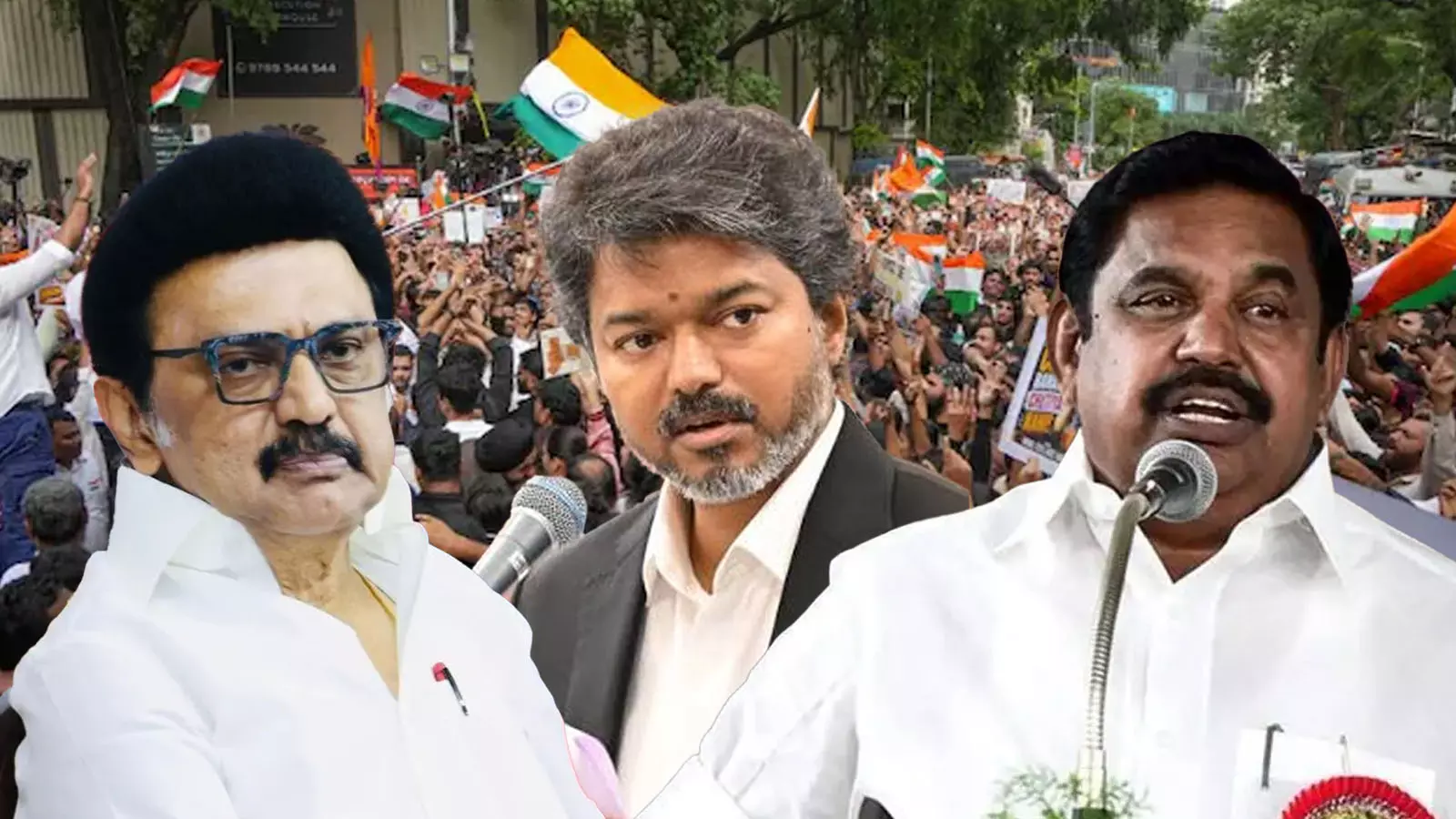
The restrained responses of the TVK and DMK reveal a major shift in how Tamil Nadu handles Centre-state issues; the AIADMK has been hit by organisational woes
The anti-NEET protests at New Delhi’s Jantar Mantar have become more than a movement against alleged irregularities in a national examination. They have also become a test of Tamil Nadu’s political parties. For decades, politics in the state was shaped by ideological contestation. Since the rise of the Dravidian movement and the political transformation of 1967, parties have differentiated themselves by their positions on social justice, federalism, language, secularism, and state autonomy.
Also read: Setback for TVK govt: HC quashes job orders for Karur stampede victims’ families
Electoral competition was intense, but it was anchored in identifiable ideological commitments. The responses to the recent NEET protests, however, suggest that this political culture is changing. The major parties continue to speak the language of ideology, but their actions increasingly reflect political calculation. The issue is therefore not simply how the Dravida Munnetra Kazhagam (DMK), the All-India Anna Dravida Munnetra Kazhagam (AIADMK), and the Tamilaga Vettri Kazhagam (TVK) responded to the protests.
It is whether ideology still guides political action to the extent it once did.
DMK has opposed NEET throughout yet
The DMK illustrates this shift most clearly. No party has opposed NEET more consistently. It has demanded the abolition of the examination, passed Assembly resolutions against it, and appointed the A K Rajan Committee, whose report concluded that NEET disproportionately disadvantaged students from rural, government schools, and economically weaker backgrounds.
The report served as the intellectual basis for the party’s opposition to NEET.
Given this history, the DMK was expected to lead the present movement. It expressed solidarity, and MP A Raja met fasting activist Sonam Wangchuk and student representatives at Jantar Mantar. Beyond that, however, the party’s mobilisation remained limited. Its student and youth wings were not deployed on a significant scale. Even in Parliament, it focused more on the Mekedatu issue than on building a coordinated opposition campaign around NEET.
The DMK exercised restraint despite its long campaign against NEET. The AIADMK remained subdued because of organisational weakness and alliance constraints. The TVK responded much like other governments confronted with public protests.
This restraint is striking because the protests presented an opportunity to reinforce one of the party’s most consistent ideological positions. For a party that has historically converted ideological issues into mass political mobilisation, such caution marks an important departure from its traditional style of politics. Instead, the DMK appeared to calibrate its response carefully.
The explanation seems to lie in changing political priorities. Nationally, its relationship with the Congress has become less certain. Within Tamil Nadu, the rise of the TVK has created a new electoral challenge. Recent statements by some party leaders that the DMK would oppose the Union government only on issues affecting Tamil Nadu also reflect a more selective political approach.
Also read: Why Karnataka is pushing to replace NEET with its own CET
This may be politically pragmatic, but it marks a departure from the party’s long-standing image as a national ideological opponent of the BJP. Political strategy now appears to influence when and how ideological positions are asserted.
AIADMK restricted by internal turmoil, BJP alliance
If the DMK reflects the pull of electoral strategy, the AIADMK presents a different but equally revealing picture. It has consistently supported exemption from NEET for Tamil Nadu, yet its response to the protests was equally restrained. Unlike the DMK and TVK, whose restraint appears to reflect political choice, the AIADMK’s restraint appears to reflect diminished political capacity.
Internal divisions, electoral setbacks, and weakening organisational strength have reduced the party’s capacity for mobilisation. Its alliance with the BJP further limits its ability to campaign aggressively against a policy associated with the Union government. Political weakness has overridden ideological commitment.
TVK's changed approach after coming to power
The TVK-led government presents another form of contradiction. Before coming to power, it strongly opposed NEET and criticised both the DMK and AIADMK for failing to abolish it. It also promised to defend Tamil Nadu’s interests against the BJP. These positions created expectations that it would stand firmly with the student movement once in office.
Instead, the government adopted a different approach. Permission for protests was denied in several places, demonstrators were detained, and even some allies questioned the government’s response. Maintaining public order is a legitimate responsibility of any government. Yet, using police action against protesters on an issue the government itself officially opposes inevitably raises questions about the balance between governance and political commitment.
The government’s response also suggests that the realities of office have begun to reshape its political approach. Like many parties that move from opposition to government, the TVK appears to be discovering that administrative responsibility imposes political constraints that do not exist in opposition. Chief Minister Vijay has repeatedly indicated that his government will avoid unnecessary confrontation with the Governor and the Union government.
Also read: How India's new anti-paper leak law can improve its exam structure
This differs from the long tradition of Tamil Nadu politics, where confrontation with the Centre was often viewed as necessary to protect state interests. Whether this reflects administrative pragmatism or a broader political strategy remains to be seen. What is already evident is that its conduct in government has been considerably more cautious than its rhetoric in opposition. Like the DMK and AIADMK, the TVK also appears to be balancing ideological commitments against political calculation.
TVK, DMK, AIADMK response has common pattern
Viewed together, the responses of all three parties reveal a common pattern. Their official positions on NEET remain unchanged, but their political responses were shaped by immediate circumstances. The DMK exercised restraint despite its long campaign against NEET. The AIADMK remained subdued because of organisational weakness and alliance constraints. The TVK, despite promising a different political culture, responded much like other governments confronted with public protests.
The three parties arrived at different political responses for different reasons, but the underlying logic was the same: immediate political considerations took precedence over ideological mobilisation. This convergence points to a larger transformation in Tamil Nadu politics.
Also read: Jana Nayagan FDFS: Cheers, tears as Vijay bids farewell to the silver screen
For decades, parties derived their legitimacy from ideological commitments. Voters could identify clear differences in how they viewed social justice, federalism, secularism, and Centre-state relations. Those distinctions now appear less visible in political practice than in political rhetoric.
This does not mean ideology has disappeared, nor does it mean the parties have become identical. Rather, ideology alone no longer explains political behaviour. Electoral arithmetic, coalition management, governance, and emerging political rivalries increasingly shape political decisions. Political practice is becoming increasingly contingent on electoral calculations, even when ideological language remains unchanged.
(The Federal seeks to present views and opinions from all sides of the spectrum. The information, ideas or opinions in the articles are those of the author and do not necessarily reflect the views of The Federal.)