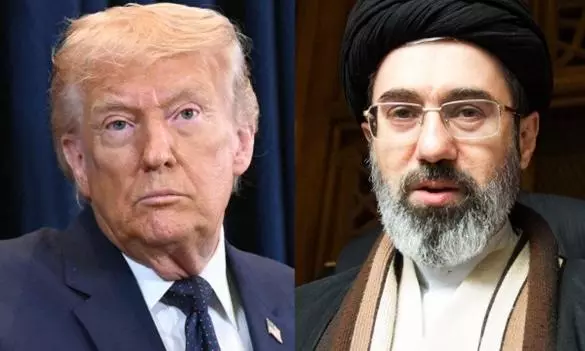
The prospects of an interim deal between the US and Iran have now become more reachable than in the past.
This arrangement will, according to multiple reports in responsible sections of the International media, include an extension of the current ceasefire for a period of sixty days, opening of the Strait of Hormuz and the lifting of the US blockade of Iranian coast and its ports, and the lifting of US sanctions on the sale of Iranian oil.
The MOU period
It also commits the two countries to hold negotiations on Iran’s nuclear enrichment programme and its stock of 400 kilogrammes of enriched uranium during this 60-day MOU period, which may be extendable.
This arrangement will be put in a Memorandum of Understanding (MOU) between Iran and the US which, if reached, will be signed, in all likelihood, in Islamabad. Pakistan Prime Minister Shehbaz Sharif, posted on X on May 24, “Pakistan will continue its peace efforts with utmost sincerity and we hope to host the next round of talks very soon”.
If President Donald Trump is to be relied upon, the MOU has been “largely negotiated”.
Trump has spoken about the MOU, in the past couple of days, to the leaders of Saudi Arabia, UAE, Qatar, Bahrain, Egypt and Turkiye. He has also spoken to Pakistan’s Chief of Defence Staff, Field Marshal Asim Munir, who visited Iran to advance the MOU. Pakistan’s Interior Minister Mohsin Naqvi was already in Iran to hold discussions on the MOU.
The Pakistani duo were significantly joined by a Qatari team to give heft to the mediation. There is no doubt that Pakistan continued to act as intermediaries between Iran and the US. On May 22 Secretary of State Marco Rubio said “The primary interlocutor on all this has been Pakistan and continues to be and they’ve done… an admirable job”.
Incentives for Trump and Iran
While Trump has all through the Iran war, before the ceasefire was announced on April 8 and afterwards, made so many contradictory statements that it is almost impossible to take any of his remarks at face value, he has not spoken to so many leaders of Muslim countries, one after the other, in the past.
This gives credence to a serious intent in the negotiations and that substantial progress has been made. Besides, there is little doubt that Israel is now not being allowed to influence US-Iran negotiations going on through Pakistan.
This will naturally be a blow to Israel Prime Minister Benjamin Netanyahu but there is little that he can do. Finally, Trump’s approval ratings are falling, the price of petrol is rising and the November mid-term is now closer on the horizon. This is a pressure point for Trump because it is making a large section of the Republicans who will contest the election nervous. All these are incentives for Trump to get the MOU.
It has to be noted that reports indicate that Supreme Leader Mojtaba Khamenei has decided that the enriched material will not be given up. The real issue will, of course, be if this war would result in Iran getting committed to get nuclear weapons in course of time.
On the Iran side too there is a need for the MOU and there are the pragmatists like President Masoud Pezeshkian, who would like it to go through. However, the tough ‘boys’ in the Revolutionary Guards, according to some reports, have reservations. These relate to the Strait of Hormuz (SOH) . They would not like to give up controlling the passage of vessels and also continue to charge a toll.
It is possible that the pragmatists will prevail because they know that the world will not accept either Iran singly or jointly with Oman controlling SOH, leave alone charging tolls.
Nuclear issue
If an MOU without an Iranian commitment not to enrich uranium in perpetuity or giving up their 400 kilogrammes of enriched uranium either fully or partially is signed then it would be a blow to Trump’s credibility. No extent of clarification like the one given by Pezeshkian that Iran does not intend to make nuclear weapons or obfuscation would be able to contain the blow. The blow would remain even if the MOU contains Iranian commitments to negotiate the nuclear issue and Trump vows that military activity will resume if Iran does not agree to US terms on the nuclear issue.
If Supreme Leader Mojtaba Khamenei finally gives his consent then the MOU may be signed in Pakistan by the middle of this week. The world will be greatly relieved at the opening of the Strait of Hormuz
It has to be noted that reports indicate that Supreme Leader Mojtaba Khamenei has decided that the enriched material will not be given up. The real issue will, of course, be if this war would result in Iran getting committed to get nuclear weapons in course of time.
This would be despite all the commitments they may choose to make. At one level, that is a lesson they would have learnt from the decapitation strike.
If Supreme Leader Mojtaba Khamenei finally gives his consent then the MOU may be signed in Pakistan by the middle of this week. The world will be greatly relieved at the opening of the Strait of Hormuz even though the restoration of status quo ante in respect of hydrocarbon supplies from the Gulf will take, at a minimum, many months.
There may be a wariness in the Gulf countries to invest money in any major projects, including in the hydrocarbons sector, till the MOU is converted into an agreement. That is not going to be easy.
Thus, the MOU will be globally hailed but imponderables will remain.
(The Federal seeks to present views and opinions from all sides of the spectrum. The information, ideas or opinions in the articles are of the author and do not necessarily reflect the views of The Federal)