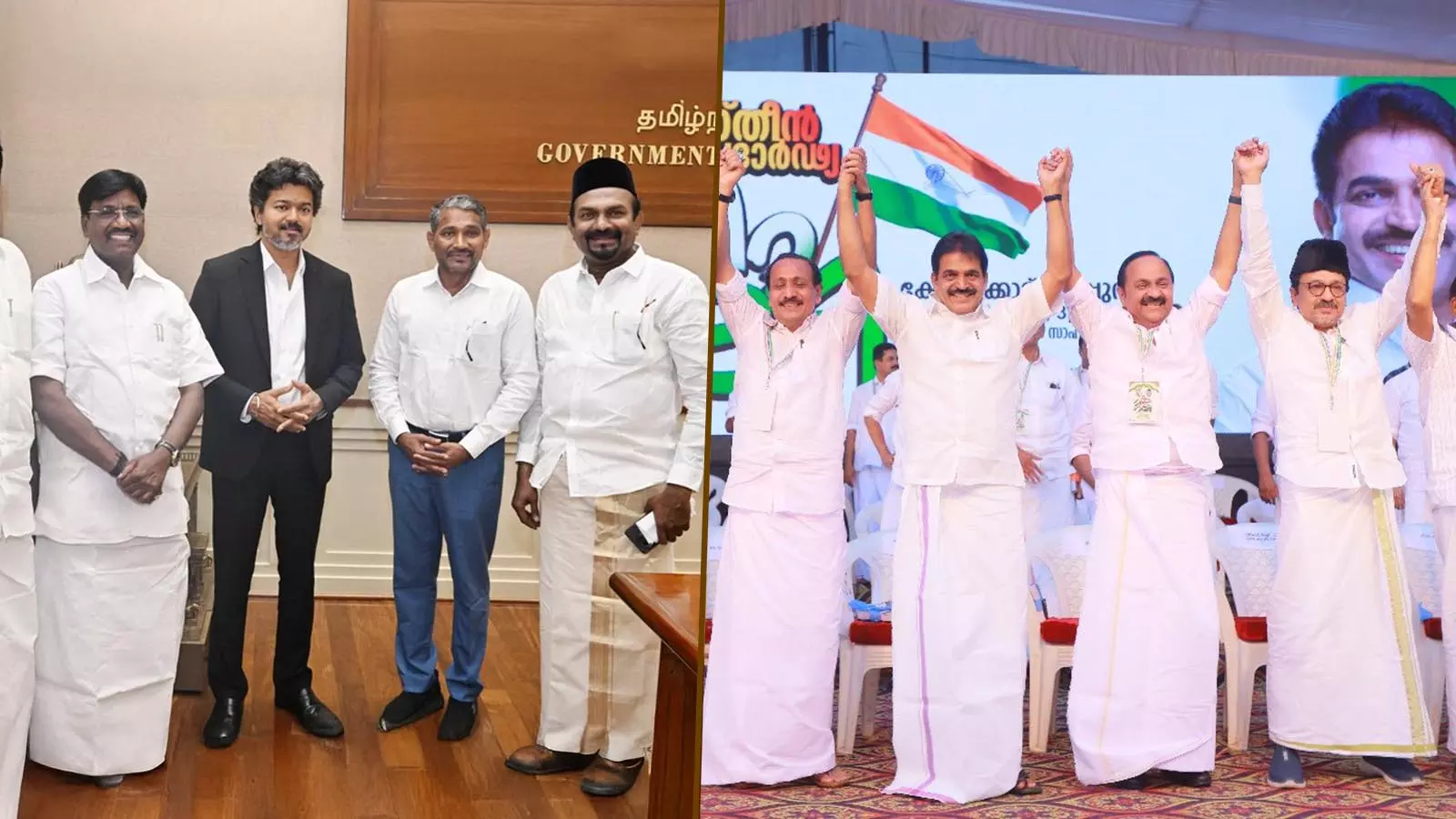
As Muslims get squeezed out of northern politics, the IUML's first Cabinet berth in Tamil Nadu shows a quieter path to real power
The way political parties talk about secularism and minority rights in India is beginning to change. For a long time, mainstream parties preferred using broad, comfortable terms like "minorities" rather than addressing specific communities directly.
However, recent discussions within national coalitions suggest a growing realisation that avoiding direct language often dilutes the actual issues. In South India, this change is moving past party discussions and turning into a real shift in how power is shared.
Instead of keeping minority communities on the sidelines or treating them merely as reliable voting blocs, a new approach to political partnership is taking shape within a democratic framework.
IUML’s entry into TN Cabinet
The political landscape in Tamil Nadu after the 2026 assembly elections has created a new precedent. In an election where the Tamilaga Vettri Kazhagam (TVK) emerged as the single largest party but needed alliances to form a stable government, coalition partnerships became essential. A key part of this new arrangement is the Indian Union Muslim League (IUML).
Also read | How Muslim groups are reshaping Kerala politics and reform debate
With the appointment of AM Shahjahan — the newly-elected IUML legislator from Papanasam — as the Minister for Minority Welfare, the party has entered the Tamil Nadu Cabinet for the first time. Working alongside Syed Farooq Basha, who won the Vaniyambadi seat, the IUML has moved from simply supporting a front to actively participating in governance.
For decades, representation for Muslims in Tamil Nadu usually meant having a few individual leaders chosen from within the larger Dravidian parties. The direct inclusion of an independent, identity-based party into the ministry marks a transition from symbolic representation to actual power-sharing.
A tale of two states
To understand how the IUML operates, it helps to look at the very different social and demographic realities of Kerala and Tamil Nadu.
In Kerala, Muslims make up about 26.56 per cent of the population, with a strong presence across the Malabar region. This substantial demographic base has made the IUML the second-largest partner in the United Democratic Front (UDF) for decades.
For decades, Muslim representation in TN usually meant having a few individual leaders chosen from within the larger Dravidian parties. The direct inclusion of the IUML into the Vijay ministry marks a transition from symbolic representation to actual power-sharing.
The party regularly handles major portfolios like Education, Industries, and Public Works, using its position to build educational infrastructure and foster economic growth while keeping radical political groups at bay.
Also read | Kerala polls: How secular consolidation defeated the Left's social engineering gambit
Tamil Nadu presents a different picture, where Muslims account for 5.86 per cent of the population. The community is more spread out, with specific electoral influence in pockets like Vaniyambadi, Ambur, Kayalpatnam, Ramanathapuram, Thanjavur, and Tiruchirappalli.
Historically, Tamil Muslims largely aligned with the broader Dravidian identity, feeling that their interests were well protected by the secular platforms of the DMK and AIADMK. Over time, the rise of other outfits like the Manithaneya Makkal Katchi (MMK) and various regional groups also meant that the community's political voice was divided.
The 2026 election shows that even where a community is a small minority numerically, a practical approach to coalition politics can lead to a role in governance.
Alliances vs polarisation
The political path seen in the South differs significantly from the trends in Northern and Western India. In states like Uttar Pradesh and Bihar, the breakdown of old secular coalitions often left minority voters isolated.
By remaining part of mainstream regional alliances — whether the UDF in Kerala or the TVK alignment in Tamil Nadu — the IUML ensures its political survival and relevance.
Past governance failures — such as the handling of the 1989 Bhagalpur riots in Bihar and the deep-seated developmental backwardness later highlighted by the Sachar Committee Report in 2006 — created a gap in leadership. In many northern states, this gap led to the rise of sharp, isolated identity-based parties, which often triggered a counter-mobilisation of majoritarian votes.
Also Read: VCK, IUML in TVK coalition: DMK’s ‘bent coconut tree’ jibe sparks row
The strategy seen in the South, particularly with the IUML, works differently. By remaining part of mainstream regional alliances — whether the UDF in Kerala or the new TVK-led alignment in Tamil Nadu — the party ensures its political survival and relevance. This collaborative approach makes it difficult for opposing forces to label the party as exclusionary, since its mandate is tied to a multi-community alliance.
Broadening horizon
With the IUML holding significant influence in Kerala and now a Cabinet position in Tamil Nadu, the dynamics of minority representation in South India are expanding. This presence in two neighbouring states gives the party a broader platform to discuss minority rights within the framework of constitutional politics.
The takeaway from these developments is straightforward: when mainstream parties avoid addressing specific communities out of electoral hesitation, those communities naturally seek their own political voice.
However, as the recent shifts in the South show, this does not have to lead to political division. By focusing on regional alliances and constitutional bargaining, it is possible for a community to preserve its identity while actively participating in the wider democratic process.
(The Federal seeks to present views and opinions from all sides of the spectrum. The information, ideas or opinions in the articles are of the author and do not necessarily reflect the views of The Federal)