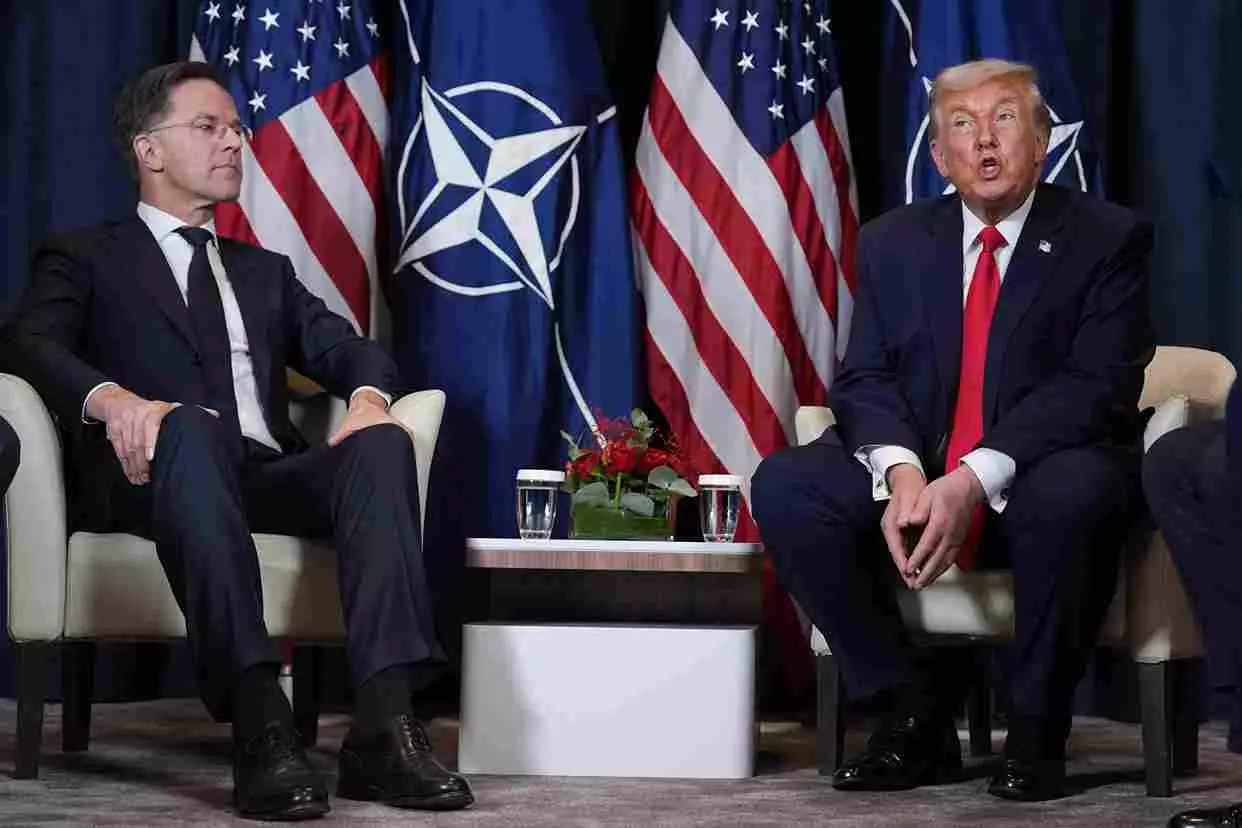
President Donald Trump, right, meets with NATO Secretary General Mark Rutte during a meeting on the sidelines of the Annual Meeting of the World Economic Forum in Davos, Switzerland on Wednesday. Photo: AP/PTI
From North Korea to Iran, Trump’s ploy of bluster and retreat has marked his leadership style; will he now quietly accept a Greenland formula after Davos?
During his speech at the World Economic Forum in Davos on December 21, President Donald Trump reiterated his desire to acquire Greenland for the sake of the national security of the United States.
Amidst his denunciation of Denmark for not agreeing to sell the territory to the US, and, of those European countries who are standing with the Nordic country, Trump made one very significant observation – he ruled out using force to achieve his objective. This was a great comedown from his earlier assertion that one way or another the US will get Greenland. He had also said that it was for Denmark to decide if it wanted the process to go the hard way or the easy way.
Europe and, to an extent, the rest of the world heaved a sigh of relief. However, according to media reports, some European distractors of the American President exchanged a one-word message on their smartphones – TACO – at Trump’s climbdown. The acronym stands for ‘Trump Always Chickens Out’. This disparagement is not surprising because there have been some earlier situations when Trump has made threats but not carried them out. Three come to mind.
Trump's empty threats
In his first term, he had warned the North Korean leader Kim Jong Un to unconditionally give up his nuclear weapons or be prepared for consequences. Later, he agreed to negotiate with Kim and held three summits to persuade him to accept denuclearisation. He even stepped into North Korea in 2019 by going across the Demarcation Line between North and South Korea.
Kim did not accept Trump’s demands and the US leader lost interest in North Korea. That has continued till now. In the North Korea case, Trump did not show the stamina to attain his objective.
Also read: Trump says framework reached for Greenland deal, cancels EU tariff threat
In 2017 and 2018, Trump had threatened Pakistan with dire consequences for supporting the Taliban. He had accused it of duplicity by pretending to support US policies in Afghanistan for which it got enormous financial disbursements. Trump indicated that all through this period it had been a reliable partner of the Taliban, a group which had killed around 2,500 US defence personnel and had engaged the US in a war which lasted almost 20 years.
Not only did Trump not carry out his threat against Pakistan, he accepted a humiliating defeat, when the US signed an agreement with the Taliban in February 2020. Under its terms, the US agreed to withdraw its forces and the Taliban agreed not to attack US troops in Afghanistan. Ultimately, the US withdrew from Afghanistan in disarray in August 2021, and the Taliban returned to power.
While Joe Biden was the US President when US troops withdrew, the fact is, that it was Trump who had entered into a deal with the Taliban which led to that situation. It is a different matter that Pakistan and the Taliban have fallen out. It is also noteworthy that US-Pakistan relations have moved ahead positively in Trump’s second term.
Recently, in the wake of the demonstrations and protests in Iran, Trump encouraged the protestors. He assured them that help was on the way. He also warned Iran that he would use force if it killed protestors. He especially mentioned that none of the protestors should be executed. It appears that none were.
It would seem that when Trump is able to take unilateral action, he makes good on his threats. However, if there is opposition to his plans, he carefully weighs his options and has no reluctance to walk away from his warnings if he feels that it is in his interest to do so.
This indicates that there was some communication between Iran and the US through third countries. Reports also indicate that the Iranian authorities killed around 2,500 protestors. Trump’s warnings to Iran not to kill protestors were not translated into action. His encouragement of the protestors proved hollow. These instances relating to North Korea, Pakistan-Taliban and now Iran give credence to the charge contained in the acronym TACO against Trump.
Also read: Trump’s Europe threats risk lasting damage to US global credibility
However, at the same time, there are cases where he has used force, breaking international norms. This was seen in his ordering the killing of the Iranian Revolutionary Guard’s General Qasem Soleimani in January 2020, the bombing of Iranian nuclear sites in June 2025, and the capture and extrication of Venezuela’s President, Nicolas Maduro, and his wife from Caracas on January 3 this year.
Mercurial approach
Therefore, there are occasions when Trump carries out the threats he makes about using force, while at other times he backs down. It would seem that when he is able to take unilateral action, he makes good on his threats. However, if there is opposition to his plans, he carefully weighs his options and has no reluctance to walk away from his warnings if he feels that it is in his interest to do so.
Unlike traditional leaders who carefully weigh their words and do not make empty threats Trump does so. This is part of the negotiating tactics he used as a businessman. The problem is that as he holds the world’s most powerful executive office his statements cannot but be taken seriously, especially, when they concern the use of force. This creates great global turbulence in inter-state relations and also has major economic implications especially on stock markets.
Trump met with NATO Secretary General Mark Rutte in Davos after delivering his speech. Following this meeting, he posted on Truth Social, “Based upon a very productive meeting that I had with the Secretary General of NATO, Mark Rutte, we have formed the framework of a future deal with respect to Greenland and, in fact, the entire Arctic Region. This solution, if consummated, will be a great one for the United States of America, and all the NATO Nations. Based upon this understanding, I will not be imposing tariffs that were scheduled to go into effect on February 1. Additional discussions are being held covering the Golden Dome as it pertains to Greenland. Further information will be made available as discussions progress”.
Trump has made Vice-President Vance, Secretary of State Marco Rubio and Special Envoy Steve Witkoff in charge of the discussions. They will report to Trump himself.
Formula for Greenland
Trump’s threats had greatly alienated European countries, some of whom decided to send small contingents to Greenland, ostensibly to carry out exercises. They were France, Germany, Sweden, Norway, Finland, Holland and Britain, who are all part of NATO. Hence, the military alliance which has been a vital element in the security structure of the West since its establishment in 1952 came under unprecedented strain.
Also read: Trump's world: Are global leaders sleepwalking into World War I-like crisis?
The real issue is if Trump would be willing now to accept a formula on Greenland, which will permit the US to put up as many bases as it needs with Denmark retaining sovereignty over the world’s largest island.
Trump’s readiness to lift the threat of enhanced tariffs would seem to indicate that he may accept a deal which involves a compromise on his part. But whatever be its shape and form he would not allow either China or Russia to have ingress into Greenland. Other NATO countries are likely to go along with this demand.
Following his meeting with Rubio and Vance in Washington on January 14, Danish Foreign Minister had said that the US and Denmark had “fundamental differences” on Greenland. Now, both sides will have to bridge them. It remains to be seen though how seriously Trump will pursue the Greenland issue now.
(The Federal seeks to present views and opinions from all sides of the spectrum. The information, ideas or opinions in the articles are of the author and do not necessarily reflect the views of The Federal)