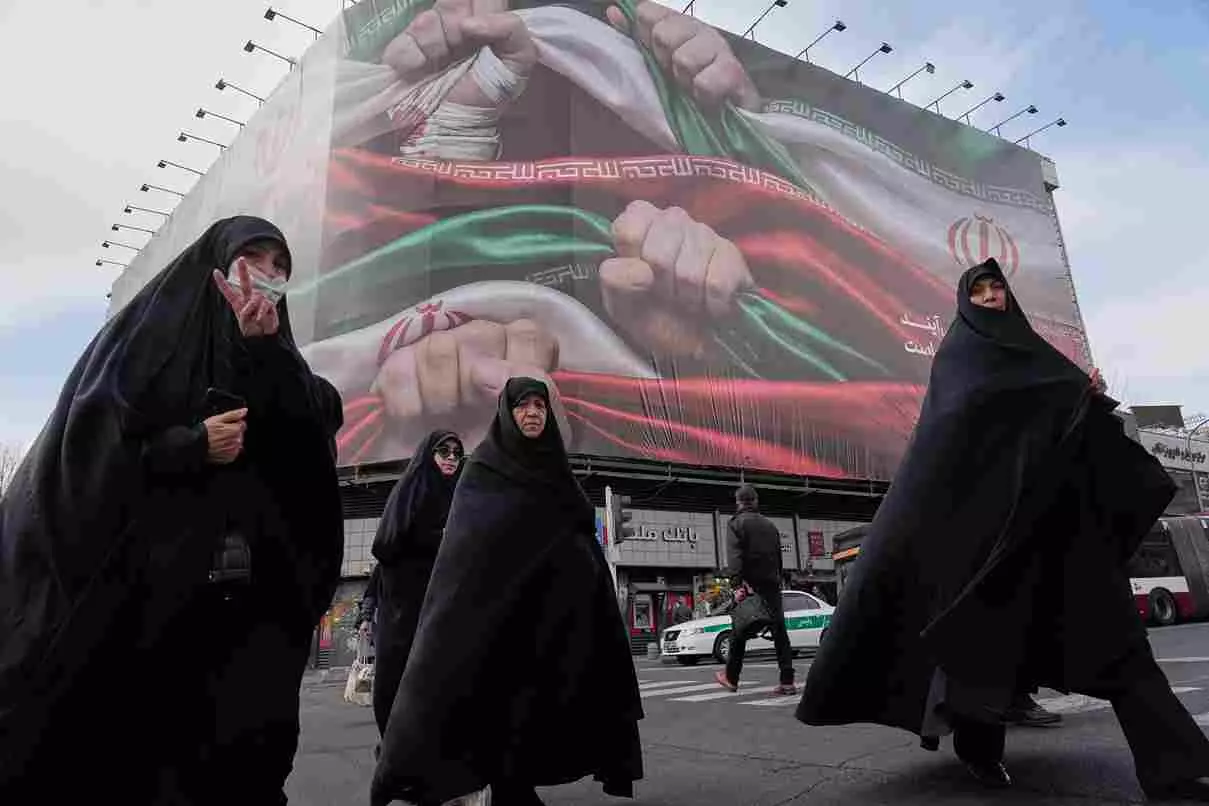
What is striking about United States President Donald Trump’s threat to intervene in Iran’s ongoing turmoil is the brazenness of his actions. And worse, its acceptance in the rest of the world. Whatever Trump does, however illegal as per international law, has now been normalised.
Trump’s reason for an imminent intervention – the deaths of protesters – is flimsier than that of the recent kidnapping of Venezuelan President Nicolas Maduro where he was projected as the kingpin of a drug smuggling cartel. After his abduction, nothing more has been said about the drug smuggling accusation.
The US president changed tack to focus on Venezuelan oil and his intention to control its production and trade. By this, Trump has shown utter disdain for the concept of sovereignty.
Riding roughshod
In the case of Iran, over 2,000 protesters have reportedly been killed in police action and hundreds arrested over the last few days. If Trump’s heart is genuinely bleeding for the deaths of people, he could have focussed his attention on Myanmar, Sudan and Yemen where thousands have been killed and are continuing to die in ongoing internal conflicts.
When Israel’s genocidal attacks were on in Gaza, after the October 7, 2023 Hamas attacks, Trump – in his 2024 election campaign – was in fact quoted as asking the Benjamin Netanyahu government to “finish the job” – so much for his concern for human lives! As President, he did get a ceasefire deal to end the attacks, but that was after the job was done – after the reported massacre of nearly 70,000 Palestinians and the destruction of Gaza.
Trump’s next target – Iran – is being reported in the media as if it is the most natural thing for the US to be doing.
In comparison, during the run-up to the invasion of Iraq, in 2003, the then US administration of George W Bush had embarked on a lengthy build up to justify its action. Bush claimed the regime of the then Iraq President Saddam Hussein had piled “weapons of mass destruction” – meaning an arsenal of banned chemical and biological weapons, ready for use.
The US linked Saddam to the al-Qaeda chief Osama bin Laden and the 9/11 attacks to create the appropriate narrative and make the invasion acceptable. Bush approached the United Nations Security Council to get its clearance. Russia and France expressed opposition to the invasion. Before the proposal was formally vetoed, the US went ahead and invaded Iraq.
The point is the US tried to get popular acceptance for its action, whatever its arguments were. As it turned out, they were all spurious – the US simply wanted regime change in Iraq.
But now, Trump has openly announced his intention to intervene in Iran – militarily, expected to be a targeted strike on the Ayotollah Khameini dispensation, its infrastructure including that housing the Revolutionary Guards and anything else that is crucial to the Islamic regime. The attack would be similar to the June 2025 US missile strike on Iran’s atomic reactor at Fordow that has since, crippled the nation’s nuclear programme.
Mossad's open support
With Trump, at his imperious best, riding roughshod over the world and his ally Netanyahu achieving huge successes strategically – breaking the Iran-Hezbollah-Hamas-Syria axis and leaving Tehran handicapped, all the US needs to do is to choose the time of its attack. Israel’s intelligence services Mossad, which always keeps a low profile, perhaps for the first time in such operations, has officially stated it is marching with Iran’s protesters.
In a post on X, quoted by Israeli media, the Mossad told Iranian protesters it will join them in their demonstrations. “Go out into the streets. The time has come. We are with you. Not only from a distance and verbally. We are with you in the field”.
Since the last two months, around 10 suspected Mossad agents – all Iranians, have been executed. Referring to the 12-day war on Iran, culminating in the US missile strike, reports quoting a Mossad official has said there were at least 100 agents who did the preparatory work on the ground. They were given the job of destroying Iran’s air defence systems and missile launchers, which they did just prior to the start of Israel’s strikes on its nuclear facilities.
Though Mossad has always been known to be active in Iran, its post on X clears all doubts on this score. It is also in tandem with Trump’s no-holds barred threats to Iran and his move to impose punitive tariffs of 25 per cent on nations trading with Iran.
The European nations, allies of the US, just don’t seem inclined to resist Trump. They did not in 2016, when Trump revoked the nuclear deal with Iran. Now, the EU has totally capitulated with the European Commission saying it will add to the sanctions imposed by the US. As for Russia, it is caught up in the war with Ukraine. China has its own deals with Trump, and is not likely to do anything other than a statement or two protesting US actions.
That leaves Iran completely isolated.
Efforts against Iran's regime
Iran has faced several crises in the past, with US-led allies making periodic attempts to dislodge the government, in most cases using dissidents within the Islamic nation. But the first attempt was a direct attack. In 1980, a year after the revolution its neighbour Saddam Hussein, instigated by the US, tried to invade Iran triggering a war that lasted eight years.
Iran managed to resist the Iraqi offensive, and the Islamic regime survived and even flourished after that. Besides this, over the years, there have been several agitations by secular-liberals, moderates and pro-reform sections that haven’t succeeded in regime change.
The reasons for the various agitations have been genuine and the protests a democratic expression of sections of people – like the hijab controversy and the opposition by a section of women following the death in police custody of Mahsa Amini, who was arrested for not wearing the veil.
But, willy-nilly the US and its allies have used every opportunity to infiltrate and turn them into mass agitations to unseat the regime. All of them have failed, thus far. The Iranian government has almost always delegitimised protests calling it an interference by foreign forces.
In the process, US-backed attempts at regime change have until now backfired, ironically resulting in the consolidation of the Islamic regime.
Anti-US sentiment
This time it looks different. Despite successfully resisting external manoeuvring, Iran has never seemed as vulnerable than now. Economic sanctions over the last several years have severely weakened the country, military setbacks including to its allies in the region have curtailed its heft in the region and internally, the regime’s biggest support base comprising small businesses, or the bazaar, has turned against the government due to the severe economic squeeze.
Trump’s strategy – to enforce regime change – however appears simplistic. Venezuela is in the US’s neighbourhood, so it was still possible to take out Maduro without a large-scale invasion. But Iran is on a different scale, the huge distance being just one of them. The mayhem that Iraq experienced after the 2003 invasion gives a clue to what one can expect in the event of a US attack on Iran.
The Islamic regime came to power, nearly five decades ago, as the result of a popular revolution. Ayotollah Khameini is not the typical dictator in the classical mould, and the Islamic Council he heads is not directly involved in the day-to-day running of the government though it needs to clear policy decisions. He is also revered as one of the spiritual heads of the world’s Muslim Shia population.
Iran’s political structure is a vast organisation that is networked and interlinked from the top to the bottom, backed by the Islamic Revolutionary guards who are not just professional soldiers but ideologically driven. A targeted strike might demolish a building or cause damage to crucial infrastructure and maybe even eliminate some top leaders, but Iran’s institutional framework has redundancies and exigencies to replace any individual.
Take the case of Qasem Soleimani who was killed in a US strike in 2020, ordered by Trump during his first term. As head of the Quds Force within Iran’s Revolutionary Guards, he had a legendary reputation and was considered irreplaceable. But once he was killed, he was replaced by his deputy Esmail Qaan, and the division continues to operate.
US President John F Kennedy was assassinated but that did not mean the government collapsed. There were systems in place to swiftly appoint vice-president Lyndon Johnson in Kennedy’s place.
To imagine that Iran does not have a similar structure in place is foolhardy, largely an outcome of ignorance and hubris. The US, in the case of Iraq, expected to be welcomed and treated with gratitude after the ouster of Saddam Hussein. After a staged initial celebration, reality kicked in.
Large sections of the Iraqi military, bureaucracy and a section of political forces under Saddam turned against the US resulting in a mess that deeply affected the region, the consequences of which the world is still experiencing. The rise of the Islamic State, for instance. Today, much of the US’s establishment considers its Iraqi invasion a strategic error.
In the case of Iran, if Trump carries out his threat and intervenes militarily in any form, the resulting consequence is too horrific to comprehend.
Fifty years since the revolution, large sections of the Iranian population continue to be anti-US. As history shows, a change in regime brought about by an internal revolt is qualitatively different from one that is imposed from the outside – Trump would do well to understand that.