A routine shipping practice has been recast as a conspiracy involving 40 nations; Trump administration's paper offers no evidence, and India should demand it
Water covers nearly 71 per cent of the Earth’s surface. Hence, historically, travel and movement of goods was primarily by water—on sailing boats and vessels. Ports developed along the coast to cater to them. The development of cheap air travel and improved land routes dramatically reduced the pressure on vessels for passenger travel except in hinterland riverine routes, and now those are largely restricted to leisure tourism.
However, sending goods by sea is the most cost-effective way of moving large volumes of freight and heavy cargo across international borders. They are also a geographical necessity; oceans separate continents, and movement by sea is the most practical.
The advent of container shipping, when entrepreneur Malcom McLean first sent 58 shipping containers in 1956 from Newark to Houston, revolutionised maritime transport.
Today, an estimated 65 million containers move on 7,000 container ships across the globe. There are more than 13,500 ports, with over 7,000 active ports and 700-plus shipping and logistics hubs. According to the UN Trade and Development (UNCTAD), more than 80 per cent of all globally traded goods, accounting for roughly 12-13 billion tonnes of cargo by volume, move on maritime routes.
Transshipment: A global reality
The shipping industry also spawned transshipment ports. Transshipment is a process (as distinct from transit) whereby cargo, usually containerised cargo, is shifted from one vessel to another while in transit to its final port of discharge. So, containers loaded in the port of origin are unloaded in a transit port and put on another vessel in which they reach the destination.
Also read: With 'friends' like America, India is learning the cost
Transshipment happens for multiple reasons—because there is no direct connection between ports or because large vessels (mega-vessels capable of carrying up to 24,000 20-foot containers or 12,000 40-foot containers) do not have discharge facilities in the destination port and the cargo needs to be shifted to a smaller vessel.
Today, Singapore, Shanghai, Busan, Jebel-Ali, Colombo, and Rotterdam are specialised container transshipment hubs
What is transshipment?
♦ It's the process wherein cargo is unloaded from one vessel and reloaded onto another in a different port during transportation
♦ The cargo is shipped from point A to point B via point C, where it is unloaded and reloaded. From point C, the cargo goes to the destination.
India, realising the advantage of having one, is developing Vizhinjam port in Keralam as a transshipment hub. Transshipment is thus a commercial and shipping reality in today’s globalised world.
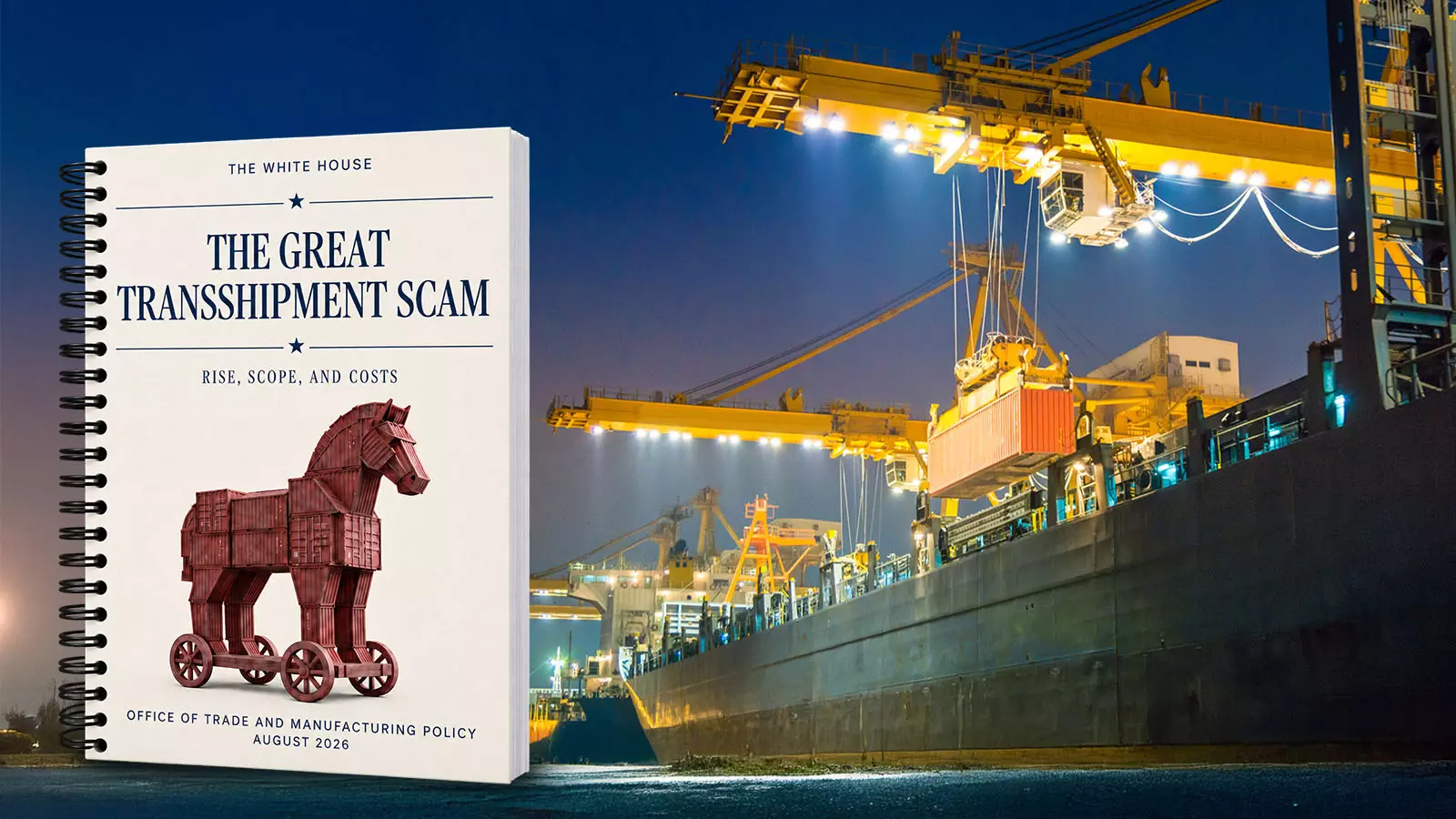
It is in this background that one must examine the White House's August 2026 release titled The Great Transshipment Scam.
Wild allegations
The paper suggests that the US is facing the threat of illegal transshipment of goods to evade applicable tariffs and alleges that as many as 40 countries are “associated with illegal transshipment risk”. The paper alleges that Chinese exporters are using the transshipment route to escape/evade the elevated tariffs imposed on their products.
The US President’s exercise of Emergency Economic Powers to impose tariffs ranging from 10 per cent to 50 per cent was struck down by the US Supreme Court. This has not deterred the US administration from exploring and imposing tariffs under other provisions.
Also read: Trump’s Iran war: Why the US midterms could change the game
Thus, in utter disregard for the WTO’s Most Favoured Nation (MFN) requirement, a core principle of international trade which stipulates that all trading partners be treated equally, the US currently has different tariffs for different products/countries. Chinese imports are put through a variety of provisions (Section 301 tariffs, forced labour clause, Trade Expansion Act on national security grounds) and subject to as much as 22 per cent tariffs.
‘Ugly sister city’ phenomenon
What the paper alleges—with scant proof, except for a decrease in Chinese imports and an overall increase in imports into the US from other countries—is that the US is being subject to a “transshipment scam”. Forty countries, said to be part of China’s “Shadow Transshipment Network”, include Mexico, Canada, India, Japan, South Korea, Indonesia, Jordan, and the UAE, with some countries, including India, being Tier 1.
The paper suggests that China-linked exporters go to these countries because they offer cheap labour, weak customs enforcement, strategic port access, and bonded warehousing facilities. The tariff loss has been projected to be anything between $40 billion and $303 billion, apart from a loss of jobs and impact on GDP. It mentions a loss of 5,300 jobs for every $1 billion increase in trade deficit.
The paper speaks of the “ugly sister city” phenomenon—these are supposed to be cities that handle specific products that impact American manufacturing corridors and jobs. Nine cities, including Pune-Gujarat-Chennai, have been identified with respect of pumps and compressors. The corresponding US manufacturing corridor is said to be Cincinnati-Dayton-Columbus.
Sweeping generalisations
The White House paper is extraordinary, to put it mildly, in its sweeping generalisations and conclusions with little evidence. The paper acknowledges a fall in Chinese imports, but if the purpose of the reciprocal tariffs was to cut imports, they have spectacularly failed.
US imports rose from $2.41 trillion in 2017 to $3.50 trillion in 2025. As Ajay Srivastava, founder of the Global Trade Research Initiative or GTRI, has pointed out, China also adapted — it now sends more components and intermediate products rather than finished products, which are incorporated in new products.
Also read: Defiant Tehran pushes Trump into globalising Iran war
While the paper acknowledges the need to “distinguish legitimate manufacturing and substantial transformation from pass-through trade”, it blurs this distinction, and is silent about the US importer who has to misdeclare the country of origin for a violation to take place and needs to be penalised, not the countries where transshipment takes place.
Furthermore, the Rules of Origin (RoO) contemplate a change in tariff nomenclature, value addition; if this test is satisfied, it ceases to be transshipment and satisfies the origin norms.
The report talks of $67 billion worth of goods having been transshipped through India, Mexico, and Vietnam; it very flippantly talks of a loss of $28 billion in tariffs but gives no break-up among the three countries. India has strengths in manufacturing pumps, having exported more than $2 billion worth of pumps (perhaps they have not heard of Coimbatore, which is also a major pump manufacturing hub, and which is spared).
What India must do
While one is not holding a brief for China, which does not have good credentials in these matters, the US, in the guise of targeting China, is hitting other countries—with little evidence of their involvement in any conspiracy abetting China. India should seek evidence and not accept the high-handed whataboutery.
The 2013 WTO Bali Trade Facilitation Agreement (TFA), to which the US is a party, recognises transshipment; the revised World Customs Organisation (WCO) Kyoto Convention (which the US has not ratified) recognises transshipment. It is a commercial reality in a world where value chains are closely integrated. Transshipment can pose challenges, but to arrive at a conclusion that transshipment per se is a RoO violation is wrong.
Also read: Indo-US ties: The Trump turbulence may not be temporary
Every Free Trade Agreement throws up concerns of similar possible RoO violations. India put in place the Customs Administration of Rules of Origin under Trade Agreement Rules (CAROTAR) in 2020, specifically to address these concerns. These rules impose requirements of documentation to validate the importers’ claim for preferential benefit, empower the customs officer to initiate verification with the country of origin.
Perhaps the US customs administration should study these rules; they would appreciate that there are less intrusive ways of handling transshipment challenges.
(The Federal seeks to present views and opinions from all sides of the spectrum. The information, ideas or opinions in the articles are of the author and do not necessarily reflect the views of The Federal.)