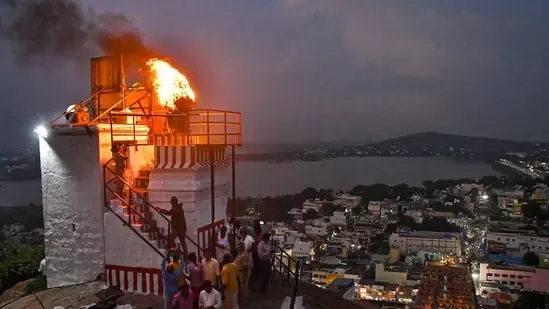
SC permitted a one-time ritual, not a resolution of competing claims. Yet the order has been recast as proof of a wider Hindu triumph, transforming a local dispute into a national political narrative
An interim judicial order permitting a ceremonial lamp to be lit at a disputed stone pillar on Thirupparankundram hill has been celebrated by the BJP and the Sangh Parivar as a victory for Hindus. However, the Supreme Court’s November 20 order was limited to permitting the ritual as a one-time measure and did not settle the underlying religious and legal dispute.
The distinction between what the Court actually permitted and what the BJP and other Hindu organisations claim has been achieved is central to understanding this controversy.
At the centre of the controversy are disputes over the identity and history of the stone pillar, whether lighting a lamp there is an established religious custom, and the competing claims concerning access to and usage of the hill, particularly in view of the nearby Sikandar Badusha Dargah. These questions remain unresolved. However, the controversy has acquired a political significance that goes well beyond the original religious claim.
What Supreme Court actually ordered
It is against this background that the Supreme Court’s November 20 order needs to be examined. The Court permitted the lamp to be lit at the disputed pillar on November 24 as a one-time measure, with safeguards for the nearby Dargah. It expressly clarified that this limited permission did not establish any customary, religious or proprietary right, leaving the substantive dispute open for adjudication.
Also read: Thirupparankundram row: Why it is a big test for Vijay's TVK govt
This raises an important question. Why was it necessary to permit a one-time ritual at the disputed site before establishing the nature of the pillar, its history, and the existence of an established religious practice? Could the existing arrangement not have continued until the competing claims were examined and decided? The concern is not about devotees’ right to celebrate Karthigai Deepam, but whether an interim judicial order should alter an existing arrangement at a contested site before the underlying claims are established.
Questions over judicial intervention
The State and temple authorities subsequently failed to implement the November 20 direction. That failure cannot be defended. A court order is binding, and public authorities cannot choose which directions to obey. The Supreme Court was entitled to examine the reasons for non-compliance. However, the developments that followed raise separate questions about the scale and consequences of judicial intervention.
On November 27, the Court directed that the lamp be lit at the pillar on November 28, issued contempt notices to State officials and temple authorities, suspended the temple’s board of trustees, appointed two former High Court judges as receivers, and directed the deployment of the CRPF. It also permitted devotees to light lamps at the site, at least 50 metres from the Dargah, and ordered protection for the Dargah and its worshippers.
The Court suspected that executive authorities might have acted at the behest of political leaders and sought officials’ communications. It also vacated its earlier stay of the relevant High Court findings.
Also read: Thiruparankundram | Light deepam at Deepathoon on Saturday: SC pulls up TN govt
These developments have given way to very important questions. Should enforcement of an interim direction also result in such an extensive intervention in a religious institution’s administration? Was it necessary to move from a limited arrangement involving authorised persons to permitting every devotee to light a lamp at the disputed site? Scrutinising proportionality is not endorsing disobedience or challenging judicial authority.
From a local dispute to a national political campaign
Beyond the judicial questions, the political response has been revealing. BJP leaders have described Thirupparankundram as the Ayodhya of the South. Prime Minister Narendra Modi invoked Lord Murugan and hailed the development. The party has presented the controversy as evidence that Hindu religious rights need protection from a government supposedly indifferent to them. Thus, a limited interim arrangement has been turned into a victory for an entire religious community.
This is where the political significance of the controversy lies. The BJP need not win more seats in Tamil Nadu for the controversy to serve its purpose. Its Assembly strength has fallen from four MLAs to one in the 2026 election. Tamil Nadu’s Dravidian tradition of social justice, rationalism, linguistic identity and State autonomy has limited Hindutva appeal. But the party’s audience is not confined to Tamil Nadu.
The party’s reduced representation in the State does not make the issue politically irrelevant. A controversy need not produce electoral gains where it begins to serve a national campaign, particularly with elections in northern States approaching.
In this context, the Ayodhya comparison gains importance: portray a contested site as an affront to Hindu sentiment, mobilise a wider community, and present the BJP as its protector.
Thirupparankundram and Ayodhya are not identical. But invoking Ayodhya gives a local dispute a national ideological meaning. The BJP can keep Hindu identity politically mobilised even without immediate electoral gains in Tamil Nadu. The presence of the Sikandar Badusha Dargah makes the controversy particularly significant for the BJP’s political strategy. The hill is home to both a Hindu temple and a Muslim place of worship, and this proximity provides an opportunity to turn a dispute over a lamp into a larger contest over religious identity, access and control of the hill.
The wider concerns arising from Sangh Parivar organisations challenging the status of
Muslim religious sites elsewhere in the country make the comparison with Ayodhya even more consequential. What is being projected as a demand to uphold a Hindu religious claim could thus become a means of deepening communal divisions. The question is where this mobilisation might eventually lead.
How media language shapes the narrative
Amidst all this, the media, too, must examine its language. Many reports describe the disputed structure as the Deepathoon, as though its identity and history were settled. The Court referred to it as a pillar identified as the Deepathoon, leaving its character and customary use undecided. Calling it the Deepathoon without qualification risks settling the issue in public perception before it is settled in law. A description can become an assertion.
None of this requires denying Murugan devotees their religious sentiments or treating their claims as illegitimate. Nor does it excuse the State’s failure to obey a court order. But disputes of this nature must be resolved based on evidence, law and established custom, not political pressure.
Also read: Thiruparankundram Deepathoon row: 10 key things Supreme Court said in its new order
When political mobilisation, judicial intervention and media language reinforce one another, an unproven claim can acquire the appearance of an established right, while a temporary judicial arrangement can be projected as a community’s triumph. A local disagreement can then become a national religious cause.
The lamp must not become an instrument for mobilising one community against another. Constitutional restraint and communal coexistence demand that unresolved claims are not given legitimacy through political appropriation.