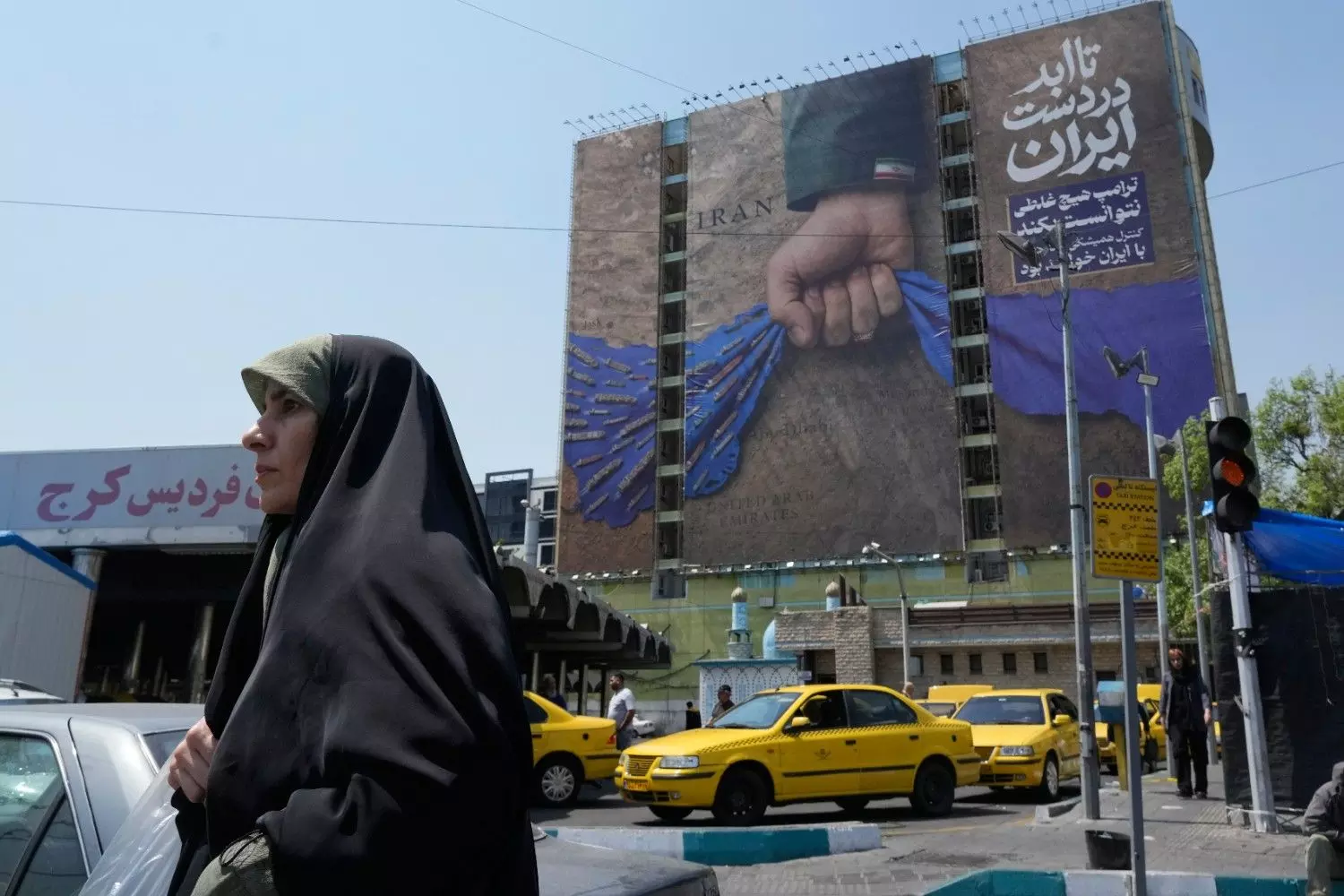
A woman walks past a billboard that shows a graphic depicting a military personnel's hand holding the Strait of Hormuz in his fist with signs which read in Farsi: "In Iran's hands forever," "Trump couldn't do a damn thing," " The control of Strait of Hormuz will be Iran's forever," in Vanak Square, in northern Tehran, Iran, on Thursday, April 16. AP/PTI
Tehran's announcement of reopening the crucial waterway hints at significant, if still opaque, adjustments in Washington’s maximalist posture—adjustments that will only become fully visible in the days ahead
A single, understated announcement by Iran’s Foreign Minister Abbas Araghchi on Friday (April 17) may well mark a turning point in the geopolitical and geoeconomic order. “In line with the ceasefire in Lebanon, the passage for all commercial vessels through the coordinated route as already announced by Ports and Maritime Organisation of the Islamic Rep. of Iran.”
Behind that measured language lies a profound shift.
Also read: Pakistan's Vishwaguru moment? It's a narrow escape, not ceasefire
After six weeks of what many across the Global South view as a brutal, unprovoked, and illegal war waged by the US-Israel axis, Tehran’s statement reads less like a concession and more like a declaration of strategic endurance. Without capitulating or surrendering its dignity, Iran has signalled that resistance to hegemonic pressure is not only possible, but effective. This is not merely about a waterway; it is about a recalibration of power.
Pakistan’s role
The announcement hints at significant, if still opaque, adjustments in Washington’s maximalist posture—adjustments that will only become fully visible in the days ahead. Crucially, Tehran has not relinquished its role in managing the 52-kilometre Strait of Hormuz waterway over which it shares sovereignty with Oman. Control, even when exercised subtly, remains leverage.
Also read: Is the US a military state camouflaged as democracy?
Amid this high-stakes standoff, Pakistan emerges as an unlikely but pivotal diplomatic actor. Working quietly behind the scenes, it appears to have nudged both sides away from rigid positions towards a fragile accommodation. The acknowledgment from Washington was characteristically theatrical: “Thank you to Pakistan and its Great Prime Minister and Field Marshall, two fantastic people!!!,” US President Donald Trump thundered.
Trump’s rhetoric
Yet if Araghchi’s statement was restrained, Trump’s reaction was anything but.
“The IRAN HAS JUST ANNOUNCED THAT THE STRAIT OF IRAN IS FULLY OPEN AND READY FOR FULL PASSAGE (sic),” he proclaimed, before escalating further: “THE STRAIT OF HORMUZ IS COMPLETELY OPEN AND READY FOR BUSINESS AND FULL PASSAGE, BUT THE NAVAL BLOCKADE WILL REMAIN IN FULL FORCE AND EFFECT AS IT PERTAINS TO IRAN, ONLY, UNTIL SUCH TIME AS OUR TRANSACTION WITH IRAN IS 100% COMPLETE. THIS PROCESS SHOULD GO VERY QUICKLY IN THAT MOST OF THE POINTS ARE ALREADY NEGOTIATED. THANK YOU FOR YOUR ATTENTION TO THIS MATTER! (sic)”
Israel appears increasingly sidelined, even as Trump issues directives that implicitly constrain its actions
His rhetorical barrage continued: “The U.S.A. will get all Nuclear ‘Dust,’ created by our great B2 Bombers - No money will exchange hands in any way, shape, or form. This deal is in no way subject to Lebanon, either, but the USA will, separately, work with Lebanon, and deal with the Hezboolah situation in an appropriate manner. Israel will not be bombing Lebanon any longer. They are PROHIBITED from doing so by the U.S.A. Enough is enough!!! Thank you! (sic)”
Unanswered questions
And then, perhaps most revealingly: “Iran has agreed to never close the Strait of Hormuz again. It will no longer be used as a weapon against the World!” followed by the triumphant, “A GREAT AND BRILLIANT DAY FOR THE WORLD! (sic)”
Taken together, these statements demand scepticism—if not outright disbelief. Trump’s bombast obscures more than it reveals. What, exactly, has Washington conceded behind closed doors?
Did the United States agree to restrain Israel’s devastating bombing campaign in Lebanon, which reportedly killed over 2,000 civilians and caused widespread destruction? Has there been movement on Tehran’s long-standing demand for the repatriation of tens of billions of dollars frozen in Western banks? Are reparations even on the table? And perhaps most critically: what, if anything, has Iran agreed to relinquish regarding its newly demonstrated ability to disrupt global shipping through the Strait of Hormuz?
These questions remain unanswered—for now. The next round of negotiations in Islamabad may begin to clarify them.
Israel appears increasingly sidelined
What is already evident, however, is a shifting regional dynamic. Israel appears increasingly sidelined, even as Trump issues directives that implicitly constrain its actions. The epithet “Butcher of Gaza”, coined by Türkiye’s President Recep Tayyip Erdoğan for Israeli Prime Minister Bejamin Netanyahu, underscores how deeply polarising Israel’s role has become—not just among adversaries, but across the broader international stage.
Iran’s insistence on comprehensive negotiations—covering everything from its nuclear programme to broader regional tensions—adds another layer of uncertainty
At its core, this moment reflects a tentative move towards confidence-building measures between adversaries long locked in confrontation. Araghchi’s announcement signals that Tehran, having demonstrated the strategic value of the Strait of Hormuz as leverage, is now willing to stabilise it—on its own terms.
But the path ahead is fraught with complexity.
America’s continued ambiguity on sanctions
No formal agreement exists on the duration of any freeze in Iran’s nuclear activities, and Tehran is unlikely to accept indefinite constraints. It may agree to cap enrichment levels or adjust thresholds on its 400 kilograms of highly enriched uranium, but only within a framework that preserves its sovereignty. Likewise, Trump’s assertion that Iran will receive no financial compensation for relinquishing its “nuclear dust” will ultimately be tested against the fine print of any agreement.
More troubling is Washington’s continued ambiguity on sanctions. The legacy of its so-called “economic epic fury” looms large. A Lancet study has estimated that sanctions have contributed to over 36 million deaths globally—an indictment that cannot simply be brushed aside. Any durable agreement will require credible, enforceable guarantees on sanctions relief.
What Trump’s ‘thank you’ to Qatar, UAE, Saudi means
Iran’s insistence on comprehensive negotiations—covering everything from its nuclear programme to broader regional tensions—adds another layer of uncertainty. These are not issues that lend themselves to quick fixes or theatrical announcements.
Complicating matters further are Trump’s public ‘thank you’ to Qatar, the UAE, and Saudi Arabia. For Tehran, such remarks may confirm suspicions that these countries quietly supported the American war effort. As one analyst noted on Al Jazeera, this perception is deeply unsettling for regional capitals.
In the end, Trump’s exclamatory tone appears aimed less at Tehran than at his domestic audience—an electorate grappling with the economic fallout of his policies. For many Americans, this war is increasingly seen as Netanyahu’s conflict, prosecuted at the expense of US interests.
What Araghchi delivered was a sentence. What it triggered may be a transformation.
The real story lies not in the announcement but in the concessions yet to be disclosed.