



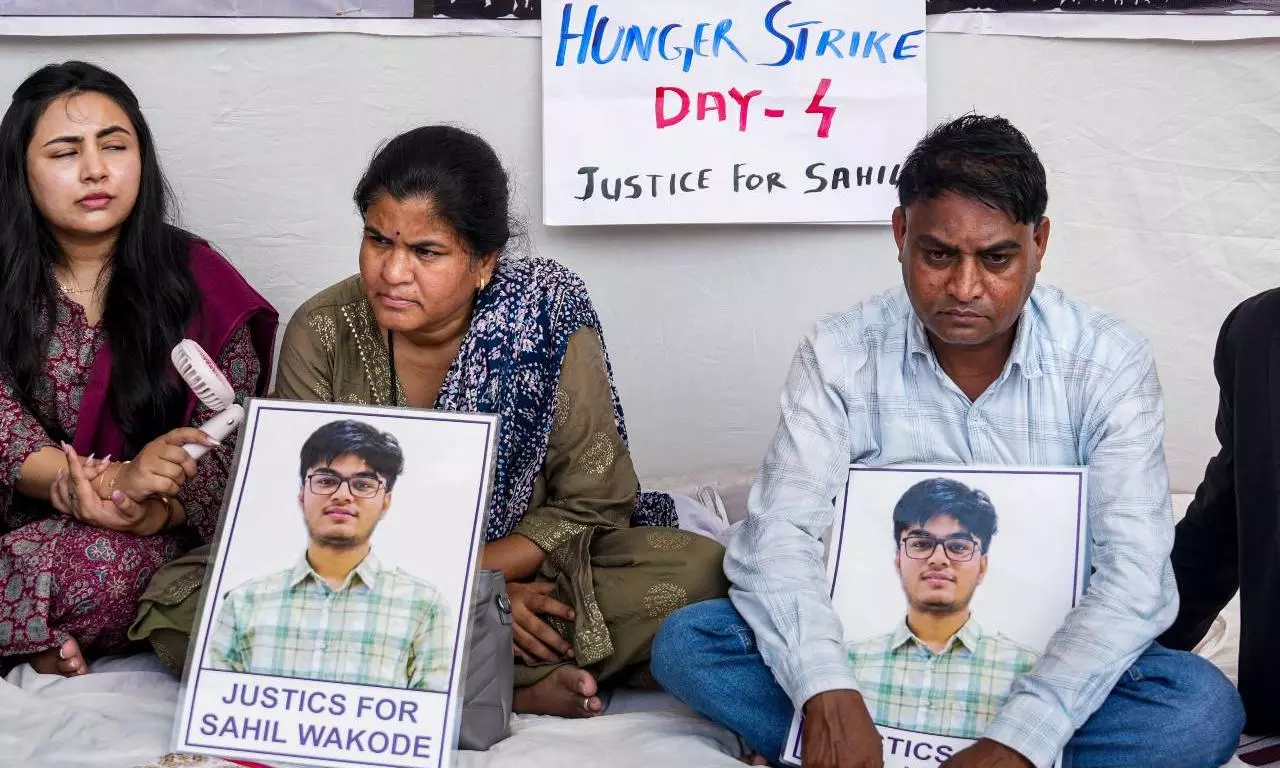
Sahil’s suicide must break myth that students like him have a leg-up through reservation; he was there because of intellectual merit, and his exam hall fiasco doesn’t negate that merit
The sad case of the death by suicide of Sahil Wakode, a second-year student in the Department of Energy Science and Engineering at the Indian Institute of Technology, Bombay (IIT-B), calls for a hard look at the way casteism pervades Indian society – even though it appears not to – including elite campuses, especially in toxic times where dominant right-wing rhetoric holds sway.
Professor Satyanarayana Doolla, professor and dean of student affairs, had allegedly asked Sahil to leave the examination hall because he allegedly used a mobile phone, which was not allowed. Sahil died by suicide. Naturally, the parents and other members of Sahil’s family are overwhelmed by grief and angry too because they think, understandably and irrationally, that the boy would not have committed suicide but for the action of Professor Doolla. But the allegation does not gain credibility unless investigations, which are underway, prove it beyond reasonable doubt. It is a painful process both for the families of Sahil and Professor Doolla.
How caste became Sahil’s handicap
The anger of Scheduled Caste (SC) students’ organisations over Sahil’s death is palpable because there is an invisible caste division that floats around in the air like poison. It is something that cannot be nailed because it is a slippery thing. Casteism is there and not there.
Then, there is this reaction among certain sections – people who take shelter behind the apparently rationalist argument of meritocracy, say with apparent justification that Professor Doolla is being punished for just doing his duty, and say with unconcealed vile glee that a “reserved quota” student cannot be let off for his wrongdoing.
In all this, there is no reference to the other two students who had killed themselves this year. Is it because, unlike the family of Sahil, the families of the other two had not raised the issue of discrimination?
Also read:65 suicides later, real test for IITs is how they treat students who fail
The mourning family of Sahil is not defending his alleged act of using a mobile phone in the exam hall. They are protesting against the inherent and pervasive casteism in campuses. It is not a rationalisation tactic. There is more than a grain of truth in the question of casteism. If a student of a dominant caste had been caught like Sahil, that boy would have brushed aside the taunt and the taint because he derives much confidence from the social confidence of his caste and peer group. Quite plainly, Sahil did not have that support. If there is a minor fall, then there is little scope for getting up and moving forward because of the unforgiving social set-up for an SC student.
Loner or outcast?
Important issues get ignored because of the useless polemical turn that the incident has taken. No one is talking to the classmates and fellow hostellers of Sahil about how they feel about the whole thing. Wasn’t Sahil an integrated member of the student fraternity? Why was there no mourning among the IIT-B students on his death? Was Sahil a loner because he was an introvert, or was it because of his caste status? Do the IITs have an induction programme where students mingle and get to know each other? It is generally the case that there are no formal social initiation processes in the Indian education system. The students just get to know each other over a period of time, or through the British colonial legacy of ragging.
Also read: IIT Bombay student Sahil Wakode’s death: What we know so far
Unfortunately, we do not know many things about the social life of students, the intricate ways in which individual students and student groups interact with one another, and the language, caste – yes, caste – and religious –yes, religious – dimensions that hover in the background, silently and quite ominously, though it need not be so. Most students break these distinctions and instinctively connect across these barriers. But it is an informal osmosis. No one observes and no one records.
Caste barrier seems broken, but it is not
India has changed over the centuries. The castes were not fortresses unto themselves. People mixed and mingled. But the situation of the Scheduled Castes, the Dalits with myriad of their internal differentiated formations, has been different. It took an ugly form in the colonial period. British administrators had tried to break Indian society’s traditional caste hierarchies through the public education system, and governments in independent India have continued with the system. There is no quota system in schools and colleges. Of course, the enrolment and dropout figures do reveal the complicated story of class and caste. But in principle, in schools, children across the social spectrum mingle with each other. And so do youngsters in colleges.
Also read: IIT Bombay suicide probe: Cops analyse CCTV footage from exam hall, hostel
The fact of the matter is that there is much change and mingling in society, including in schools and colleges, and perhaps more in schools and colleges, and yet caste divisions persist. And they persist across all castes. Friendships and other social bonds exist across caste lines, and there is a crossing of the lines when young men and women fall in love, and inter-caste marriages take place. There are no social statistics about the proportion of inter-caste marriages. And there is also no measure of the social bonds of friendship and professional fellowship that exist across caste divisions. What Sahil and students like him do not have is the social safety net because of the caste barrier, a barrier which seems to have been broken, but it has not been.
Sahil was a product of merit, not just quota
There are two conflicting myths that need to be broken. One is that of meritocracy. The second is that of the ‘reserved quota’, and that the quota system undermines merit. Meritocracy is not a simple fact. Behind it lie social and economic advantages. It is not fully based on the fairness principle. Social monopolies would continue in the guise of meritocracy. If societies and nations are to prosper, there is a need for social diversity. An Indian society that marginalises religious minorities, SCs, Scheduled Tribes and Other Backward Classes would not have the critical mass of skilled force needed to make India a developed economy.
Also read: IIT Bombay student death: Police question Professor Suryanarayana Doolla for 10 hours
Sahil was not in IIT-B because he had a leg-up through reservation. He was there because he had shown inherent intellectual merit. He did not fail the intellectual merit test because of the examination hall incident.
(Suicides can be prevented. For help please call Suicide Prevention Helplines: Neha Suicide Prevention Centre – 044-24640050; Aasara helpline for suicide prevention, emotional support & trauma help — +91-9820466726; Kiran, Mental health rehabilitation — 1800-599-0019, Disha 0471- 2552056, Maithri 0484 2540530, and Sneha’s suicide prevention helpline 044-24640050.)
(The Federal seeks to present views and opinions from all sides of the spectrum. The information, ideas or opinions in the articles are of the author and do not necessarily reflect the views of The Federal)
