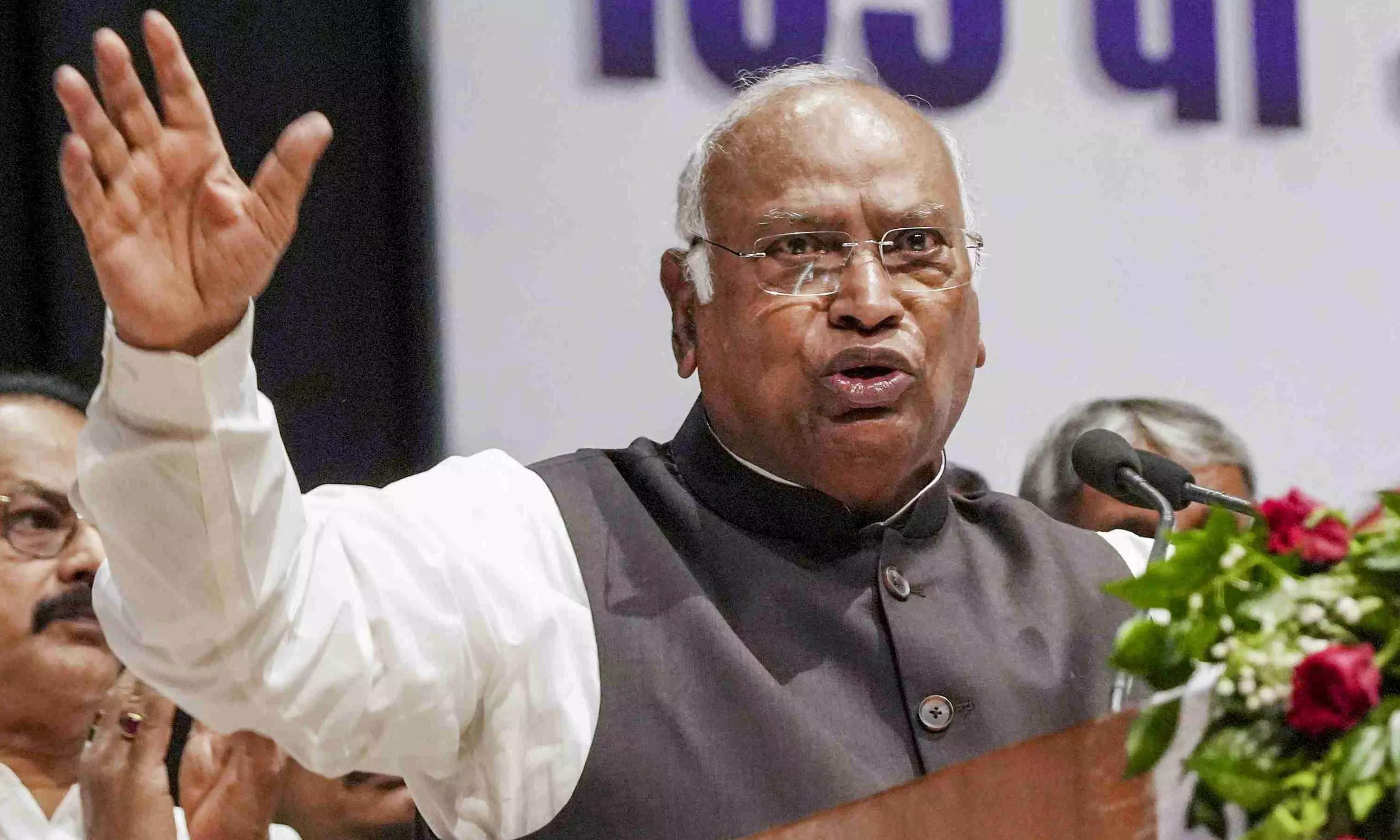
Congress president Mallikarjun Kharge's recent remark gives the BJP a chance to divert attention from the SIR controversy. File photo
Cong chief’s ‘Modi ka baap’ remark shifts national spotlight away from Opposition’s questions on SIR and EC, provides BJP opportunity to embark on manoeuvre it revels in – diversionary tactics
In political communication, timing, focus and consistency are everything. A single slip of the tongue or an ill-advised burst of vernacular defiance or needless bravado can immediately neutralise weeks of meticulous agenda-setting.
Congress president Mallikarjun Kharge’s recent outburst at a rally in Patna, where he retorted "Modi ka baap bhi..." in response to an audience heckler, is a classic textbook example of an unforced error, even though a normally restrained Congress president would not have shot his mouth off, but for the provocation.
Political self-goal
It was not merely imprudent; it was a self-goal that handed the BJP a moral high ground and a narrative lifeline precisely when it had been on the defensive for the past several weeks. It provided the ruling party an opportunity to embark on a manoeuvre it revels in – diversionary tactics.
For weeks, the opposition had been attempting to build momentum around serious institutional questions. Unquestionably, the Congress was playing a pivotal role in a focused opposition campaign highlighting alleged irregularities in the Special Intensive Revision (SIR) process of electoral rolls.
Also read: Vijay vs Udhayanidhi: War of words turns intensely personal
For the second time in three months, the government was forced to answer for another individual, Chief Election Commissioner Gyanesh Kumar, in this instance, after former Education Minister Dharmendra Pradhan in July, for possibly acting more brazenly than his brief.
Demands for the resignation of Kumar over charges of voter roll manipulation acquired greater resonance after the stunning reports were published in the Indian Express, establishing that Election Commissioners Sukhbir Singh Sandhu and Vivek Joshi formally objected on record at least 14 times over 10 months to decisions made by Kumar and publicised as those of the EC.
Coupled with the decision of youth and students’ organisations, especially the Cockroach Janata Party (CJP), to also flag the issue, the opposition campaign not just triggered a substantive debate, but also struck at the core of electoral integrity and the democratic process.
Yet, with a single sentence that was impulsive at best, uttered from a public stage, Kharge completely flipped the headline. Prime Minister Narendra Modi and the BJP’s formidable electoral engine do not need a second invitation to seize upon such retorts.
Outrage as diversion
Predictably, top cabinet ministers and BJP machinery immediately pivoted from answering questions on voter list revisions to portraying Kharge’s remark as an assault on the prime minister’s lineage, humble origins, and constitutional dignity.
It was the ‘chaiwala’ narrative once again. Asserting in 2014 at a Congress party meeting that he was certain that Modi could never become India’s prime minister, former Congress leader and one-time Union Minister Mani Shankar Aiyar had said: “He keeps saying, make me prime minister as I began life selling tea. Fine, if that’s his main qualification and he wants a stall here (at the meeting venue), we can let him sell tea here,”
It was the line that enabled Modi to launch the ever so successful Chai Pe Charcha campaign, besides enabling the BJP to play the sympathy card by framing Aiyar’s remark as a direct insult to Modi’s humble and self-made roots.
Also read: Why did BJP skip personal attack on Mamata in Bengal campaigning? | AI With Sanket
Twelve years later, Kharge has supplied the ruling party with a fresh outrage narrative. Its own press conferences, ground mobilisation, and constitutional critiques on the SIR process, days before the planned protest in Delhi in November, could potentially be drowned out by prime-time outrage television.
Yet, the degradation of the Indian political discourse, where a party chief invokes an opponent's father on stage, did not happen overnight, nor is Kharge its sole author.
Contrarily, the remark highlights a broader trend: the gradual coarsening of public rhetoric in Indian politics. Equally importantly, perhaps, is Modi’s foundational role in reshaping the boundaries of political decorum.
Who started the culture of sobriquets?
While the BJP leaders carry the hurt expressions on Modi’s behalf, it cannot be overlooked that he pioneered the widespread use of mocking sobriquets for political opponents during high-decibel election rallies, as well as other occasions.
Notable instances include 'Jersey Cow' for Sonia Gandhi, 'Hybrid Bachchha', 'Pappu' or 'Shehzade' for Rahul Gandhi, '50 Crore Ki Girlfriend' for Sunanda Pushkar, late wife of Congress leader Shashi Tharoor, and 'Maunmohan Singh' to taunt Manmohan Singh for his public introversion.
The Prime Minister did not even spare the august platforms of Parliament. He once mocked Renuka Chowdhury’s laughter and juxtaposed it with the believed laughter of the mythological character Surpanakha, as depicted in the Ramayana serial on Doordarshan. Modi did not even spare former vice president Hamid Ansari a barb, that too on the occasion of his retirement as chairman of the Upper House of Parliament.
Politics gets personal
Yet, restricting the roots of personalised attacks on political peers to Modi, or other individual leaders, misses the larger structural shift in Indian democracy: Coarsening of political language is deeply tied to the linguistic de-Sanskritisation and vernacularisation of public life that began in earnest during the 1990s.
It is also the same period when, triggered by post-Mandal politics, a massive social expansion of Indian politics was witnessed. Indian polity was noted for remarkable use of ready wit, amid policy debates from the first decades after independence. The transition from regional aggression to personalisation, and high-decibel political campaigning alongside electoral hectoring, was a long process, with the last stages of this decline of discourse coinciding with the emergence of soundbite as entertainment.
Also read: How Kharge's Manusmriti citation turned into a 20-min Rajya Sabha storm
It is an elitist bemoaning of lost hegemony of the dominant social groups of the early decades, which framed the emergence of Backward Classes in politics as being accompanied by ‘coarsening’ of the political discourse. The truth, however, is that political vocabulary expanded as conversations in the political arena transitioned from hegemonic, Sanskritised/Anglicised elite etiquette to vernacular assertiveness, democratic plebeianisation, and subaltern counter-hegemony.
This change from the late-1980s onwards has often been termed by scholars as the second democratic upsurge. Previously marginal groups made a direct entry into the political theatre as parties became conscious of chunavi ganit (electoral mathematics) also a euphemism for caste identity being factored during candidate selection.
The Sanskritisation paradox
Yet, there is a paradox – although de-Sanskritisation was witnessed in this era as an overall trend, the BJP, despite factoring and publicising caste identity of key leaders and candidates, has consistently re-Sankritised official discourse especially since 2014, as part of its strategy to deepen the stranglehold of the Hindutva idea on society.
This is often evident in the chasteness of pronunciation and official nomenclature that clings to the past vocabulary of the social elite. This way, the BJP has also succeeded in incorporating marginalised social groups, especially among Dalits, within its fold.
(The Federal seeks to present views and opinions from all sides of the spectrum. The information, ideas or opinions in the articles are of the author and do not necessarily reflect the views of The Federal.)