



Has CJP protest revealed a chink in BJP’s armour? | Talking Sense With Srini
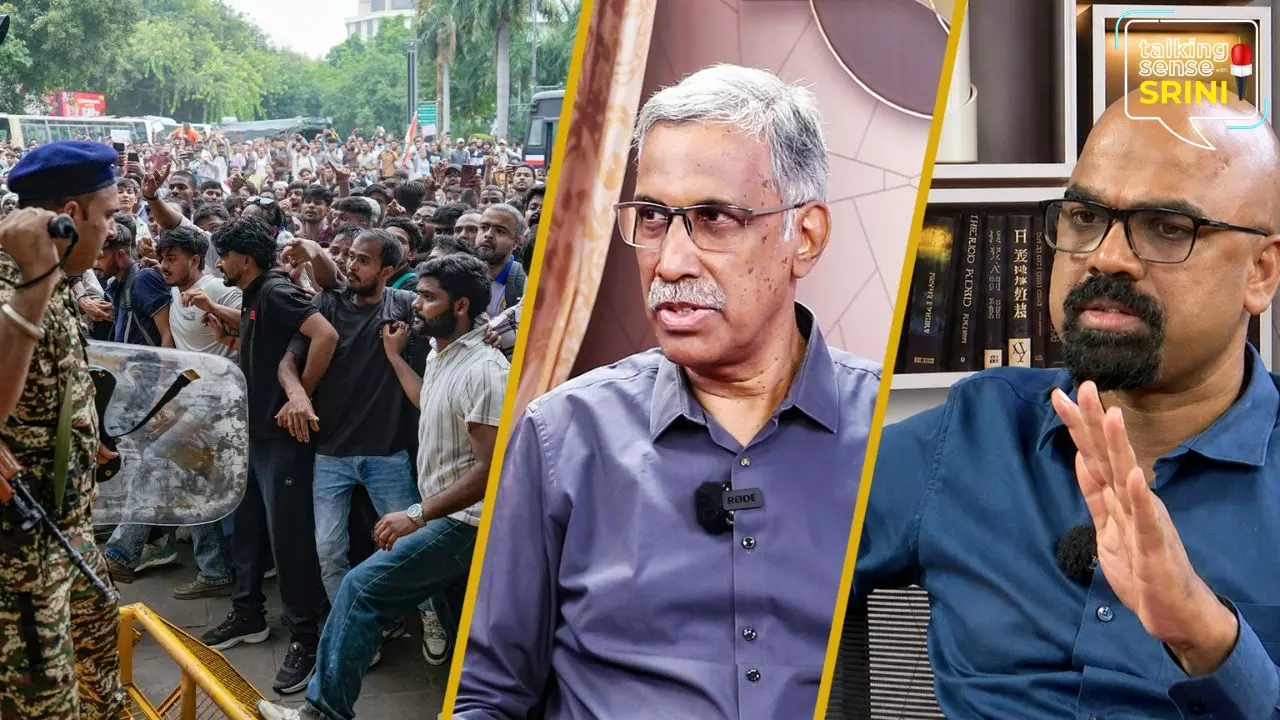
The Federal's Editor-in-chief S Srinivasan and economist A Kalaiyarasan unpack the political and economic implications of the Cockroach Janta Party protest

“Once the bottle opened, a lot of cockroaches came out and nobody knew where they came from.”
The Federal’s Editor-in-Chief S Srinivasan recalls his friend’s description of the events in Delhi—how quickly a seemingly-isolated protest snowballed into a national political moment.
What began with the NEET controversy and the detention of Sonam Wangchuk soon evolved into something much larger, forcing the government onto the defensive and challenging long-held assumptions about India’s youth.
For Srinivasan and economist A Kalaiyarasan, the CJP protest is not just about examinations. It is about a generation grappling with shrinking opportunities, an economy that is failing to meet rising aspirations, and institutions that are steadily losing public trust.
Has BJP’s political invincibility been dented?
For Srinivasan, the most immediate political consequence is that the BJP was forced to react rather than dictate the narrative.
“It has certainly put the BJP under a bit of pressure,” he says.
Initially, the protest received little attention from the government. As Srinivasan recalls, protesters complained that “not even a clerk has come to visit us”. But as the crowds swelled, the Centre was forced to react. After violent measures, BJP finally opened one channel of communication as Union Minister JP Nadda met two CJP members.
Also Read: 'Don't waste our time,' says CJI as SC declines urgent listing on CJP protest plea
The Opposition also sensed an opening. Rahul Gandhi, who had already been focusing on youth and education through rallies in Kota and Dehradun, moved quickly to embrace the issue.
According to Srinivasan, the Congress had been trying to bring education and employment concerns into mainstream political discourse, and the Delhi protest gave those efforts fresh momentum.
“The ball is now in Rahul Gandhi’s court,” Srinivasan opines.
‘Youth anxious about the future’
Kalaiyarasan argues that the protests cannot be explained by the NEET issue alone.
“The youth today are anxious about the future,” he says. “The transition from education to employment is either broken or bleak.”
Drawing on Periodic Labour Force Survey data, he points out that a large section of young Indians struggles to secure meaningful employment. Even those who do find jobs often discover that the opportunities fall far short of what higher education had promised.
“The pathways to the middle class seem to be broken,” he says.
The problem, he argues, is not merely unemployment but the quality of jobs. Engineering graduates increasingly find themselves taking gig work or low-paying jobs with limited career progression. Even in the formal sector, salary growth has slowed dramatically.
“The anxiety comes from seeing your seniors,” Kalaiyarasan explains. “If they tell you their salaries haven't meaningfully improved in years, students naturally begin asking, ‘What does my future look like?’”
‘Economy not generating enough jobs’
India may be one of the world’s fastest-growing major economies, but Kalaiyarasan warns that headline growth figures conceal deeper structural weaknesses.
“If you convert that into per capita income, India is not even a middle-income country,” he says.
He argues that the nature of India's growth has changed. While earlier phases of economic expansion generated jobs and private investment, today's growth has become less employment-intensive.
Also Read: 16 Delhi Metro stations shut amid CJP protest; commuters stranded
“We missed manufacturing,” he says. “We moved from agriculture to services without building a strong manufacturing base.”
For years, India's services sector absorbed educated workers. But technological disruption, artificial intelligence, and changing global trade patterns have narrowed those opportunities.
“The kind of investment that is coming today is not generating employment,” he said.
This disconnect, he believes, lies at the heart of the frustration expressed by young protesters.
A generation that proved its critics wrong
The mobilisation has also challenged stereotypes about Gen Z.
“The older generation always thinks less of the next generation,” Srinivasan says. “But it is almost always proven wrong.”
He believes the protest demonstrated that young Indians are not confined to social media activism.
Also Read: 'Too much support': CJP urges well-wishers to stop sending food to protest site
“They’re not just concentrating on digital screens. They can also hit the streets.”
Kalaiyarasan agrees, arguing that today's youth carry far greater expectations than previous generations because higher education has expanded dramatically over the last two decades.
“Education creates aspirations,” he says.
When millions enter colleges expecting social mobility but encounter an economy that cannot deliver comparable opportunities, frustration becomes inevitable.
“There is a mismatch between what education promises and what the system is currently able to offer.”
‘Trust deficit in institutions’
Both speakers see the protests as reflecting a broader crisis of confidence in institutions.
Repeated controversies around examinations have contributed to growing scepticism about fairness and merit. But the trust deficit extends beyond education.
“There is a trust deficit in institutions,” Kalaiyarasan says.
Also Read: Dharmendra Pradhan a 'big liability', should have quit: Renuka Chowdhury
Srinivasan adds that the media also failed to recognise the scale of public sentiment.
“The national media completely missed it,” he says, arguing that mainstream outlets had become too dependent on official narratives while younger audiences increasingly turned to alternative platforms.
Even the administration appeared surprised. Srinivasan points out that the Delhi Police itself admitted it had not anticipated such a large mobilisation.
The lasting impact
For Kalaiyarasan, the protest has exposed three urgent challenges: Repairing the education system, generating quality employment, and restoring trust in institutions.
“We need to reflect on these fundamental questions,” he says.
Also Read: LIVE: All Congress leaders, CJP protesters released from detention; Wangchuk shifted to Medanta
Srinivasan arrives at a similar conclusion from a political perspective.
“The politics of protest has come back to centre stage," he said.
Whether the CJP protest ultimately changes government policy remains uncertain. But it has already demonstrated that beneath the surface of impressive economic growth and political stability lies a generation deeply anxious about its future.