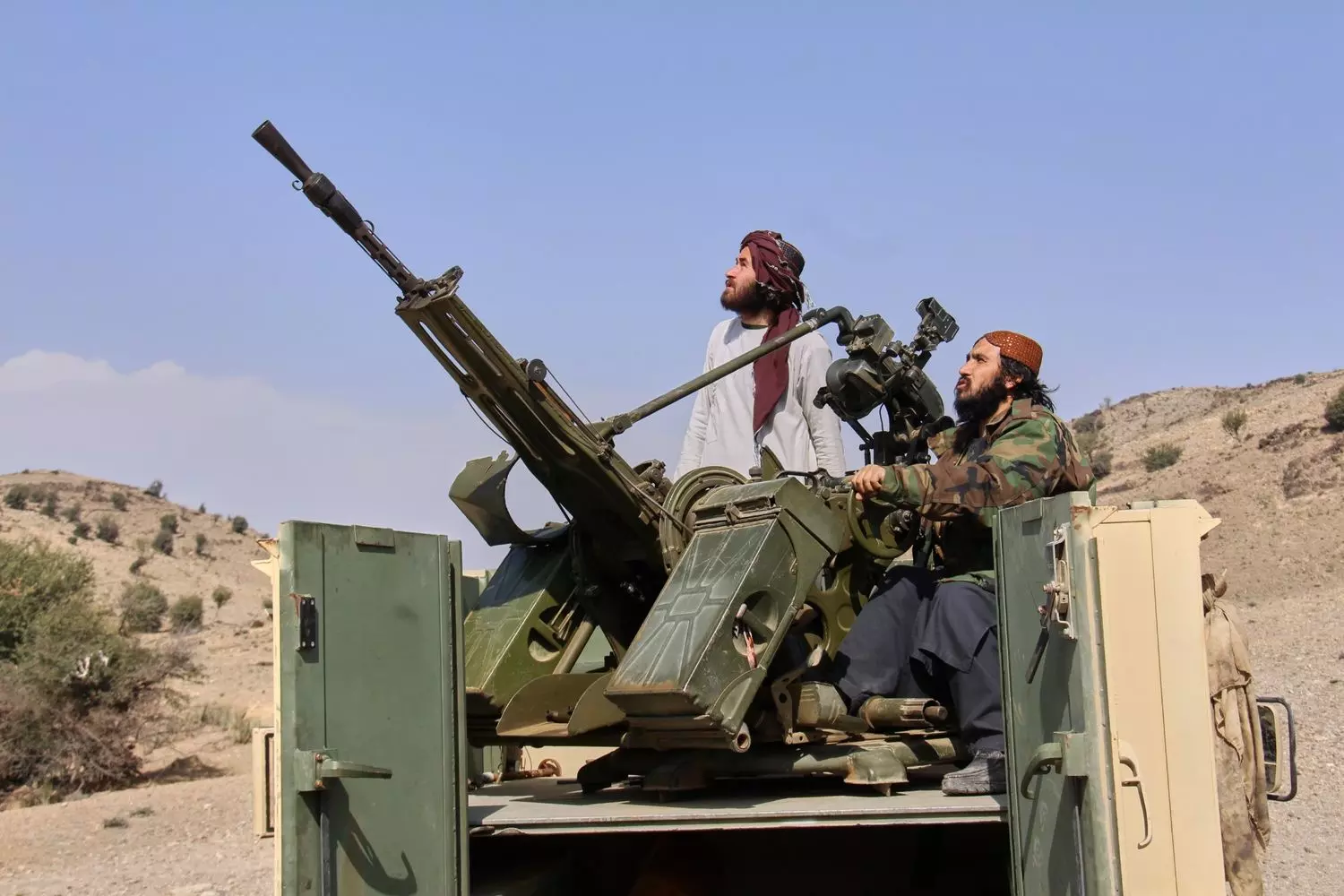
Taliban fighters stand guard beside a mounted weapon on a truck at the Afghan side of the Ghulam Khan border in Khost province, Afghanistan, on Friday. AP/PTI
Pakistan exported terrorism to India for three decades, now it is drowning in a flood of its own making
Intense fighting has broken out between Pakistan and Afghanistan. Pakistan bombed the Afghan capital, Kabul, the current spiritual capital, Kandahar, where the Taliban leader Mullah Haibatullah stays, and Paktika on the night of February 26 and the early hours of the next morning.
Pakistan did not target only military installations but also residential areas. The extent of damage caused in the Pakistani bombing is not clear as yet. And, there are no reports of the death of any senior Taliban leader in the bombing.
Revenge for suicide bombings?
This round of heavy fighting began with the Pakistani Air Force bombing seventeen locations in Afghanistan along and across the Durand Line on February 22. It claimed that these were in response to the suicide bombings carried out by the Tehreek-e-Taliban-e-Pakistan (TTP; which Pakistan now calls Fitna Al Khawarij) over the past few weeks. Pakistan routinely alleges that the TTP has Indian support and blames the Afghan authorities for not reining it in. A number of women and children died in the Pakistani bombing.
Asif is a motormouth, and his words cannot be a serious indication of the thinking among the Army generals who ultimately decide war and peace in Pakistan
Kabul opened fire with heavy weapons two days ago on Pakistani posts along the Durand Line. It stated that it had inflicted heavy casualties on the Pakistani forces. Pakistan refutes these claims and asserts that its forces have inflicted substantial losses on the Afghan forces.
Will it lead to all-out war?
Can this tit-for-tat fighting flare up into a war involving the forces of the two countries crossing the Durand Line? There is a lot of bravado on the Pakistani side.
Also Read: The world waits with apprehension as Trump decides on attacking Iran
Defence Minister Khawaja Asif said on Friday (February 27), ''Our cup of patience has overflowed. Now it is an open war between us and you (Afghanistan)."
Asif is a motormouth, and his words cannot be a serious indication of the thinking among the Army generals who ultimately decide war and peace in Pakistan. Indeed, Khawaja Asif’s words indicate frustration. They are not taken seriously, even by the civilian government. They are certainly not an indication of Pakistan's real intentions and policies. A more nuanced expression of Pakistan's approach to Afghanistan was provided by the Pakistan Foreign Ministry.
What Pakistan Foreign Ministry said
On February 26, the Official Spokesperson of the Pakistan Foreign Ministry at a media briefing said this regarding Pakistan’s approaches to Afghanistan: “First on Pakistan's military response: we will respond swiftly, strongly in exercise of our right to self-defence. This message has been put across through all international stakeholders. As regards taking the international community and other foreign governments and entities into confidence, there are two tracks of this engagement. First is bilateral trade, where we engage with the countries, particularly Afghan neighbors with which we have bilateral/trilateral dialogue mechanisms on these issues. So, these issues are taken up there. Secondly, as you are aware, the UN Security Council's Counterterrorism Committees, both on Al Qaeda and Taliban Sanction Committee are also seized of the matter and this matter is routinely discussed there.
Also Read: Why a Saudi-Pakistan defence pact doesn't imply an 'Islamic NATO'
''You must be following our statements made at the Security Council. We demand action against these terrorist outfits operating with impunity and with freedom from Afghan soil. On your question regarding dialogue: I am not aware of any structured dialogue. In terms of people-to-people relations, we have nothing against the people of Afghanistan. The contentious issue is the terrorist outfits who operate in Afghanistan, and the official support and impunity being offered to that terrorism. As regards the people of Afghanistan, we respect them, and we have traditional historic linguistic ties with them. We do not wish any harm to Afghan people”. (sic)
Pakistan's measured policy
This writer has deliberately quoted the words of the spokesperson at length because they indicate the diplomatic effort which Pakistan is putting in trying to convince the global community that it is pursuing a measured policy towards Afghanistan. It is engaged with its partners and others to convince them that its use of force against Afghanistan is justified and that the Afghan Taliban are supporting terrorist groups to carry on their activities in Pakistan from their bases in Afghanistan. It is obviously asking the international community to tighten the screws on Kabul.
The Pakistan Army has, in the past, made strategic blunders. Kargil is an eminent example.
It is not likely, however, that the major powers will disengage with the Taliban because of Pakistan. They will seek to persuade the Afghan Taliban to put an end to the TTP, but they will not go beyond words. They know that the Afghan Taliban march to their own tune and will not accept pressure, and certainly not on the TTP, who are really part of them.
Will Pak goof up again?
It will be a profound misreading of the situation if Pakistan feels that it can, with the use of air power, inflict such damage on the Afghan Taliban that they will hand over the TTP or put an end to their activities. Will Field Marshal Asim Munir send ground troops into Afghanistan? The Pakistan Army has, in the past, made strategic blunders. Kargil is an eminent example.
It will make such a blunder if it sends its forces into Afghanistan. Munir may think that the Afghan Taliban were only able to take on the US because of Pakistan’s support, and without it, they would have been crushed. Therefore, now with no foreign support, they cannot resist Pakistan. It is true that without Pakistan’s support the Afghan Taliban could not have defeated the US. However, Pakistan is not the US.
The chances are that Pakistan will carry on firing across the Durand Line and bomb Afghan cities. This will hardly impact the Taliban.
Besides, the Pashtuns have deep reservations about the Punjabis, and the Pakistan army is a Punjabi Army. Hence, any ingress into Afghanistan by the Pakistani Army will be met with ferocious resistance.
The chances are that Pakistan will carry on firing across the Durand Line and bomb Afghan cities. This will hardly impact the Taliban. On the other hand, it will only lead them to allow greater rein to the TTP.
Pakistan has used terrorism against India for more than three decades. Now it is at the receiving end of the TTP’s unconventional war against it. This will not lead Pakistan to give up terror against India.
(The Federal seeks to present views and opinions from all sides of the spectrum. The information, ideas or opinions in the articles are of the author and do not necessarily reflect the views of The Federal.)