A decade of litigation has pushed the system to rethink coercion, credit and compliance, and the real test lies in turning the recommendations into law
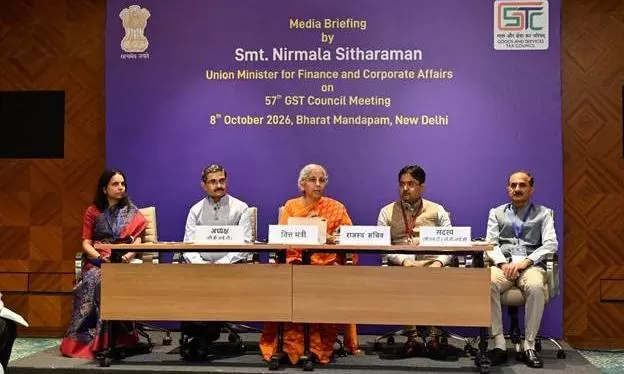
There are moments in the life of a tax system when an amendment to a statute becomes much more than an amendment. It becomes a statement of intent, a change of temperament and, sometimes, a course correction. The 57th meeting of the GST Council represents precisely such a moment.
Nearly a decade after GST was introduced with the ambitious promise of One Nation, One Tax, the Council has now embarked upon the next, and perhaps more consequential, phase of the reform: One Nation, One Predictable Tax System.
What makes this meeting particularly significant is that the Council has looked beyond rates and revenue collections and addressed the very architecture of tax administration: arrest and prosecution, input tax credit (ITC), refunds, adjudication, registration, interception, and compliance.
There is a discernible thread running through these recommendations, a movement from coercion to proportionality, from discretion to transparency, from cascading to credit, and from compliance anxiety to taxpayer certainty.
End of arrest powers
The most striking recommendation is undoubtedly the proposal for complete withdrawal of arrest powers under GST by omitting Section 69 of the CGST Act. At the same time, the Council has recommended raising the prosecution threshold from Rs 1 crore to Rs 5 crore and rationalising the offences under Section 132.
This is not merely an administrative adjustment, but a bold reaffirmation of constitutional proportionality and the distinction between fiscal liability and criminal culpability. Tax administration must unquestionably possess strong enforcement machinery. Organised fake-invoice syndicates, fictitious transactions, deliberate evasion, and fraudulent availment or passing on of ITC cannot be treated with kid gloves.
But a classification dispute, valuation controversy, interpretational difference, or genuine disagreement over ITC eligibility cannot, merely because the amount involved is substantial, be allowed to acquire the colour of criminality.
Weapon of last resort
Arrest directly implicates personal liberty. Consequently, the coercive power of the state must satisfy the constitutional discipline of necessity, proportionality, and procedural fairness. The Council’s recommendation therefore deserves emphatic appreciation. It recognises that criminal law must remain the weapon of last resort, not the first response to a disputed tax position.
The proposal to raise the prosecution threshold to Rs 5 crore and narrow the relevant offences under Section 132 reinforces this philosophy. The proposed amendment to Section 132(1)(c), for instance, seeks to focus the offence on fraudulent availment of ITC without receipt of goods or services or without an invoice or bill.
The message is unmistakable: be uncompromising with fraud, but be fair to the bona fide taxpayer.
Also Read: GST Council scraps tax officials' arrest power, raises prosecution threshold to Rs 5 cr
The jurisprudence of proportionality is beginning to find its way into GST administration. This change in legislative temperament does not exist in a vacuum.
Over the past few years, the courts have repeatedly been called upon to examine whether the extraordinary powers conferred by GST legislation are being exercised consistently with proportionality, natural justice, statutory purpose, and constitutional fairness.
Limits of personal liability
In Amit Manilal Haria v. Joint Commissioner, CGST & Central Excise, decided by the Bombay High Court in February 2026, the court considered the extraordinary personal penalties imposed upon senior employees of a company under Section 122(1A). The court’s decision provides an important judicial examination of the limits of derivative personal liability and proportionality in GST penalty proceedings. It is noteworthy that the petition in Amit Haria [supra] was argued by this writer.
The significance of such jurisprudence goes beyond the individual case. It contributes to an evolving judicial dialogue on a fundamental question: how far can the machinery of a tax statute travel before the remedy itself becomes disproportionate to the wrong? The 57th Council’s decision to rationalise prosecution, penalties, and arrest powers demonstrates that this jurisprudential conversation is increasingly reflected in the policy architecture of GST.
The Council has also proposed reducing the maximum general penalty under Section 125 from Rs 25,000 to Rs 10,000 and introducing reduced penalties in specified non-fraud situations. The direction is therefore unmistakably towards proportionality rather than punishment for punishment’s sake.
Evolution of ITC
The same judicial-policy dialogue is visible in the evolution of input tax credit.
The Supreme Court’s landmark decision in Safari Retreats brought into sharp focus the centrality of ITC to the GST architecture and examined the interaction between blocked credit and the underlying purpose of a value-added tax.
This writer was part of the legal team appearing in the Supreme Court proceedings in Safari Retreats. The importance of the case lies not merely in the particular category of construction-related credit that came before the Court. It brought to the forefront a much larger question: whether exclusions from ITC should be understood in a manner that defeats the economic architecture of GST and creates cascading tax costs.
Also Read: GST gets a trust reset: Arrest powers go, penalties cut, refunds automated
That philosophy is now visibly reflected in the 57th Council’s recommendations to rationalise Section 17(5). The Council has proposed removing restrictions on ITC for several categories, including outdoor catering, health and life insurance, telecommunication towers, and pipelines laid outside factory premises, among others.
The stated objective is to reduce cascading and facilitate a smoother flow of credit across the supply chain. It would be simplistic to say that a particular judicial decision alone produced these reforms. Policy is shaped by several considerations. Yet there is little doubt that judicial scrutiny of the architecture of ITC has helped sharpen the legal and policy debate.
Safari Retreats was therefore not merely a dispute about one category of credit. It formed part of the continuing conversation about what GST must ultimately remain, a genuine value-added tax with a robust and rational credit chain.
Judicial battle and legislative reform
Perhaps nowhere is the interaction between litigation and policy more apparent than in the continuing controversy surrounding Section 16(2)(c).
For years, genuine recipients have confronted the difficult situation of having paid the supplier, received the goods or services and complied with their own obligations, while facing the possibility of ITC denial because the supplier failed to discharge the tax. The constitutional and statutory questions surrounding this provision have generated substantial litigation, including writ proceedings in which this writer represented taxpayers.
The central issue is deceptively simple: Can a bona fide recipient be made to bear the ultimate fiscal consequence of an independent default by his supplier?
Also Read: GST’s arrest powers go, but can trust replace deterrence?
The answer requires a careful balance between Revenue protection and taxpayer fairness. The recipient must not become an insurer of the supplier’s tax compliance. At the same time, the law must retain robust safeguards against collusion, fictitious transactions, and fraudulent credit.
Recent litigation continues to keep this issue firmly before the courts. In 2026, the Bombay High Court, while disposing of petitions raising challenges to Section 16(2)(c), expressly kept the constitutional contentions open. The broader judicial debate has therefore helped expose the practical difficulties embedded in a rigid supplier-default mechanism.
Against this background, the 57th Council’s decision to examine a mechanism for protecting genuine recipients assumes considerable significance. The official release itself does not announce a final amendment to Section 16(2)(c); the issue remains part of the reform process. That is perhaps prudent, because the devil, as always, will be in the statutory detail.
The ultimate solution should embody a statutory safe harbour for bona fide recipients who have exercised prescribed due diligence, while preserving the Revenue’s power to proceed rigorously against collusive and fraudulent transactions.
Principle of fiscal neutrality
That would be a major step towards restoring the principle of fiscal neutrality. The law should pursue the person who committed the default, rather than automatically visiting the innocent recipient with its consequences. ITC must flow like a river, not accumulate like a dam. The Council’s wider ITC reforms deserve equal applause.
The proposal to permit refunds of accumulated ITC relating to specified input services and capital goods in zero-rated and inverted-duty situations is particularly welcome. The economics are straightforward. Blocked credit is blocked working capital. Blocked working capital is an additional cost of doing business. And an additional tax cost ultimately undermines the neutrality and efficiency of GST. The Council has therefore taken an important step towards ensuring that ITC flows through the supply chain instead of becoming trapped within it.
Also Read: GST 2.0 explained: What India’s new tax regime means for you | K Vaitheeswaran interview
Its proposals for Invoice Management System, electronic credit reversal and reclaim statements, and better alignment between GSTR-3B and GSTR-2B similarly recognise that technology should prevent disputes rather than merely document them after they arise.
The philosophy should be simple: identify the mismatch today rather than issue the notice three years later.
A new chapter in GST jurisprudence
What is particularly encouraging is that these reforms appear to draw together several strands of GST jurisprudence that have developed independently over the last decade.
The courts have repeatedly emphasised the need to respect natural justice, proportionality, statutory purpose, reasoned decision-making, and the constitutional boundaries of executive power. Taxpayers and practitioners have, through constitutional litigation, brought these tensions before the courts. The legislature and the GST Council now have an opportunity to convert those judicial lessons into a more coherent statutory framework.
Also Read: GST reforms to inject Rs 2 lakh cr into economy, says Nirmala Sitharaman
This is how a tax system should evolve. Litigation identifies the fault lines. Judicial precedent clarifies the constitutional and statutory boundaries. Policy responds. Legislation ultimately absorbs the lessons.
The result, at its best, is not confrontation between the taxpayer and the State, but institutional learning. The journey from Safari Retreats on the philosophy of ITC, through the continuing Section 16(2)(c) litigation, and the more recent decisions concerning disproportionate personal penalties, illustrates this process vividly.
GST Council deserves credit for listening
The 57th GST Council deserves genuine appreciation for recognising these fault lines and attempting to address them. The Council has not simply reduced rates or tinkered with procedural forms. It has tackled the DNA of GST administration.
It has proposed removing arrest powers, raising the prosecution threshold, rationalising penalties, widening ITC, introducing procedural safeguards against credit blocking, automating refunds, improving adjudication, and moving towards intelligence-based interception.
Taken together, these are not isolated reforms. They form a coherent philosophy. Trust the compliant taxpayer. Target the fraudulent taxpayer. Use technology to distinguish between the two. That is the essence of a modern tax administration.
The unfinished task
The recommendations must now be translated into carefully drafted legislation, rules, notifications, and circulars. The Council’s own release appropriately acknowledges that its recommendations will acquire legal force only through the relevant statutory and administrative instruments.
The drafting must therefore preserve the spirit of the reforms. In particular, the eventual resolution of Section 16(2)(c) must ensure that a bona fide recipient is not made to pay twice merely because his supplier has failed in an independent statutory obligation.
Also Read: GST Council meeting: Why simplifying registration, refunds must be key focus
Similarly, the reforms concerning arrest and prosecution must ensure that the withdrawal of coercive powers is accompanied by precise, intelligence-led enforcement against genuine fraud. And the rationalisation of ITC must continue to respect the foundational principle that GST is intended to tax value addition, not repeatedly tax the same economic value as it moves through the supply chain.
New covenant between state and taxpayer
GST began with a grand promise. Its first decade was inevitably a period of experimentation, litigation, course correction, and institutional learning. The 57th GST Council has now shown encouraging signs that GST is entering a more mature phase. The proposed removal of arrest powers tells the honest taxpayer: you will not be treated as a criminal merely because you have a tax dispute. The proposed ITC reforms tell business: legitimate credit should not be unnecessarily trapped.
The continuing reconsideration of Section 16(2)(c) tells the genuine recipient: the law is willing to examine whether supplier default should automatically become your burden.
The Rule 86A reform says: you will be heard before your credit is blocked.
The refund reforms say: the government should not retain your legitimate money indefinitely.
And the adjudication reforms say: tax demands must be founded on reasons, evidence, and due process.
Also Read: GST Council meet on rate reform begins; Opposition states seek compensation
This is the beginning of a healthier relationship between the taxpayer and the State. The real measure of a great tax system is not how many notices it issues, how many arrests it makes, or how much credit it blocks. It is how little litigation an honest taxpayer has to face, how quickly legitimate credit and refunds move, and how confidently an entrepreneur can conduct business without the constant fear of disproportionate enforcement.
The 57th GST Council has taken an important step in that direction. The judicial dialogue of the past decade has helped illuminate GST’s fault lines; the Council has shown the willingness to repair them. If the legislative follow-through matches the ambition of these recommendations, this meeting may well be remembered as the moment when GST moved decisively from control to confidence, from coercion to proportionality, from cascading to credit, and from compliance anxiety to taxpayer certainty.
GST began with the promise of “One Nation, One Tax”. Its next chapter should be even more ambitious: “One Nation, One Fair, Certain and Trust-Based Tax System”.
(The Federal seeks to present views and opinions from all sides of the spectrum. The information, ideas or opinions in the articles are of the author and do not necessarily reflect the views of The Federal)