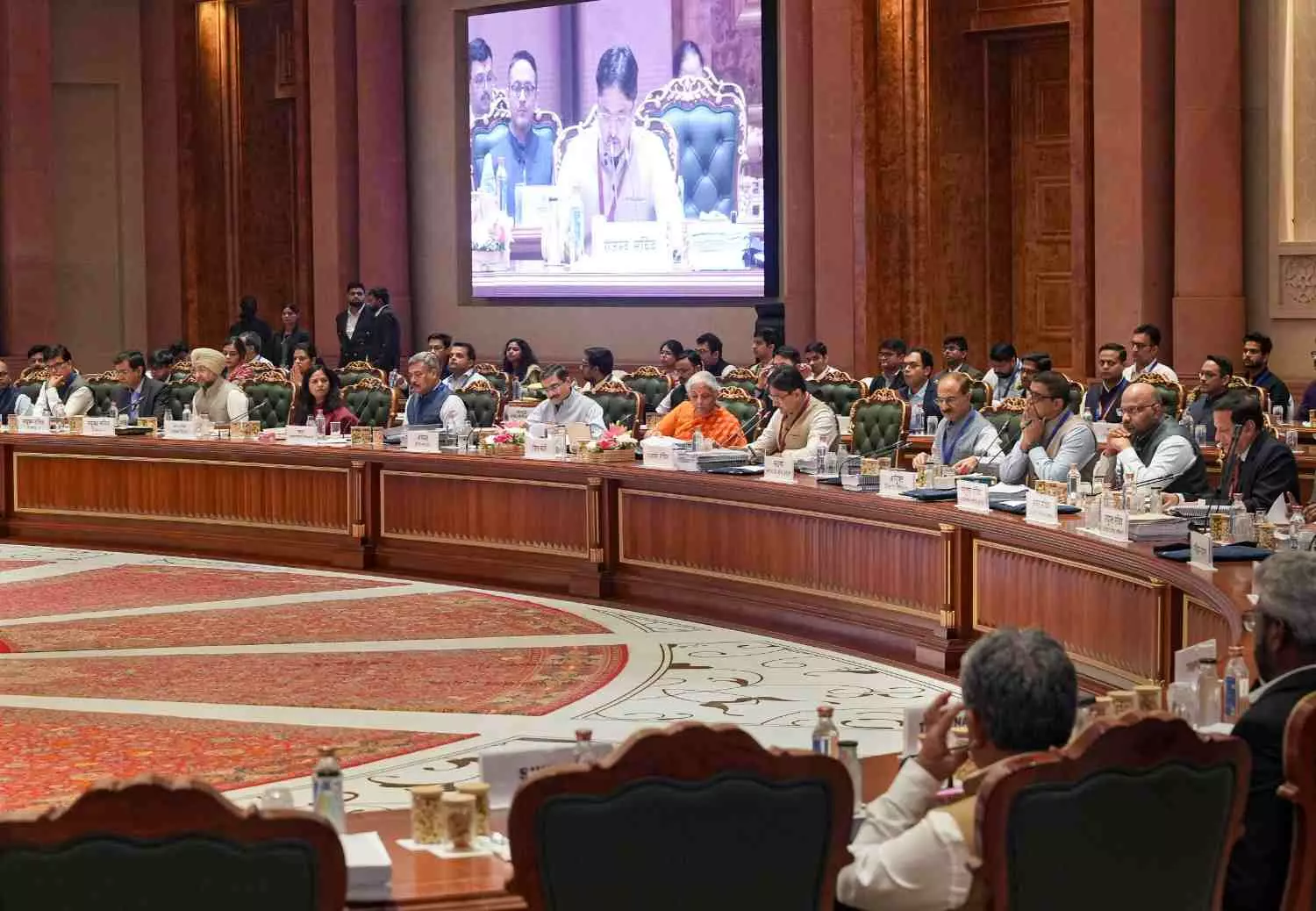
Finance Minister Nirmala Sitharaman, state finance ministers, union territory representatives, and senior finance officials during the 57th meeting of the GST Council in New Delhi on Thursday (Oct 8). Photo: PTI
GST gets a trust reset: Arrest powers go, penalties cut, refunds automated
Industry welcomes moves to unlock stuck credits, speed up refunds and cut compliance costs

The 57th GST Council meeting on Thursday (October 8) saw the Centre and states agree on sweeping changes to make GST administration more taxpayer-friendly, reduce litigation and ease businesses' compliance burden. The decisions confirm a series of key newsbreaks The Federal reported earlier.
The Council recommended removing GST officers’ power of arrest, raising the prosecution threshold from ₹1 crore to ₹5 crore, cutting the general penalty from ₹25,000 to ₹10,000 and introducing faster, largely automated refunds.
Most reforms are proposed to take effect from April 1, 2027, marking a major shift toward what the government describes as a trust-based GST regime.
Arrest powers to go, prosecution threshold raised
One of the most significant decisions is the proposed removal of GST authorities' power to arrest. The Council also recommended raising the monetary threshold for prosecution from ₹1 crore to ₹5 crore. This means criminal prosecution would generally be reserved for substantially higher-value cases, reducing the risk of criminal proceedings for businesses involved in relatively smaller tax disputes.
The Council further recommended removing the minimum punishment prescribed under the GST law. The quantum and nature of punishment — including fine, imprisonment or both — would instead be left to judicial discretion.
Tax experts see the measures as part of a broader move towards decriminalising economic offences and reducing excessive enforcement pressure on compliant businesses.
General penalty cut to ₹10,000
The Council also recommended reducing the general penalty, applicable where no specific penalty is prescribed, from ₹25,000 to ₹10,000.
Also Read: Jobs, skills, AI access will shape next phase of India's growth: World Bank
In addition, the government said taxpayers who file late, make mistakes or fall behind on payments would face recovery, interest and a proportionate penalty, rather than multiple or disproportionate consequences. The Council also proposed not issuing notices in cases involving a monetary amount below ₹10,000. Together, these measures aim to ensure procedural lapses do not lead to excessive litigation or disproportionate penal action.
Major push to unlock blocked ITC
A potentially significant relief for industry is expanding refunds under the inverted duty structure. The Council recommended allowing refunds of accumulated input tax credit arising from input services, with the measure applying to eligible credit availed from November 1, 2026.
The reform is particularly relevant for sectors where the GST rate on inputs and input services is higher than the rate applicable to the final product. Businesses in such sectors can accumulate large amounts of unutilised credit, locking up valuable working capital. The Council has also recommended a phased approach to allow refunds for plant and machinery/capital goods from April 1, 2027.
Industry bodies welcomed the move, saying that unlocking accumulated credit would improve liquidity and allow businesses to redeploy capital towards expansion, investment and employment.
Refunds to become faster and more automated
The Council has proposed a major overhaul of the refund process. Under the proposed system, 90% of eligible refund claims could be sanctioned provisionally through an automated, risk-based mechanism, with the timeline for provisional refunds being reduced from seven days to three working days.
The system would also automate refunds of excess cash balances and speed up the acknowledgement of refund applications.
KPMG India's Abhishek Jain said the effectiveness of the system would depend significantly on how taxpayers are classified as low-risk. If the risk-assessment mechanism works effectively and covers large, compliant taxpayers, the reform could substantially improve working-capital flows.
Relief for bona fide buyers in supplier-default cases
Another major issue on the Council's agenda was the treatment of input tax credit where a supplier fails to meet its tax obligations. A committee has been constituted to examine structural reforms aimed at protecting bona fide recipients from tax demands arising because of supplier defaults. The committee is expected to submit its recommendations within three months.
Tax experts consider this particularly important because ITC disputes linked to supplier non-compliance have become a significant source of GST litigation.
EY India's Saurabh Agarwal described the proposed change to Section 16(2)(c) as a welcome step that could provide greater certainty to compliant taxpayers.
Faceless assessments and risk-based enforcement
The government also plans to introduce faceless tax assessment for CGST taxpayers registered in multiple states. The Council's broader approach is to reduce physical and discretionary intervention and rely more heavily on technology and risk assessment. The government also intends to make enforcement mechanisms more targeted, including greater use of intelligence-led checks rather than routine intervention.
Also Read: India’s economy is growing fast. The harder test is what comes next
Several proposed changes are expected to benefit exporters and foreign-exchange earners. Services supplied through foreign branches are proposed to receive greater recognition as exports, while testing, repair and certification services performed on goods belonging to foreign clients could also qualify as exports under the revised framework.
These changes could be particularly relevant for India's rapidly expanding Global Capability Centre (GCC) ecosystem and other service exporters.
Industry hails shift to trust-based GST
Industry leaders broadly welcomed the decisions. ASSOCHAM President Nirmal Kumar Minda described the measures as a major step beyond rate rationalisation, saying they could unlock stuck tax credits, accelerate refunds and reduce compliance costs for MSMEs.
Deloitte India's Mahesh Jaising said the Council largely met industry expectations and that GST was moving from a stabilisation phase to optimisation.
PwC's Pratik Jain said the reforms were progressive and could help unlock capital, rationalise ITC restrictions and improve ease of doing business.
KPMG's Abhishek Jain described the decisions as a clear shift towards trust-based tax administration, while EY's Saurabh Agarwal said the reforms could strengthen investment, growth and India's global competitiveness.
No GST rate changes
Importantly, no GST rates were changed at the meeting. Finance Minister Nirmala Sitharaman said the Council had largely addressed the major anomalies relating to input tax credit and inverted duties.
She described the reforms as addressing almost 99% of the outstanding issues relating to GST rates and processes, while emphasising that the next phase of GST would be driven by trust.
“Business has to be trusted. Taxpayers have to be trusted,” Sitharaman said, stressing that tax administration should not be unnecessarily intrusive.
The recommendations will require the necessary legislative amendments, rules and notifications before they become fully operational. Nevertheless, the 57th meeting signals a fundamental change in the philosophy of GST administration — from enforcement-led compliance towards simplification, automation, certainty and trust.